Pilgrims

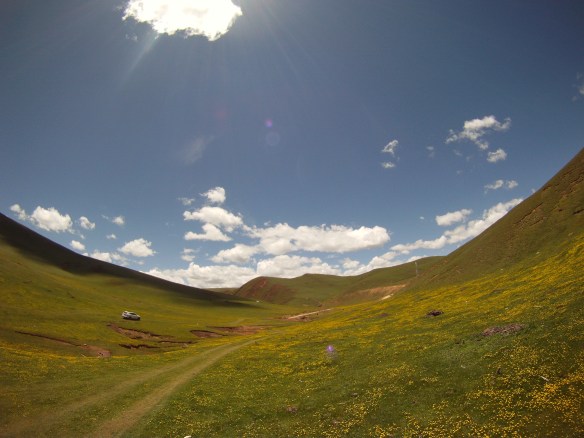
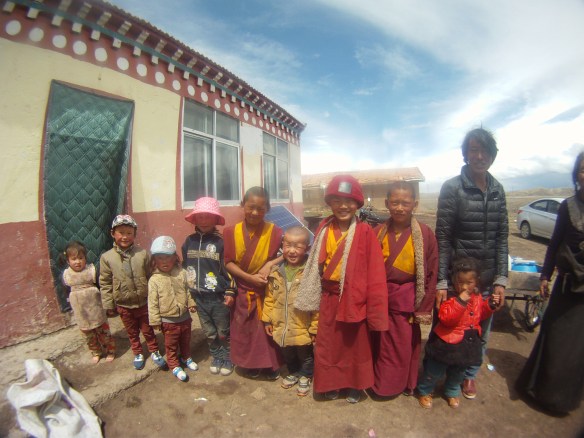
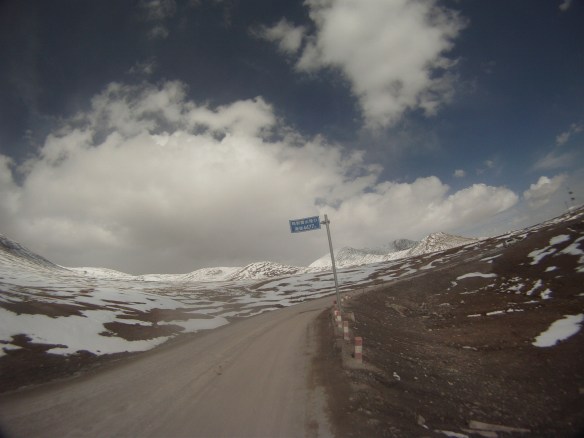
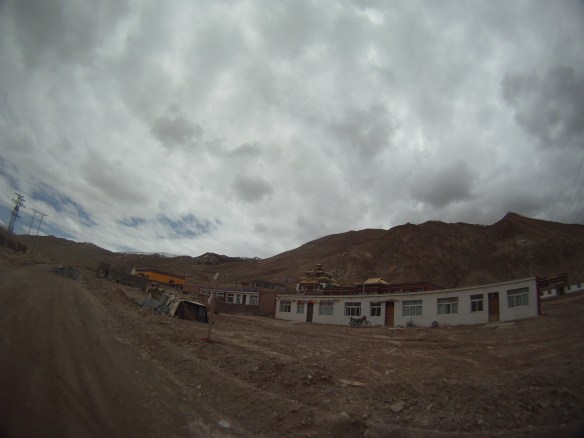
Summer rains sweep through mountains. The wet earth, once vacant now sprout wild flowers. A bird sings, a group of yaks pass and the sound of footsteps fill the road. Pilgrims. The walk in numbers with large sacks of food and supplies on back, sometimes with a stick in hand. Some pull large carts filled with clothes, cooking utensils and grain, no matter what they carry they  all head for the holy city of Lhasa, more than 1000 km away. Cars too are filled with pilgrims of a different sort, men and women who bring the comforts of their homes and sleep in warm beds. In this way it is easy to forget the world outside and embracing the dreams we all forget at dawn. 

DCIM100GOPRODCIM100GOPRO

DCIM100GOPRO

DCIM100GOPRO

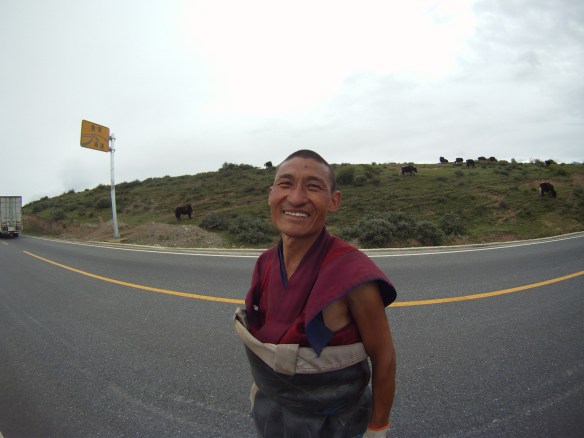
This pilgrim was prostrating his way, 3 steps one bow, to Lhasa.

Traveling has been very difficult lately. My Chinese Yuan supply has slowly dwindled and it is impossible for me to exchange money. I have therefore been subsiding on the bare minimum (fresh vegetables and cold noodles) and quickly making my way to Yunnan where I hope to find a large enough bank to withdraw funds. Hostels, hotels, and even apples are too expensive right now. The rain makes maters worse as I often spend hours pedaling up steep mountains only to find myself descending into a hail storm.

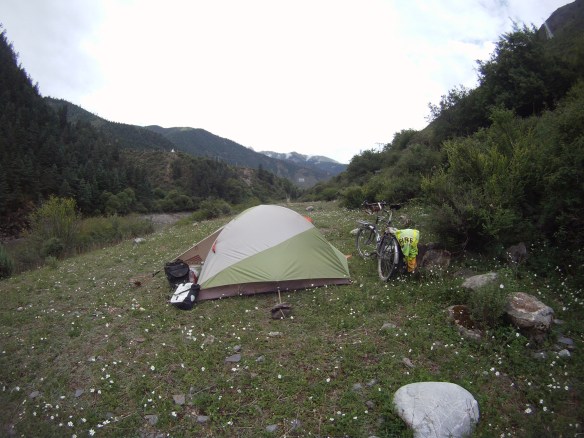
However it is too beautiful to be inside. Even when I am in the tent at night I want to open the fly and look out into a sky with patches of stars. I am too often invited by locals to stay inside warm wooden houses and each time I look down into forested distance and decline. It will take me several days to get to Yunnan, in the meantime I am riding when I can and when I can’t hiding in my tent beside soft streams.

DCIM100GOPRO


Backroads of Sichuan

IMG_2884After graduating college I spent close to a whole year traveling China with my father. It was a time when anything was better than returning to the US and contemplating the next step in life, and traveling seems to occupy those moments in my life. My father too, had plenty to escape, his health was failing and his energy to conduct his antique business had long since left him. We traveled to so many Buddhist temples and holy places that I can hardly remember which ones were interesting and which ones were more like Buddhist amusement parks . Most if not all the monasteries had long since been destroyed during the Cultural Revolution and had been replaced with flashy stucco replicas with large plastic golden Buddhas.

IMG_3312

DCIM100GOPRO

Native grass at 14,000 feet.

During our many temple visits we met a very interesting Tibetan teacher who became a close friend. We spent several days with him at the monastery, then invited him to our home in Guang Zhou. He had a very familiar laugh and a smile never seemed to leave his face. After my father’s death, we continued to keep in touch. He would call at 2 am California time and laugh about the time difference, and repeatedly ask when I would return to China.

IMG_2679

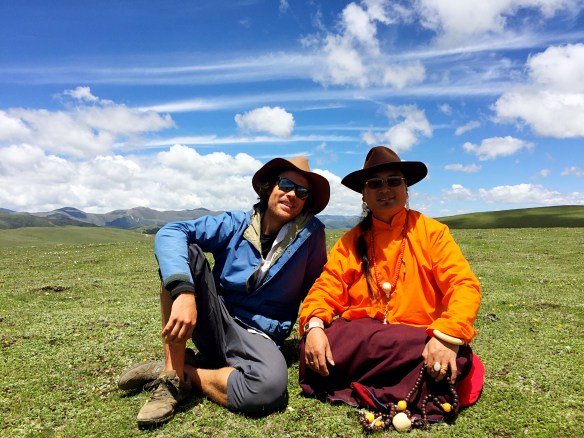
Rin Chen Jer Po Rinpoche and Padma (my Tibetan name)

IMG_2178

An offering. Rin Chen’s monastery in northern Sichuan

DCIM100GOPRO

Rin Chen’s village, Zong Mai Xiang

After more than a year of silence, I hesitated, then called him while pedaling south through the deserts of Qinghai. He quickly remembered me and extended an invitation to visit him in Sichuan. It turned out that his home was not too far off my route so I braved a 100 km single track mountainous road to his home village.

DCIM100GOPRO

Rin Chen making a call at the only place with service, the nearest tallest mountain pass 4,700 meters.

My friend’s name is Rin Chin Jer Po, who at the age of 19 was told by a senior Buddhist teacher that he had a strong potential in the practice of selflessness and Enlightenment. Immediately after hearing the news he decided to make a pilgrimage to India, and walked to the Holy city of Lumbini in northern India. When he arrived he met his future teacher  and decided to devote his life to the study of Buddhism. After a year in India he returned to his home in Sichuan province and began to teach in China.

IMG_2605

En-Route to Zong Mai Xiang village.

DCIM100GOPRO

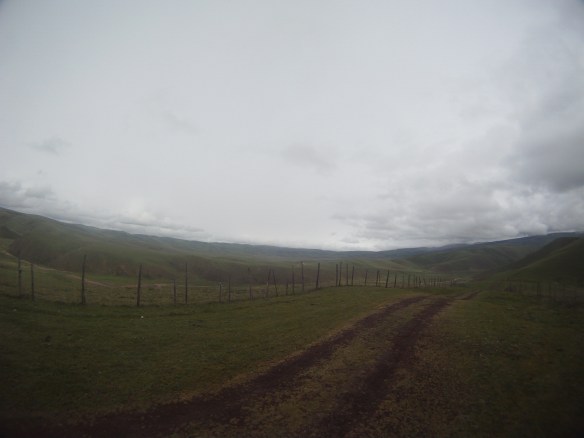
Rin Chin’s village was almost impossible to find as it is extremely remote and not located on any maps. He gave me the name of his temple and told me that he was about 100 kilometers from a certain landmark. En-route it took me close to a whole day of cycling to and fro on a large highway looking for a small dirt road that would take me his way. Once found I quickly noticed that I would be riding on a road full of muddy pot holes, loose rocks and steep climbs. At times I doubted my resolution to visit him but continued on as he was very good to my family after my father’s death.IMG_3387

When I arrived at his village I spent close to an hour asking villagers about where he lived, no one seemed to have heard the name Rin Chin Jer Po. Did I pedal to the wrong place, I thought? The name of the temple was familiar to most but no one seemed to have heard the name Rin Chin Jer Po. Finally I asked a few monks at the monastery for the residence of the abbot, thinking this was his home I quickly entered expecting to see him. Instead I met a relatively large bald man with a very happy face. I apologized for barging into his home, however he seemed too surprised at seeing a foreigner that he didn’t seem to noticed that I had just walked into his home. I quickly described Rin Chin to him and made a long hair gesture as well as large earrings. He quickly knew who I was talking about and led me to his residence.

IMG_3314

A large Tibetan meal of Blood sausage, boiled beef and beef buns. The yogurt (in bowls) was really good!

Seeing Rin Chin through his second story window brought tears to my eyes and his large smile met mine. My doubts about coming quickly vanished and I was invited into his home and treated like a royal guest. A Tibetan  feast of fresh beef, yogurt, milk tea, and lots of Sampa was soon prepared and a bed in the monastery waited me. It took me a day to get used to Tibetan customs as women do everything for the men; wash their clothes, cook, serve, and prepare all the meals, wash their feet, make and serve tea the daily tea.

IMG_2604

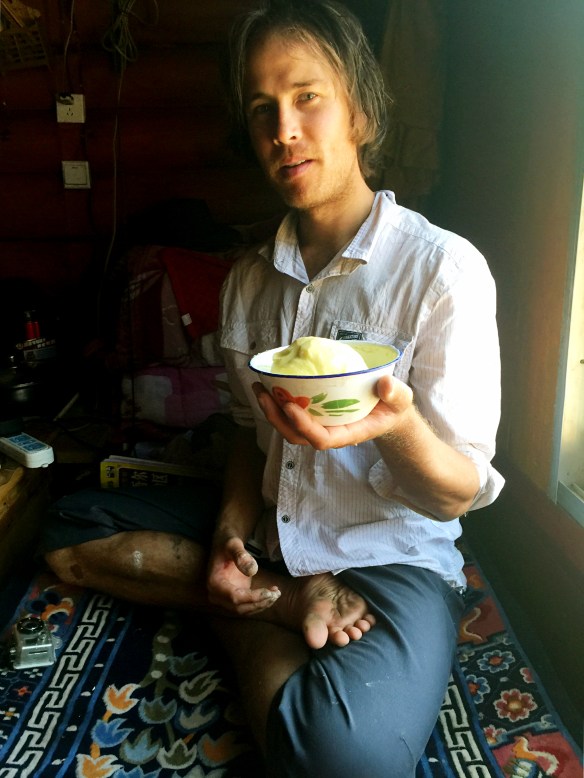
Preparing to eat a large bowl of butter and boiled roots, a Tibetan delicacy!!

DCIM100GOPRO

The boiled roots are added to a large bowl of butter, the liquid butter is sipped while the roots are chewed. I must have eaten close to 3 sticks of butter. The white cheese looking like stuff is milk curds.

DCIM100GOPRO

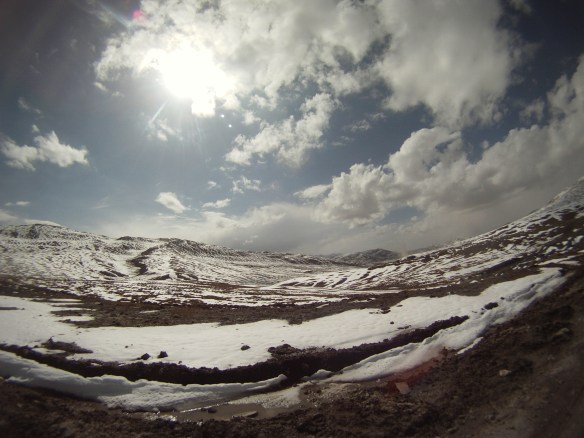
Spring has finally sprung at 14,000 feet.


I am headed south again, towards the province of Yunnan. It is warm, humid and rainy. Food rarely deviates from Tsampa, boiled beef and buns. My bags are full of gifts from Rin Chen and I must have at least a months worth of Tsampa and butter in a large bag.

Cycling at 15,000 feet

DCIM100GOPRO

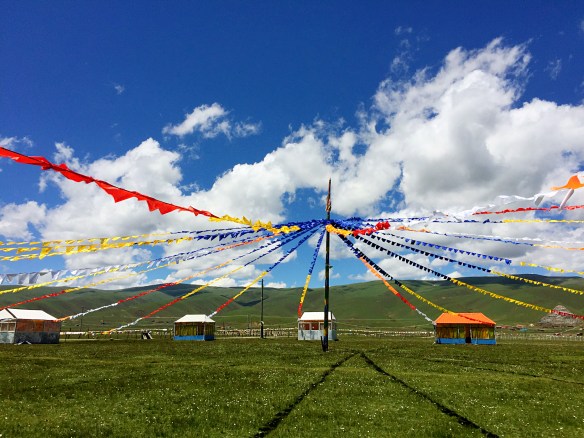
Prayer flags line bridges protecting pilgrims in remote canyons

DCIM100GOPRO

A Tibetan local, behind is his summer yurt and tent. His summer camp site was well above 15,000 feet.

DCIM100GOPRO

An unexpected snow storm. The snow actually acts as a insulator and kept me warm throughout the night. 

DCIM100GOPRO

At over 15,000 feet I often find myself short of breath, and have developed a practice of breathing in twice for every out breath.  Skipping or holding my breath for a passing, dusty vehicle is out of the question and leaves me dizzy. I also seem to have developed a deep, dry cough that wakes me at night.

DCIM100GOPRO

The culture is primarily Tibetan, with many locals unable to converse in Mandarin. This family invited me out of the rain for a lunch of Tsampa, tea and yak butter pan fried bread. I probably ate close to 2 sticks of Yak butter in 30 minutes.

tsampa

Tsampa is a ground flour that is added to milk tea with yak butter. Once finished drinking the tea the flour is mashed into a ball then eaten with more yak butter.

DCIM100GOPRO

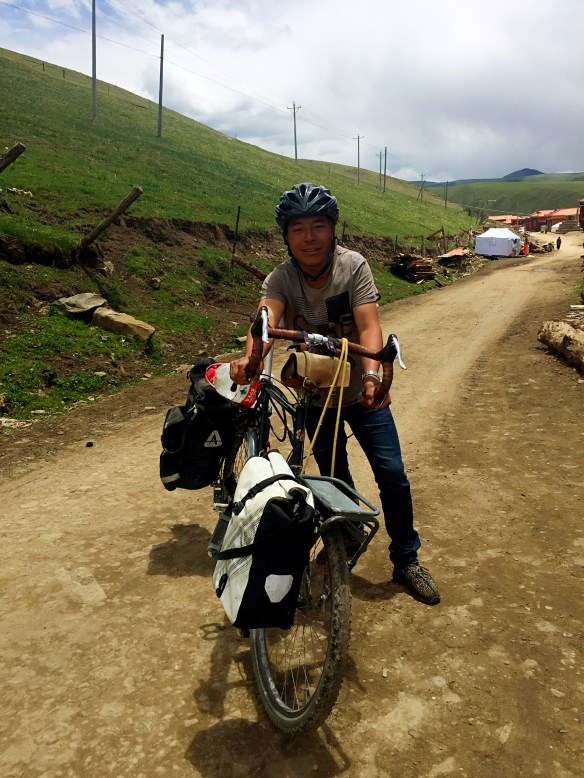
Many of the villages have seen very little foreigners, and Esperanza loaded for a journey draws quite a crowd.

DCIM100GOPRO

These are the coldest nights I have every experienced, every night around 2 am I wake up in a shiver and patiently wait for sleep and the sun to rise.

DCIM100GOPRO

Elevation after a steep climb, 4677 m.

DCIM100GOPRO

Old man with two grandchildren

DCIM100GOPRO

The remote mountains are home to many Tibetan Buddhist monasteries.

DCIM100GOPRO

The sun is fierce and warm throughout the day, but once it falls temperatures quickly fall.

DCIM100GOPRO

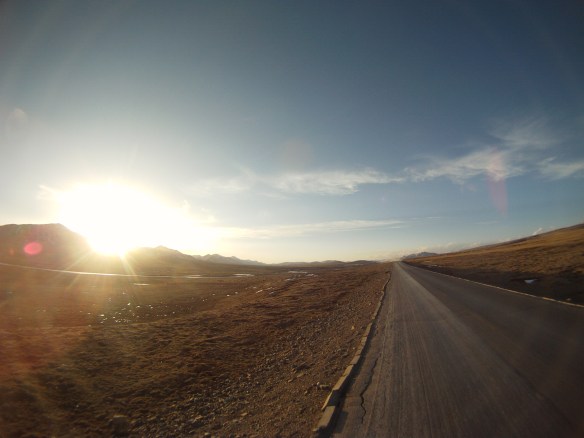
A cold barren landscape, too high to for trees to grow, and little but small puddles of standing water.

DCIM100GOPRO

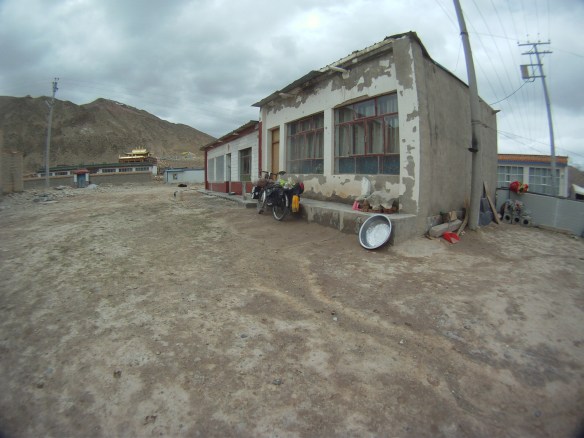
A small roadside cafe, wild dogs are rampant, and I have been attached several times wild pedaling through villages. 

DCIM100GOPRO

A yurt with a yak dung burning stove will keep you warm throughout the season.

Chinese bureaucratic nightmare

DCIM100GOPRO

i pedaled past miles of trucks waiting to go through the border patrol.

There is little left for me to do but circle around to the western side Qinghai and hope to cross into Sichuan through the mountains. The entire southern half of Qinghai is close to foreigners. I pedaled a long 60 km into the wind to find a huge border patrol forcing me to return. I asked to speak with the superior officer and found myself in a room with several Tibetan monks sitting on the dirty floor. The superior told me the monks did not have proper identification and had been held in custody for 2 days.

Qinghai-Adventure-Routes-Map

I was headed south from Golmud and planned to take side roads to Yushu. I am now headed east of Golmud and hope to cross near the yellow river.

I begged the officers to let me through as this was the only southern road to Sichuan. But was repeatedly told that the road also went to Tibet and in order for me to move forward I had to have a permit! Imagine being in California and being unable to visit San Diego because the same road that took you there continued on to Mexico!

After rejoicing the end of my hardships, I am back into the cold windy desert. I will try again to find a southern passage to Sichuan. If I fail I am not sure what to do.

Land of extremes

DCIM100GOPRO

Small road house dinner, my first day in Qinghai

DCIM100GOPRO

Home Dog Wind, from Guangxi province. He was headed north.

I am now in Qinghai province in the city of Golmud. This morning it was snowing and I looked around to see that I am surrounded snow packed mountains. It is going to be a cold ride south from here, but I hope to find shelter with locals in small villages along the way. The desert was difficult, almost everyday there was a sand storm and temperatures at night dropped below freezing. Local truck stops however carry their own special “Baijiu” (Sake) recipe, and a few sips helped warm me through the cold nights.

golmud-to-lhasa-railmap

I am so close to Tibet, that could easily make a brief trip over there. That is… if I wanted to book a tour with a guide, confirm with hotel dates and give up my bike. It is currently impossible for anyone without a Chinese passport to enter Tibet independently. Too many protests and riots before and following the China Olympic games. In some ways it would be a sad sight to see, considering that the Dali Lhama has lived in exile since his departure in the late 1950’s.Old potala palace

Tibet’s Potala Palace before Chinese invasion

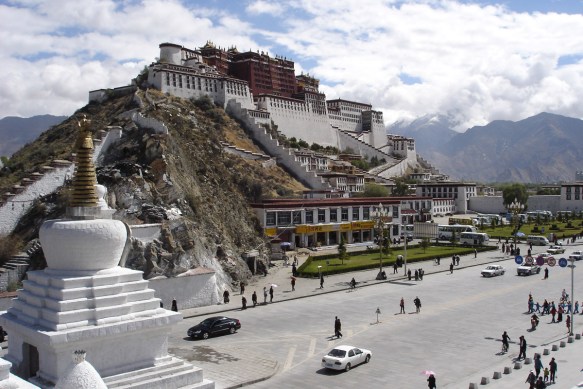
Modern Potala palace

After

I feel strong yet confined here in China. People, pollution, traffic, noise is sometimes overwhelming and in many ways I feel that I am better of in my cold tent out in the desert. All night and day I can hear the horns from the cars outside my hotel window honking at pedestrians. Mega phones seem to be the new craze, and everywhere I go, supermarkets, side walk corners and city centers they are blasting pre-recorded loops advertising cellphones and sales. Accommodation continues to be difficult, but there is not much I can do.

It is almost June but there is still plenty of snow, cherries are in season and throughout the town there are carts selling kilos for a few cents. Flowers are blooming.  I continue on.


The Horizon is a Mirage

DCIM100GOPRO

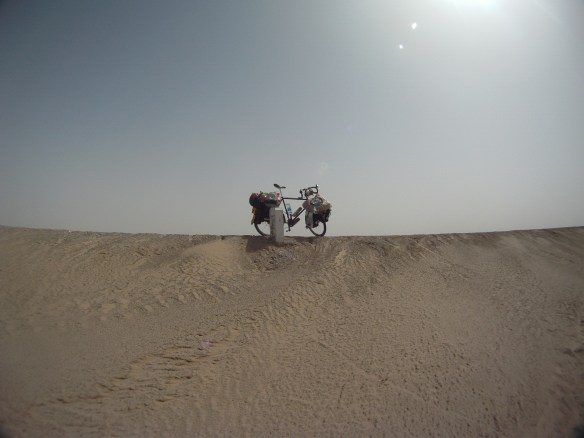
The sky, once blue is now covered in dust. At night I faintly see the moon, a few nearby planets, and the lights of a nearby quarry. It is in these long stretches that I begin to break down. Days of pedaling into a dry mundane desert landscape, with strong gusty winds pushing me across the narrow road. My physical strength wavering brings anxiety, doubt and fear.

17_Qinghai map

My location is very near Youshashan, in the northwest of the province. I am headed south east to Golmud.

DCIM100GOPRO

Small roadside village, Qinghai

In the six days of Xinjiang desert I experienced a wind like no other country. Relentless, dry and full of sand. Sometimes I would stop and cover my face, for what seemed like several minutes while a blinding sand storm passed. Within a few kilometers my teeth, nose, ears and face are covered, and breast pocket begins to fill. A night my sleeping bag feels like a sand box.

DCIM100GOPRO

Some friendly Chinese employees working at a remote power station, they served me breakfast and gave me a few packets of tea.

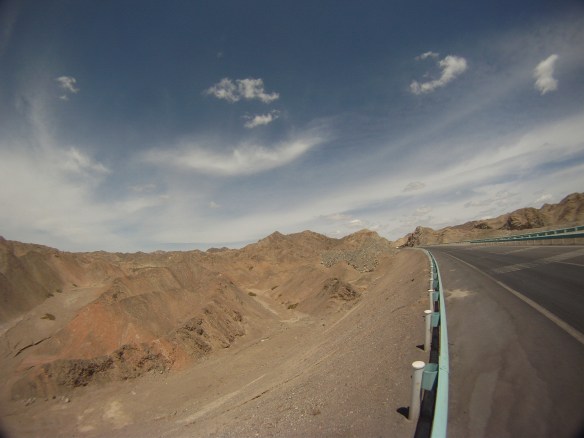
My mood suddenly changed as I got within 100 km of the Xinjiang/Qinghai border. The forever flat desert gave way to steep dry mountains and I began to climb into a fresh cool atmosphere. The wind stayed strong but was no longer filled with dust. Trucks constantly passed and the roadsides were piled high with trash, and un-recycled junk. I stopped at a small roadhouse and watched the few Chinese travels toss their litter into the desert wind.
The air slowly got thin and cold as I climbed to 9,000 feet. I smelled the air for the cargo of the trucks passing; coal, oil, and sometimes hay. Other rather scentless ones carried wire, plastic pipes, and really smelly live stock. On one occasion I was passed by a truck carrying a load of large pigs, as it passed I was sprayed with water but as I looked over I noticed it was a large pig peeing off the side.

DCIM100GOPRO

High desert camping, temperatures dropped well below freezing and I awoke to a frosted landscape.

The few people I encounter are friendly and courteous. Being stereotypical one would expect to find weird, socially strange people operating small business in the extreme remote but in China they seem completely normal and treat me with respect and trust.

DCIM100GOPRO

Roadside military, my passport and visa would randomly to checked in the most remote locations.   

The remote landscape once a refuge has begun to frighten me. A few sections of my route took me through single-lane roads covered in sand. With no traffic I felt that if I stopped pedaling I may never be found. I push on, I am 450 km from the city of Golmud, if all goes well I should be there in 4 days. There are police check points everywhere and I constantly give false information as to my destination (which is extremely close to the Tibetan border and may potentially be forbidden to foreigners without a permit).


Crawling into the Abyss

DCIM100GOPRO

Bicycle street Urumqi, getting ready for the long desolate road south

I didn’t know it at the time. But I was lucky. I left Urumqi and confidently pedaled south into the mountains. In the distance I could see a storm gathering and the once snow capped mountains were no longer visible. My cadence was sporadic, my chain just didn’t seem to stay in gear. When I got to the lower foothills I took a closer look and decided to turn back, as there was no way I could ride 350 km at my current pace. That night a snow storm covered the foothills, road and mountains and somewhere a landslide closed the main road in both directions.

DCIM100GOPRO

A dry summit, after pedaling to the Turpan Depression, 500 ft below sea level, there little to do but go up! A long 50 km climb to the top of this pass.

After following a few Chinese cyclists dressed in Lycra, I returned  to Urumqi and found the bicycle shop area. It was A long alley filled with all sorts of bikes; fat, cruisers, mountain, fixies even unicycles. By that time I knew I needed more than just a chain, so I started asking around. First shop, “no” second shop “no” third “no”. One shop owner told me that most people just buy a new bike when they need to replace a part! And asked me if I wanted to buy a new bike! Finally I came across a small roadside shop and convinced the owner to take the parts off of a bike he was selling. It took a few hours but I got what I needed and installed everything curbside.

DCIM100GOPRO

Osh or Pilaf. The Rice a roni’s great ancestor, and large wok cooked in lamb fat, carrots, onion and garlic. 15 yen for a plate with meat, 5 yen without.

Finding a place to stay is so difficult that I contemplated pedaled back out of the city to camp. In some ways there is almost no point in asking how much a room costs as most hotels can not accept foreign guests! I ended up at another 3-4 star hotel and spent 5 days worth of food money on one night! (Couchsurfing is also a problem as most police in Xinjiang do not allow foreigners to stay with individuals). Anyhow, I spent a nice day in the Muslim district and as it was Friday, I pushed my way back into the hub of the Muslin quarter to see what prayer time was like.

DCIM100GOPRO

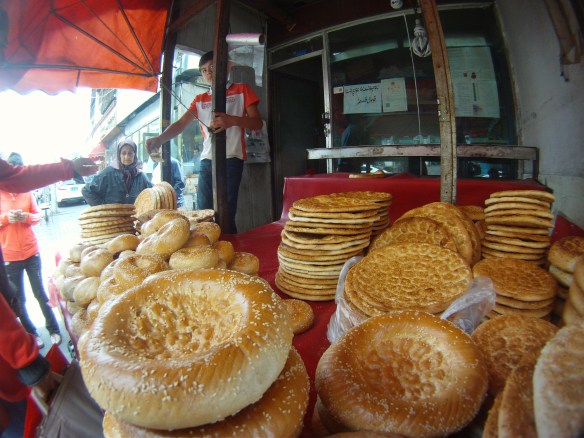
Naan. Central Asian bread. A good piece of Naan is cracker like in the inside, (crispy and crunchy), and bread like (doughy and soft) on the crust. I like the thin large pieces with seseame seeds best. However sometimes I will settle for the bagel looking like ones in the middle because they are sweet! Usually around 2-4 yen a piece. Made fresh daily in a large circular oven.

Traffic was backed up for miles but I weaved in and out, and suddenly I found myself at the largest mosque in the city. The side walks were filled with men sitting, knees down on top of small, colorful, hand woven-carpets, all sitting in silence, waiting for the call to prayer. The road emptied. I watched, listened and prayed, surrounded by devotees and Chinese riot police.

DCIM100GOPRO

Deep fried street eats. (Jie tou Xiao chi)

I don’t think anyone could say China or rather Xinjiang was dangerous There are literally police everywhere. All the bus stops, subway tunnels, intersections and gas stations have check points, and the banks, supermarkets, and hotels have guards operating x-ray machines and metal detectors. The presence is extremely noticeable in the Muslim districts and during prayer time there were fully armed riot police waiting for unrest. From what I have heard there were several Uighur riots during the Xinjiang Conflict of 2009 and 2014. Many Uighur openly feel and have expressed that Xinjiang is an independent country and that the Peoples Republic of China is occupying their land. The PRC has responded with a strong police presence and many discriminatory policies.

DCIM100GOPRO

Uighur man chops meat for Lagh Mian

DCIM100GOPRO

I no longer eat street meat, as I have been sick countless times. However I will still eat the meat pastries.

DCIM100GOPRO

Somsa pastries

After Friday prayer most people return to their places of business and rest, but many go to eat! This is the norm for Muslims on Friday, as it is considered the Sabbath. Leaving the Mosque I looked for the most local “hole in the wall” Muslim restaurant I could find and quickly found myself surrounded by Uighur’s sitting at small shared tables.
Considering the situation, and how much I must have stuck out wearing a baseball hat and sunglasses, I surprisingly did not draw much attention. Ordering the norm, a bowl of Lagh Mian I had a conversation with my table mates in Veyu and Mandarin. They told me all about the riots and that the Uighur historic city of Kashgar has almost completely been rebuilt with large Chinese hotels and businesses. I was happy to tell them that I was American and wished them well, I hope that it may lead to a better reputation in the Muslim world. I get a very mixed response from the locals, they are either super grumpy like “Ramadan a full day of fasting and no water” grumpy or they are exceptionally kind. I just wish I could get an idea which is which before I connect.

DCIM100GOPRO

Camping among the reeds. I was swarmed by mosquitoes minutes after propping up Esperanza.

Leaving the city once more I crossed paths with a few Chinese cyclists who had recently returned from Lhasa. (Another ethnic minority suppressed by the PRC). They wanted to join me on my route south but I repeatedly declined the invitation and proceeded alone. No matter how lonely the road gets I still enjoy the challenge of doing everything myself.
My new route south took me down to the lowest point in Central Asia The Turpan Depression, 505 ft below sea level. Within a 100 km from Urumqi few hours the weather became hot and dry. I camped in a small oasis areas but found the ticks and mosquitoes almost unbearable.

DCIM100GOPRO

Turpan Depression, in some areas there is literally a large hole in the ground

As many times as I have visited China I still find myself completely amazed by the size, traffic and population of the cities. On some days I come across cities tucked away behind step mountains in the far remote corners of the province, completely surrounded by desert. The cities are usually more like “towns” as it is not uncommon to hear someone say “You know… this is not really a city its more of a town…. the population is small maybe about about 700,000 to 1 million people”. These “towns” are being developed at an extremely rapid rate, with large apartment buildings, hotels and universities. From a far I can almost always spot a few cranes and soon to be future apartment buildings. I sometimes wonder, with still so much development how can the economy be doing so bad?

China intersection

King of the road. Just another day at a Chinese intersection. There is no country other than maybe the Philippines that is like this. The traffic lights are considered a “suggestion”.

China mapp

I am currently in the city of Korla (just below the Tian Shan mtns) headed south east to Chengdu, Sichuan. There is very little in terms of services between here and there.

I leave tomorrow for a long trip through the desert. The Qinghai city of Golmud is 1,100 km from here and I hope to be there in less than 2 weeks.

Korea in retrospect

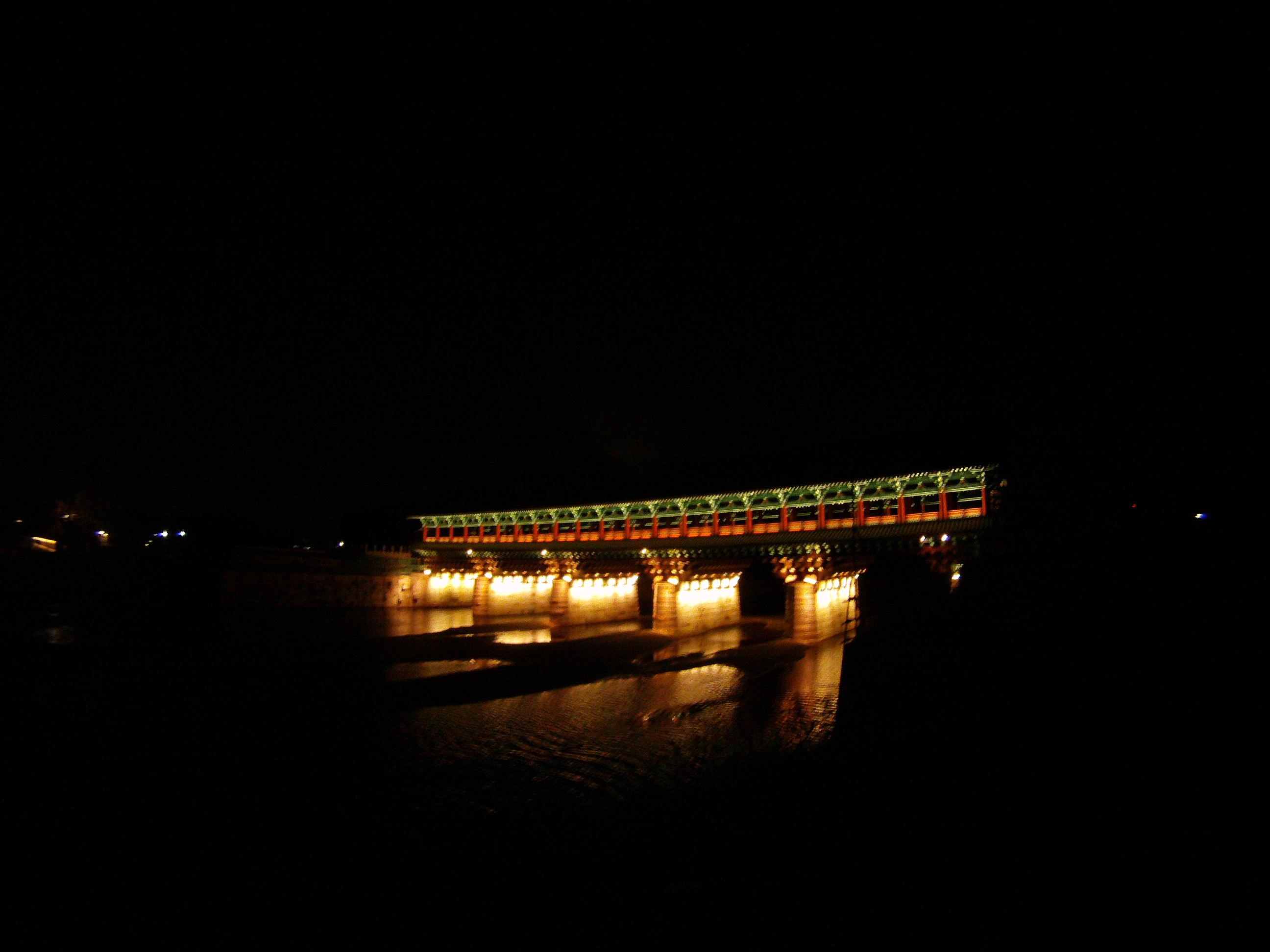
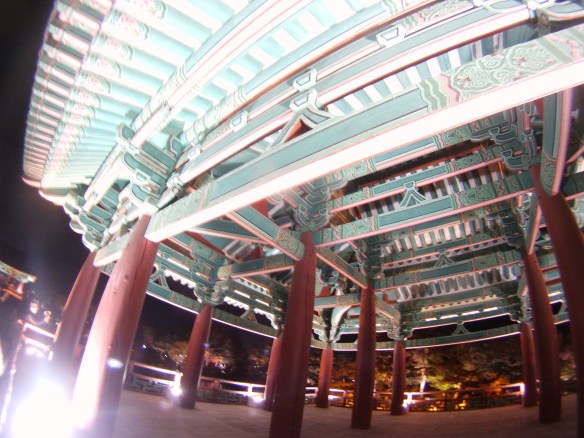
Night views of Gyeongju

Night views of Gyeongju

I really lucked out on boat last night! Trying to find the correct terminal to check Gabriella, I ran into the owner of a limousine service who bought me dinner and upgraded my ticket to first class!! Instead of sleeping in a mixed dorm room with 12 other travelers I had a large room with a double bed, small kitchenette, T.V and bathroom all to myself. Unfortunately the journey was only a few hours, making it really difficult to leave the comfort of the suite for the cold, rainy Fukuoka morning.
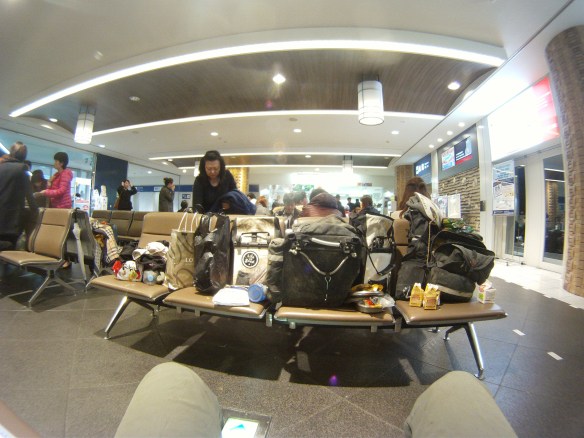
Setting up camp at the ferry terminal in Japan

Setting up camp at the ferry terminal in Korea

My plans for visiting the beautiful Korean island of Jeju changed when I noticed that November is quickly coming to an end, leaving me with little over a month before heading back to the states for the holidays. Korea, besides being one of the most populated countries in the world, was especially bike friendly! Bike paths can literally be found everywhere and when pedaling on the highways vehicles usually pass with care. The traffic light system is also designed in a (rather annoying) overly cautious manner where 5 seconds will pass between a red light and the green! Making maters worse intersections are usually devoid of sensors, which leads to huge traffic jams during rush hour. During this time I see many vehicles do what I call a “Korean U-Turn” where drivers will often turn around near the intersection at a red light and try to drive into nearby drive way to avoid waiting at the signal.

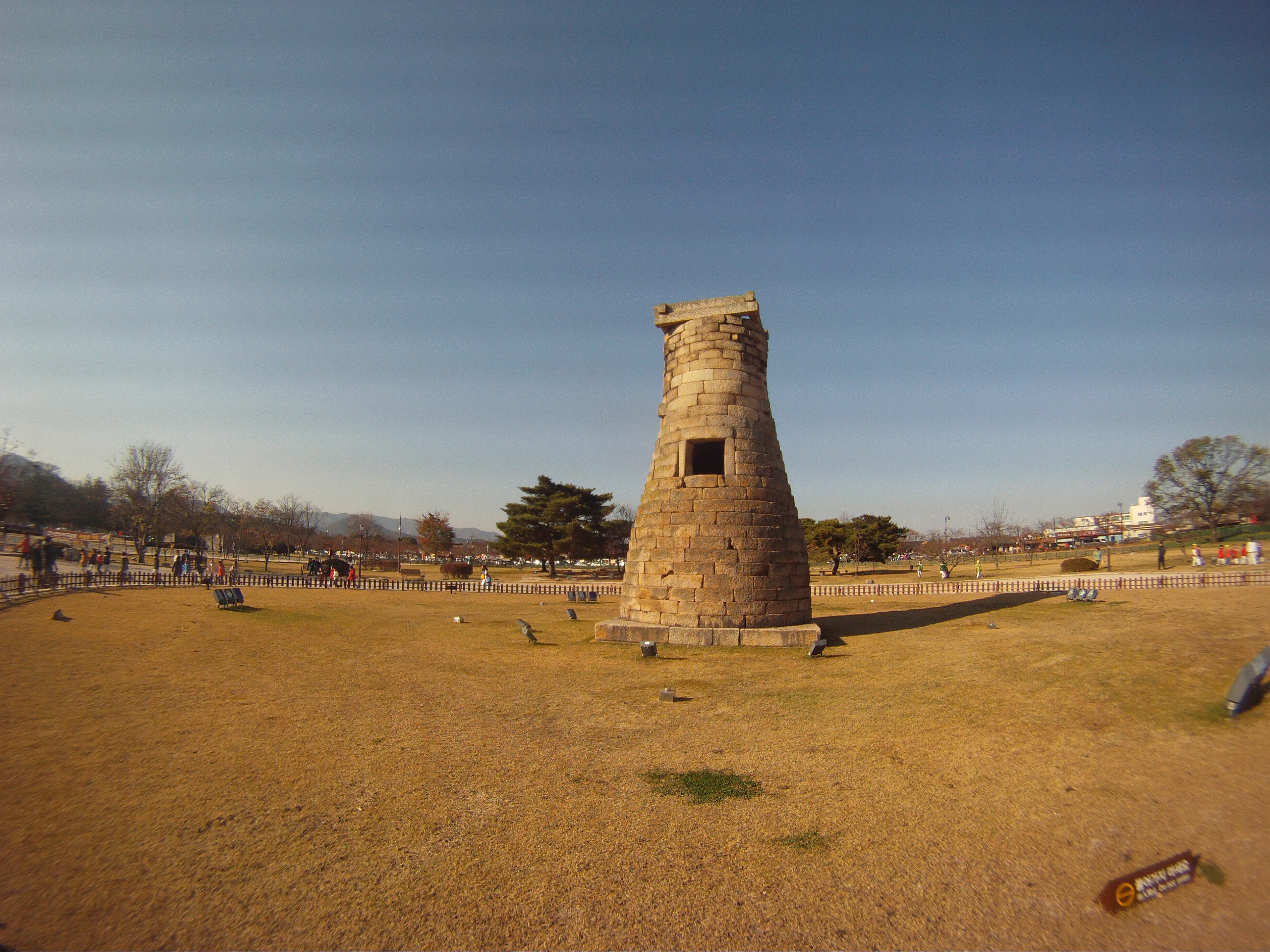
East Asia's oldest observatory

East Asia’s oldest observatory

The mix of people and openness of elders was also quite interesting, especially in the countryside where I was often lectured and sometimes even scolded by elderly women for the following:

1. Not wearing warm enough footwear/clothes. (Sandals are a definite no-no)

2. Camping in the wilderness (they said this will make my mother and father worry)

3. Not eating the correct food (“kimchi and noodles everyday will make you weak and eventually sick”)

Luckily my Korean and their English was extremely limited so the top three pretty much sum up the conversations of many encounters.

Morning view from my wild campsite

Morning view from my wild campsite

While pedaling through the more inhabited regions I would often set up office at a Starbucks or McDonald’s, which always has free internet and unlimited hot water. The Starbucks’ in Korea almost always take up two floors. The bottom floor is usually empty, and at first you think that you are the only customer. That is until you go up the stairs and see that almost every seat is filled with Koreans on their laptops or cellphones. No one speaks and it’s almost as if you are on the silent floor at the local library.

A very early Korean Pagoda

A very early Korean Pagoda

I must say though that, one could visit Korea solely on the purpose of frequenting the public bath houses (Jim Jill Bang). I stayed at a few of these during my visit, usually pedaling into the city in the late afternoon and asking a local to point me in the direction, (Jim Jill Bang Odi Soy Yo). Almost every major city will have one and on all three occasions I have never seen another foreigner inside. It usually costs less than $10 to; bath using 3 different shower set ups (standing, siting and tub), soak in 3 different pools (very hot, warm and cold), sauna, steam and sleep in a warm wooden room near a wood burning stove. Home cooked food is usually available, but sleeping can sometimes be difficult as cellphones frequently ring at odd hours during the night.
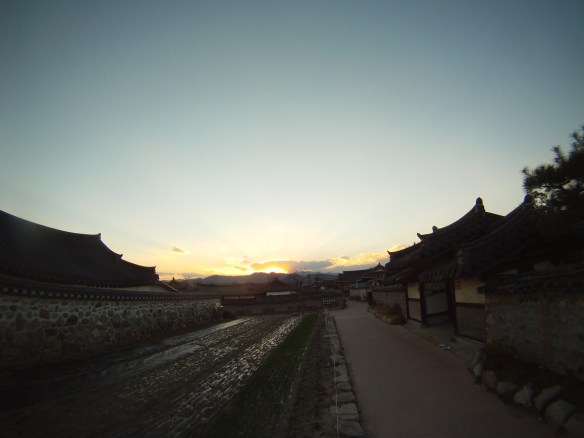
Ancient Confucian academy Gyeongju

Ancient Confucian academy Gyeongju

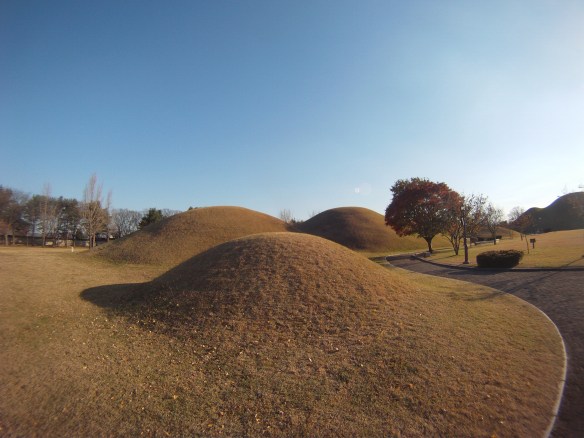
Before pedaling to Busan (where I took the ferry to Fukuoka) I spent 4 days exploring the ancient Korean capital of Gyeongju. During Korea’s dynastic period, Gyeongju was the main city in Korea, with 5 different Dynasties calling it their capital. Throughout the city there are hundreds of landmarks ranging from tombs to temples to ancient villages. There are also lots of examples of early works of Buddhist art fabricated at the time when Buddhism was spread to Korea by the Chinese Tang dynasty (early 7th century C.E). The Koreans at this time also adopted Confucianism as well as the Tang Clothing style. Many of the giant tombs in Gyeongju contain Chinese board games, pottery and jewelry.

Tang clothes style adopted by the Koreans in the early 7th century C.E
Tang clothes style adopted by the Koreans in the early 7th century C.E

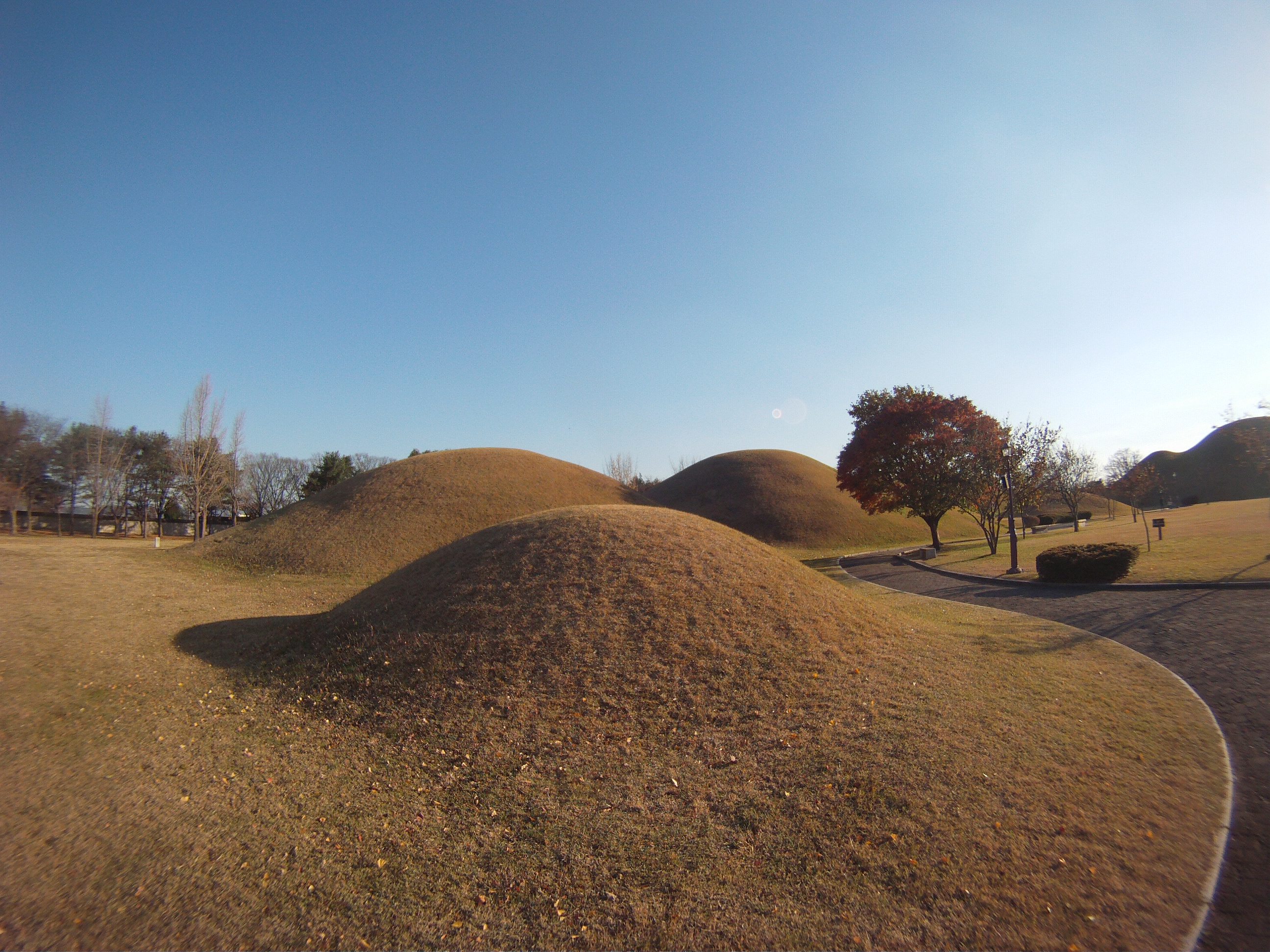
Royalty were buried inside these mounds of dirt

Royalty were buried inside these mounds of dirt

Gyeongju bridge day

Gyeongju bridge day

Night

Night

On my last day in the ancient city, I made friends with a “Miss Kim“, a Korean lady in her 80’s who claimed the title of Kimchi master! This is a pretty bold statement in a land of cabbage but I took her word for it as she gave me a tour of the different types brewing in large plastic tubs in her yard. Like my grandparents in Los Angeles (who always adopt and use the latest piece of technology) she boasted that she gave up using the classic black ceramic kimchi pots because she wanted to introduce a new style of fast/flash fermenting, and plastic tubs warmed faster during the day. I tried all different flavors and even drank her home-brewed soy sauce and miso paste.
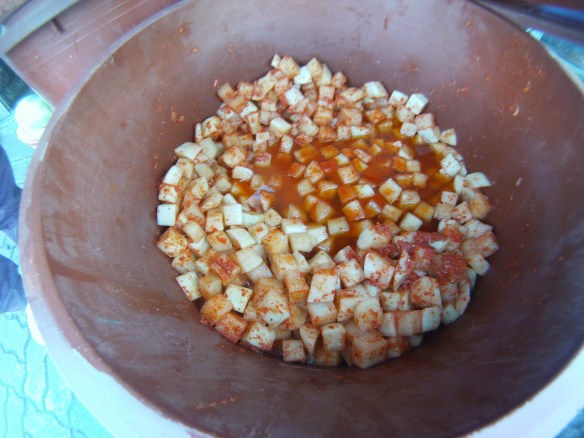
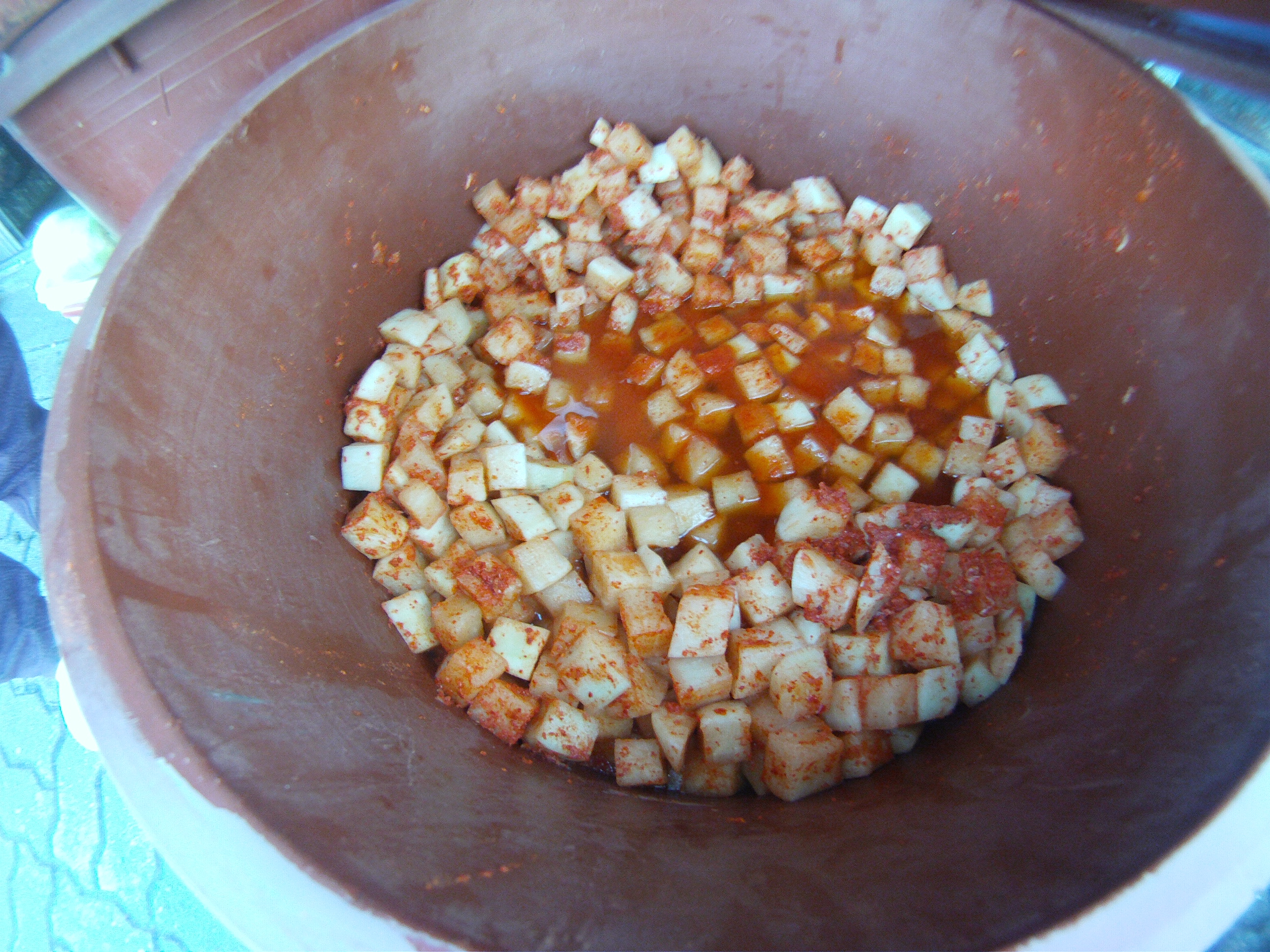
Chopped daikon kimchi

Chopped daikon kimchi

Fermenting soy beans a few months away from soy sauce

Fermenting soy beans

A few months later

A few months later Soy Sauce

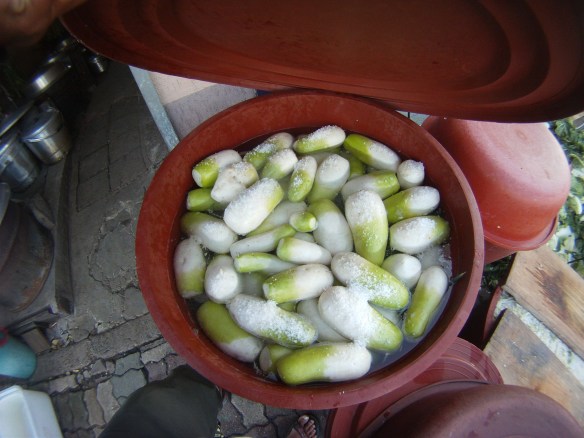
Whole Daikon soaking in salt water

Whole Daikon soaking in salt water

I got totally lost following a bike path headed for Busan and ended up in the center of one of Korea’s largest cities, Ulsan. Aimlessly, I pedaled for close to 45 minutes, taking steep walkways to underground shopping malls and pedaling roads built on bridges that seemed to lead to the heavens. As it got dark, I gave up and decided to fill up my stove and cook dinner in a park. My luck quickly changed at the gas station where I befriended an employee who gave me fruit, crackers, vitamin drinks, gloves and 20,000 won ($20).
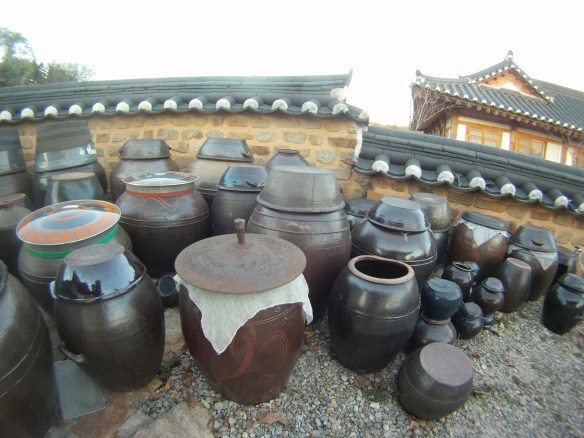
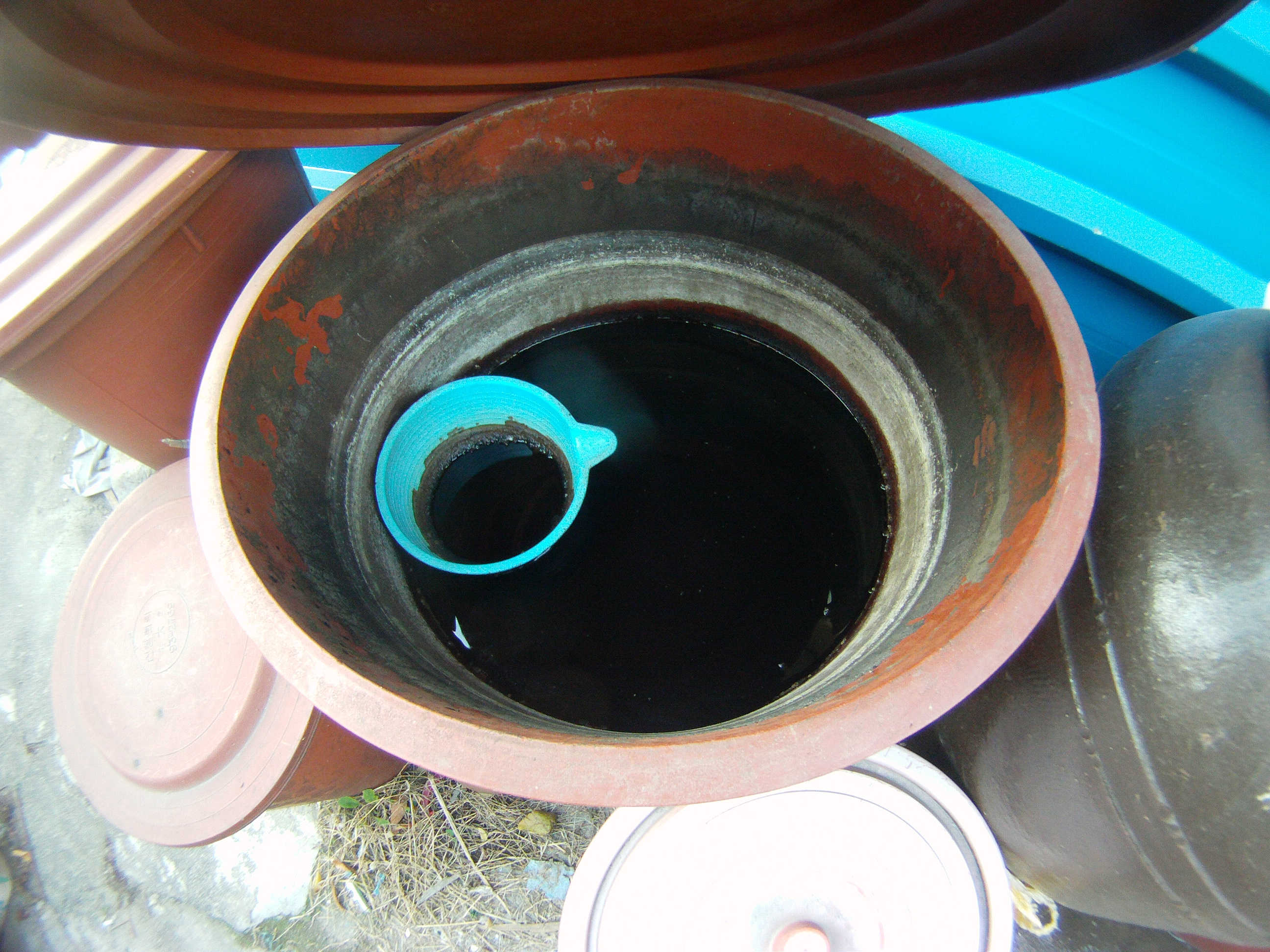
Old style Kimchi ceramic pots

Old style Kimchi ceramic pots

20,000 won goes fast in a Korean grocery, store especially when you buy foreign goods! For the first time in a very long time I bought peanut butter, jelly and gummy bears! I was so excited that I woke up several times at night to eat a few bites of peanut butter, and chew on a gummy or two.

DCIM101GOPRO

Overall I would have to say that the same mechanism that led me like Korea, has also made me dislike it. Many people seem to be stuck in social constructed norms, where situations that don’t fit in with their daily routine are often ignored. This can be said for many countries but it was very noticeable in Korea. I found that many people will ignore me when I ask for directions on the street. If I speak to them in Korean or pronounce a destination in Korean they will tell me that they don’t speak English and walk away. It seems that they would rather ignore than to confront a new situation. Being ignored is great when you are camping in the central park but when you are lost it’s frustrating.

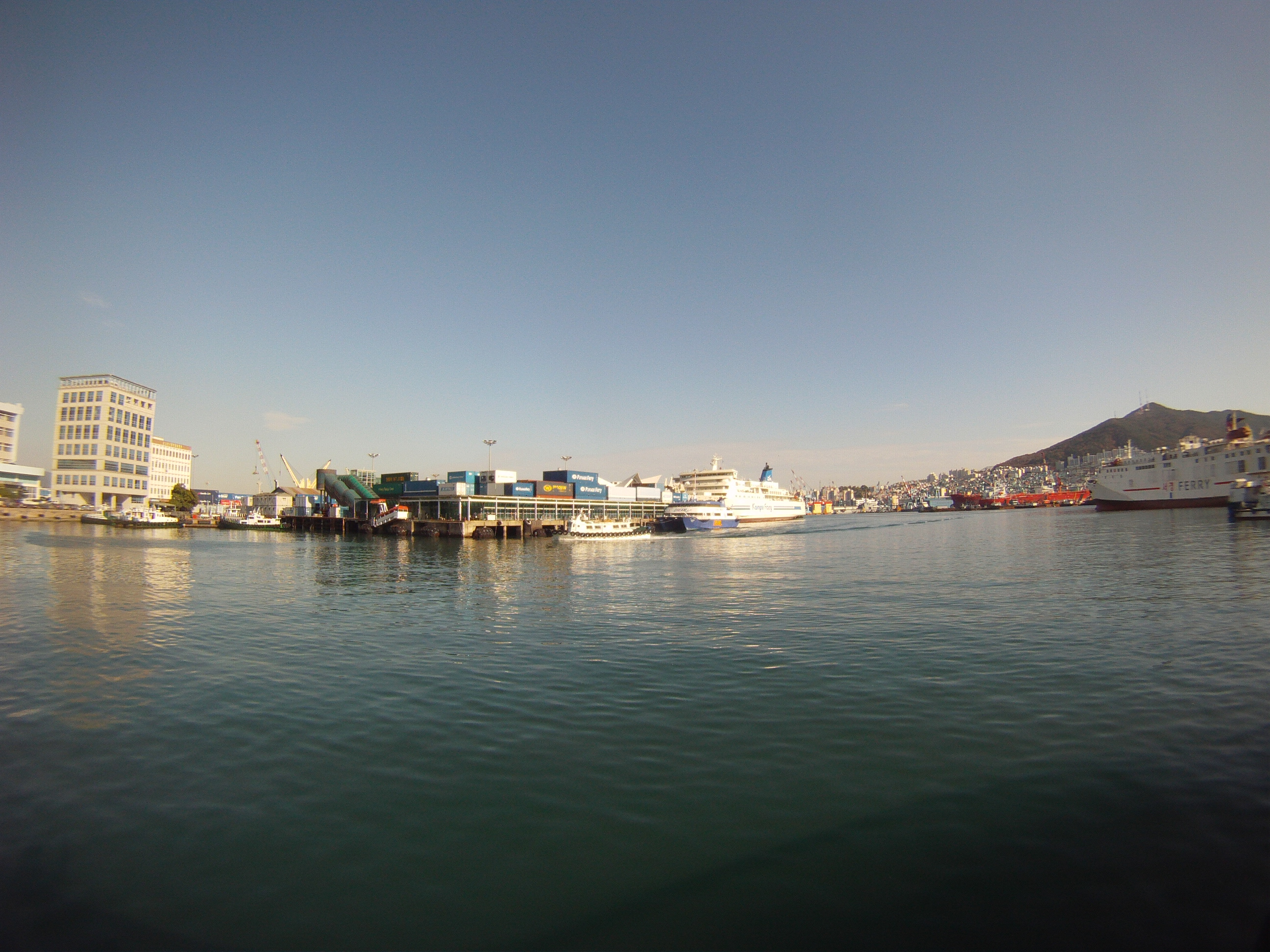
Busan port, so long Korea

Busan port, so long Korea

Even with these constrictions I met many great and hospitable people,  and hold a high regard for Korea. It was an interesting experience traveling there, and I am interested in how Japan will compare.
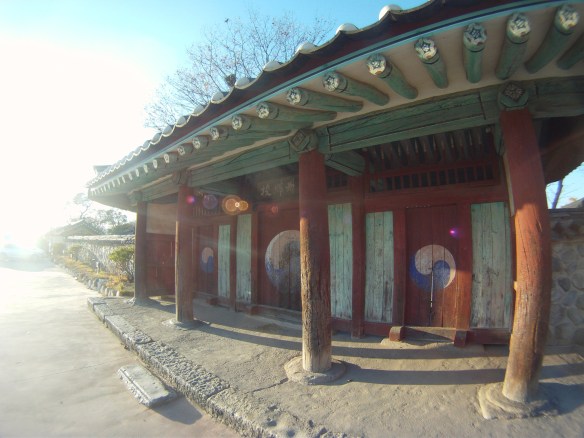
Confucian temple Gyeongju

Confucian temple Gyeongju

Time to find a place to set up my tent in the busy city of Fukuoka! I looked at a few hostels but they are all located up several floors in large buildings with small stair cases/elevators and it just too much work to carry Gaby all the way up to a cramped dorm room for one night. Prices are also pretty steep here so I rather save a few Yen for more peanut butter and gummies.

-Julian

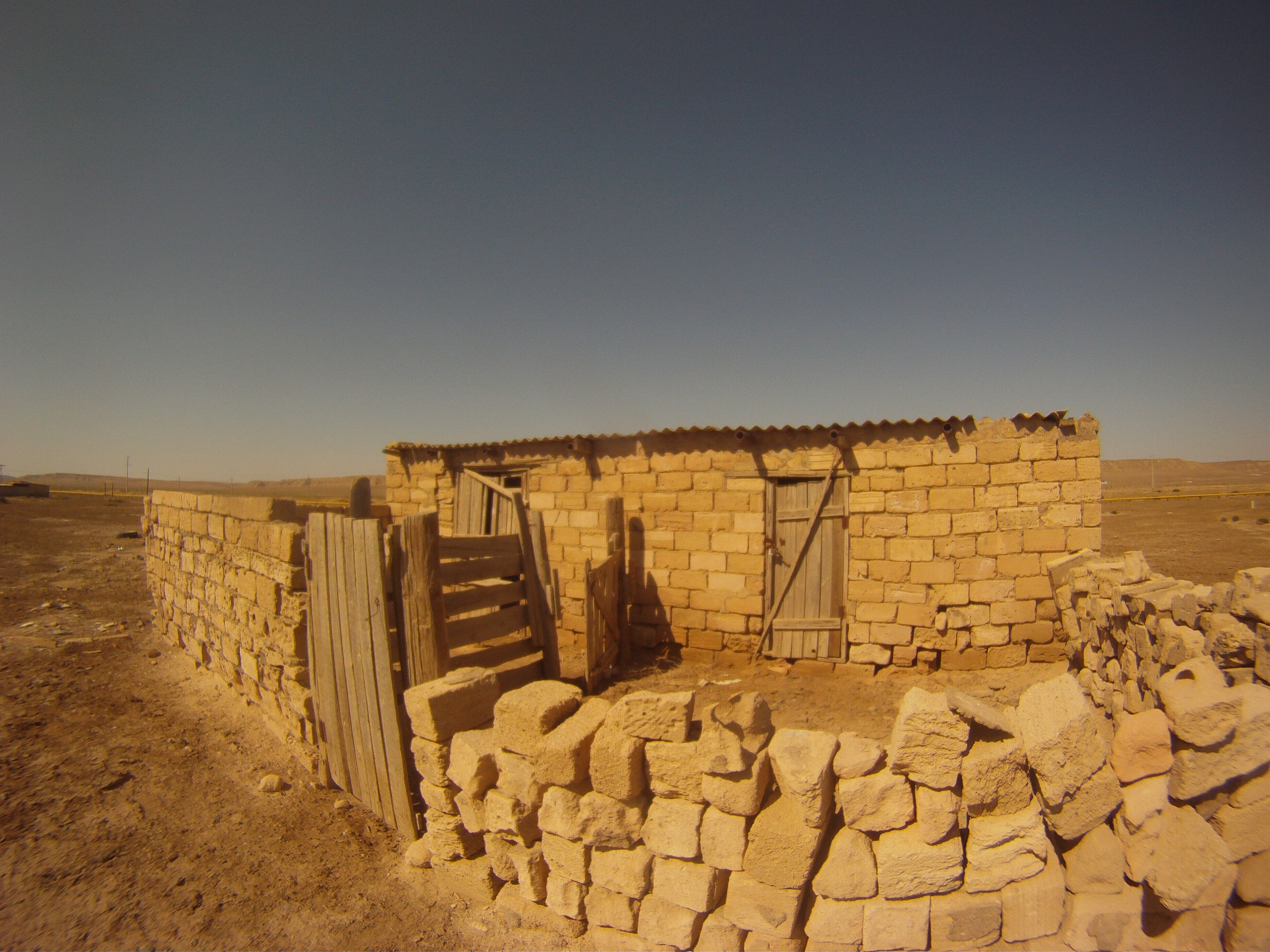
Kazakhstani Desert Nomads

It is 45C. A dry hot dusty wind dries your mouth, nose and eyes. You try to swallow and clear your throat but your saliva has long since evaporated. Your teeth crack as there is sand and dust between then, and your body radiates the immense heat absorbed from the sun. It is over a hundred and fifty miles in each direction to the nearest source of water, food or shelter. Your bike is extremely heavy with several days of food and over 15 liters of water. These thoughts are at first comforting but after a few kilometers of pedaling know that in this environment the water will only last you at most 32 hours. You can not over exert yourself, because if you get too hot these is no shade to cool you off, but you must keep pedaling to survive. (An average day in Kazakhstan and Uzbekistan)

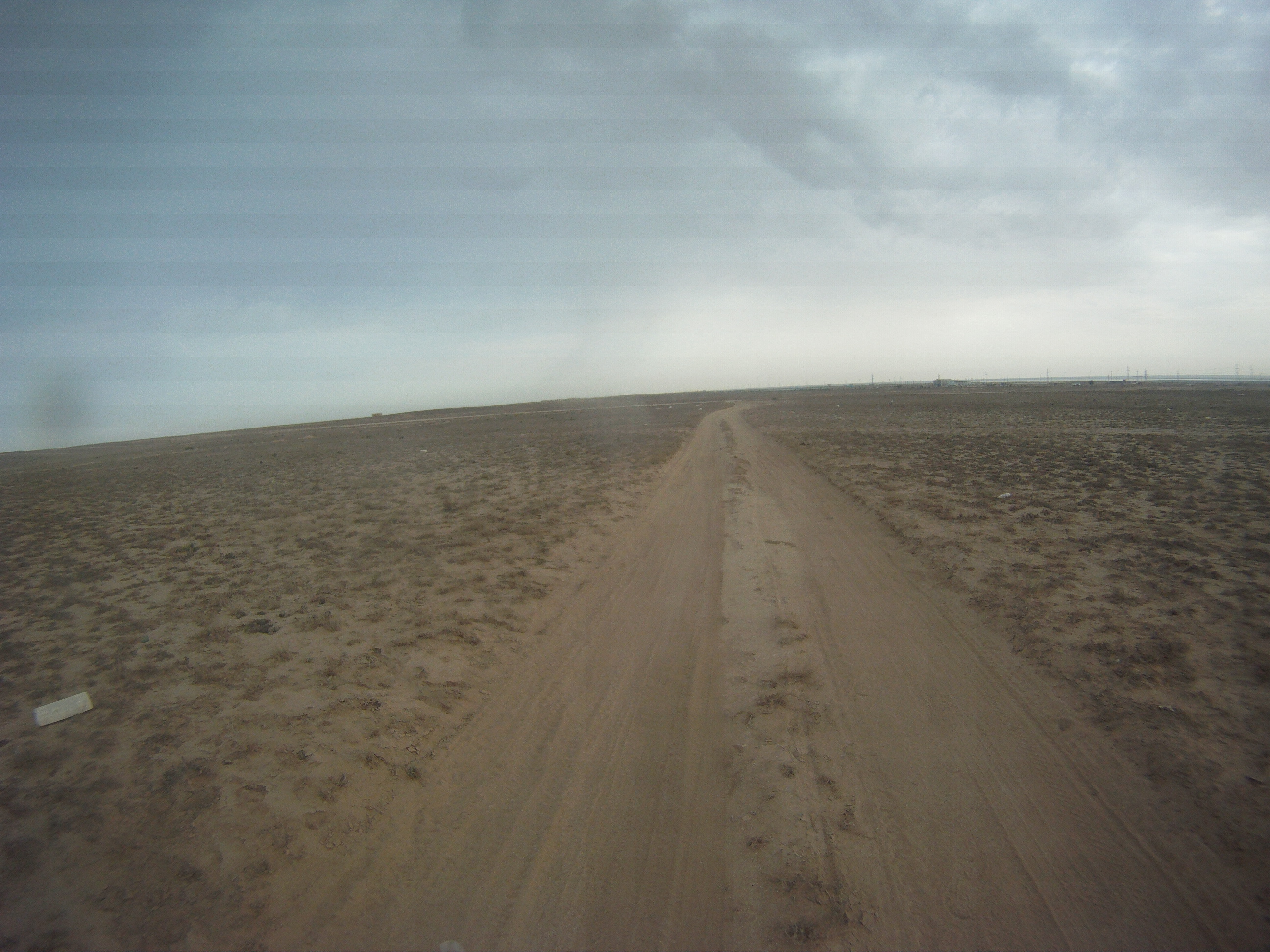
A long desert road

A long desert road

My journey through Kazakhstan was quite challenging. In the 5 days it took me to pedal to the Uzbekistan border I pedaled through the most difficult terrain I have ever encountered. Immediately upon waking on my first day, I was engulfed with dry hot desert winds, and a sun so strong you feel like you are an ant in a child’s sandbox, seconds away from being torched with a magnifying glass. I have never been so thirsty in all my life, and I have really come to respect water as by far our most precious natural resource. The distance between towns and villages is daunting and can be as much as 200 miles on a dusty potholed road covered in a foot of powdered sand. The average daily temperature is close to 45 C, and there is little more than a concrete pipe to give you respite from the sun. I carry between 15-20 litters of water daily, but I can’t seem to consume enough water, I haven’t pee’d in days. I am haunted by the memory of my brother and I’s pet frog Samson, who we left outside in a small cage with little water during a summer weekend. We returned to find nothing more than a dried carcass.

Yes...These is a lot of water strapped on to that bike! A hidden 10 liters under the white bag

Yes…These is a lot of water strapped on to that bike! A hidden 10 liters under the white bag

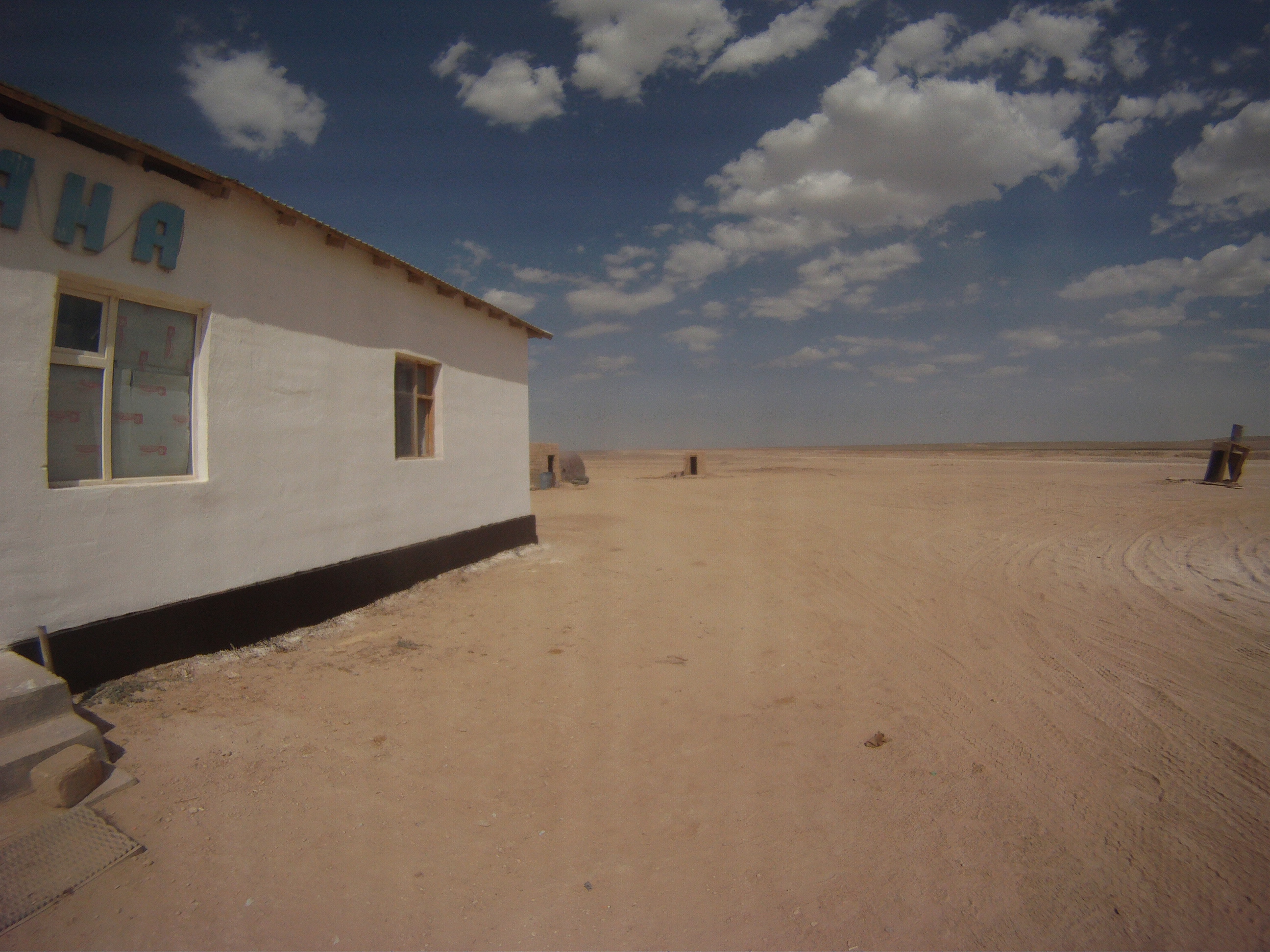
Chaihana, local tea house that sells water 3x the price of gasoline

Chaihana, local tea house that sells water 3x the price of gasoline

After arriving at Aktau, the port city in Kazakhstan, I suddenly started having diarrhea, at first I figured it was my body, too scared to attempt cycling through Central Asia, trying to get me to give up, but it continued for close to a week. After a few days I debated taking antibiotics, I have a whole arsenal of intestinal chemotherapy, but every time I consume them they make me so weak that I can barely cycle for several days after a normal dose. Between being weak and having diarrhea I chose the latter and frequented all sorts of absolutely disgusting outhouses! However as foul and disgusting as they are, it sure beats digging a hole squatting in the hot desert sun!

The cleanest toilet in Kazakhstan

The cleanest toilet in Kazakhstan

There is something very unique about the Central Asia environment, the land between the Caspian sea and Central Uzbekistan (my current location) is completely devoid of life. In the evening, when the sun finally goes away for a few hours, it is absolutely silent. Scorpions prowl the evening sands and eat the moths that are attracted to my cooking stove and headlamp. I have never know such affectionate creatures as they like to cuddle and sleep next to me under my tent. Each morning I pack my tent only to find several underneath. In the morning lizards and geckos come to eat the flies that have gathered to drink my toothpaste water, and ants carry away my littered bread crumbs. In 2008 I visited the Chinese Central Asian province of Xinjiang during August, and I clearly remember the difficultly in handling the dry heat even when traveling around in an air-conditioned automobile! It is easy to get in a bad mood, and keeping a positive attitude is the key to survival here. You can not freak out about the heat or not having enough water! Otherwise you might as well hitch hike or take a bus because you will never make it! You can’t change your surroundings but you can always can change the way you look and relate to them.

The best time of day!

The best time of day!

House in remote desert village

House in remote desert village

I have never been so happy to see fruits and vegetables! The only produce market in 500 miles. Beyneu

I have never been so happy to see fruits and vegetables! The only produce market in 500 miles. Beyneu

Occasionally I encounter wild camels (who can survive for a minimum of 15 days without water). They wander about the desert in the hot in sun, and often wake me at dawn trying to eat my tent or panniers. The word for tree in Russian “Derev’ya” is almost as useless in Kazakhstan as the word for snow in Arabic, “Thalj” they don’t exist! Shade can be found when you are passed on the dusty road by a large semi truck, or inside a cement drain pipe, other than that there is no choice but to handle the heat. Pedaling at night is always an option but the roads are very busy as soon as the sun goes down. It seems that most vehicles out here are not equipped with air conditioning making the day time too hot for a commute.

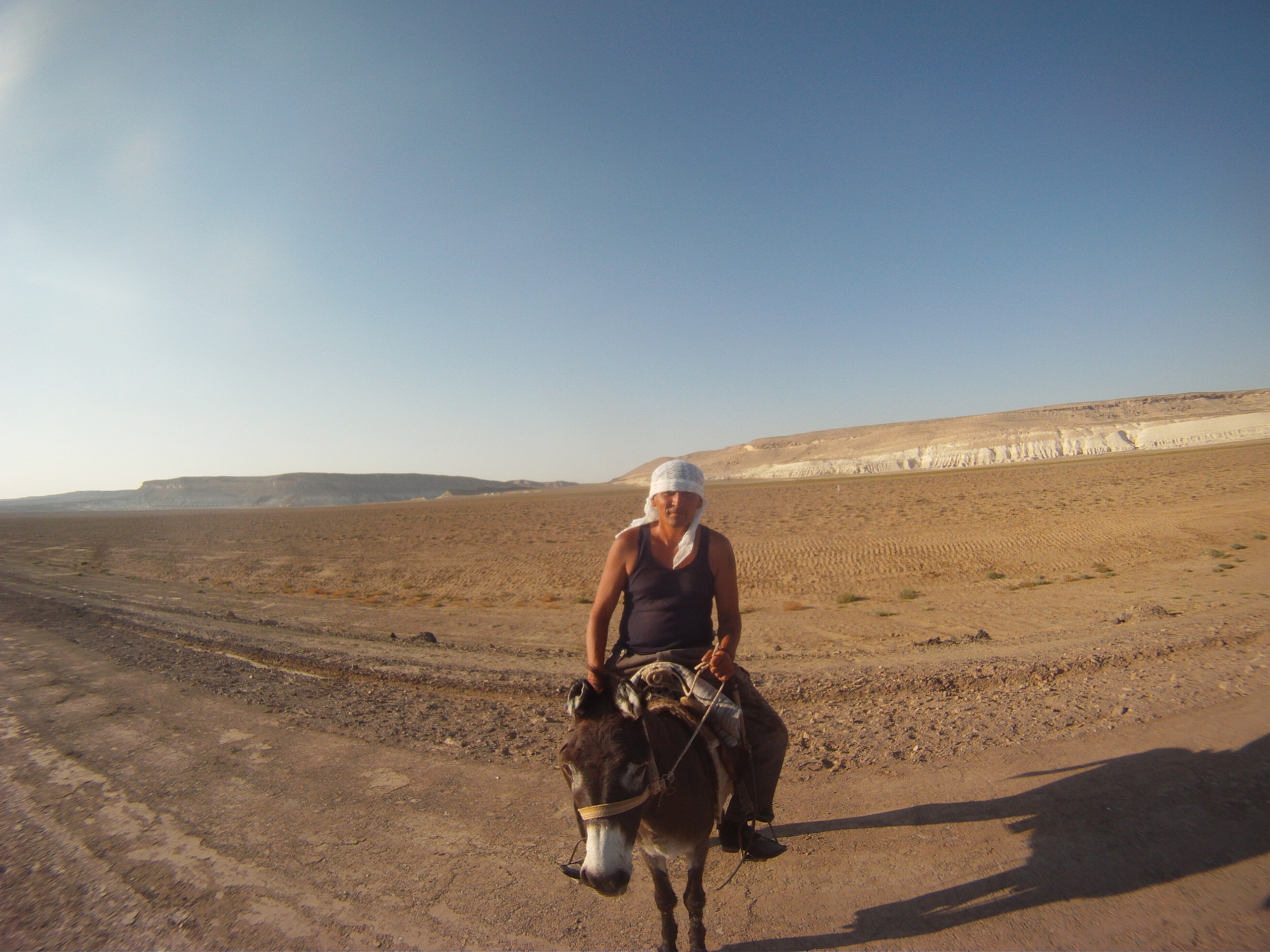
True desert nomad, I offered him a bottle of water but he told I would need it more than him! He had holsters on his saddle one for water one for vodka

True desert nomad, I offered him a bottle of water but he told I would need it more than him! He had holsters on his saddle one for water one for vodka

Kazakhstani’s are extremely friendly and seem to be very curious of my travels. There are few that venture out into the desert herding sheep with nothing more than a bottle of water and vodka. These are known as theKochevnik poustynyaDesert Nomads. These nomads make me feel like baby as I pedal past with a bike loaded with 15 liters water. Life is definitely possible out here, but very difficult. I talked with a domestic tourist in the city of Beyneu and he told me that the USSR used to send criminals to these parts of Kazakhstan as the temperatures can be as hot as 50C in the summer and -50 C in the winter. Locals don their own form of the Arab kefiye, and often make masks out of old tee shirts to protect their faces from the sun. At first it was a bit scary coming across these locals in masks because they also often wear sunglasses making them look a lot like the scarecrow in Batman, but they are usually yelling hello and jumping up and down trying to grab your attention.

Local with sunmask

Local with sun mask

Local Kazakhs these guys do not speak Chinese

Local Kazakhs these guys do not speak Chinese

I know that the heat will eventually die down, but right now life if really difficult on the road. On one occasion a trucker gave me a half-drunken bottle of Fanta, rather than discarding this precious sugary liquid I boiled it and cooked oatmeal in it. Pretty disgusting but it’s food. I entered Uzbekistan 2 days ago and have only passed 2 villages, a part of me wants to take it easy and rest all the time, the other part wants to haul ass and get out of this desert hell. Days are torn between the two. My mind is strong and I continue on….

DCIM106GOPRO