I am 3 hours away from boarding an overnight ship headed for the Japanese harbor city of Fukuoka. I am hoping this trip goes better than my experiences traveling across the Caspian sea, however from what I am told we will arrive in Fukuoka sometime between 3-4 am.
Korea has been a great experience I really enjoyed my time here. I will post Korea in retrospect when I arrive in Japan. See you there!
Ann Yong from Korea -Julian
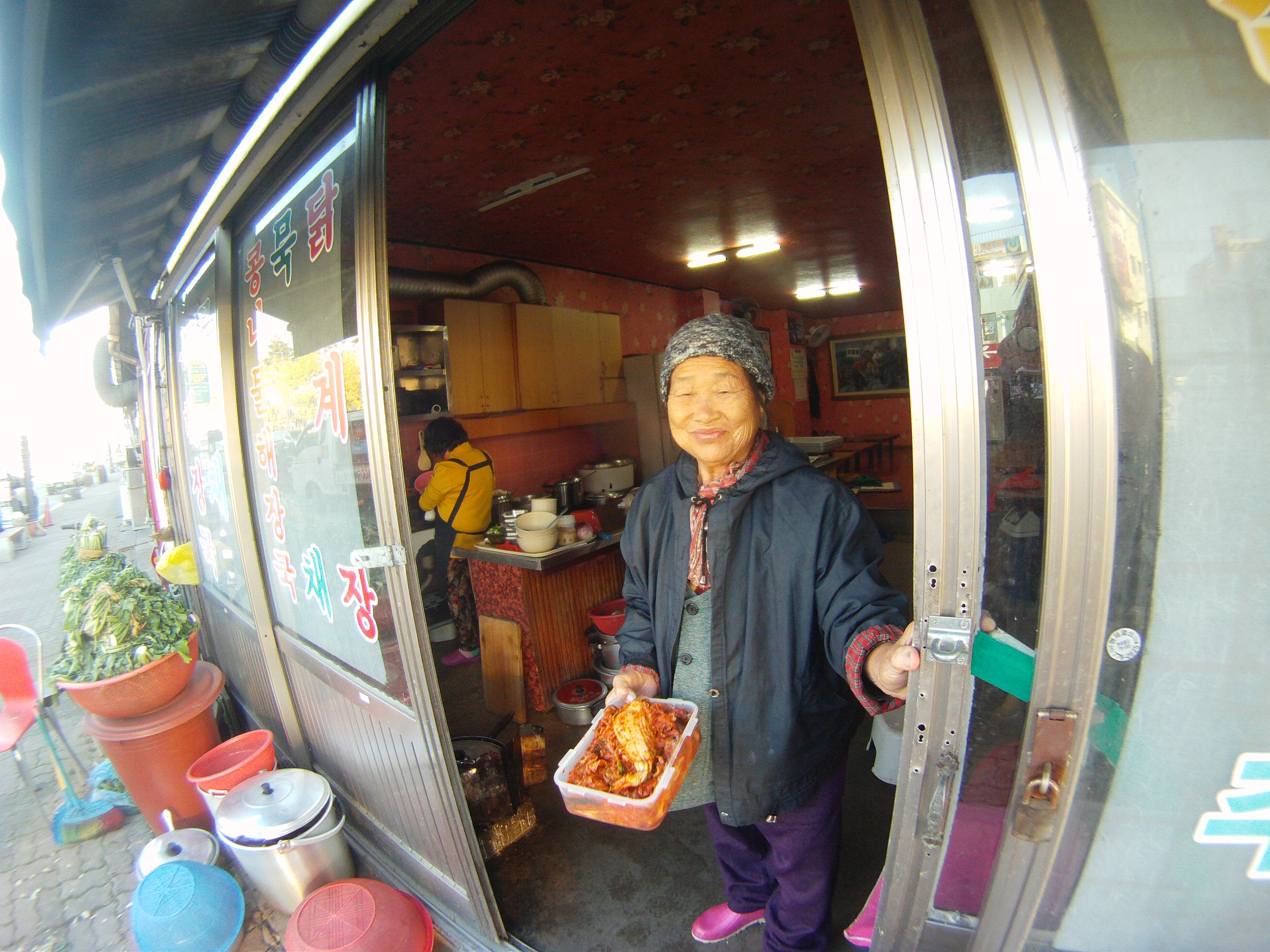
Miss Kim, KimChi master!! I will tell her story next post
Korea has very little flat ground, I spend most days climbing pass after pass dreaming of popcorn topped with liquid aminos and nutritional yeast
A bowl of noodles in an ice broth, originally the King’s favorite dish, I think the MSG did me over though.
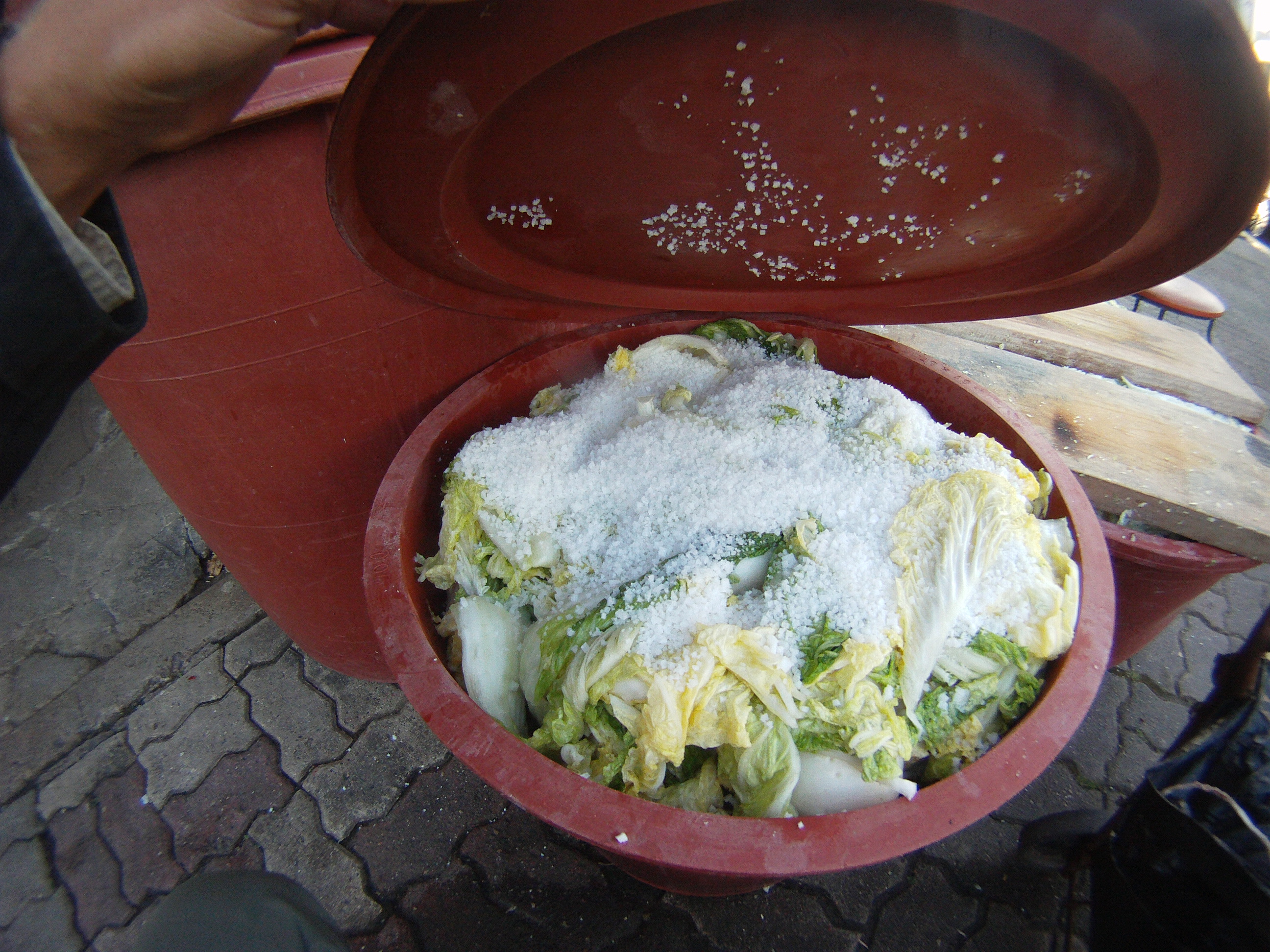
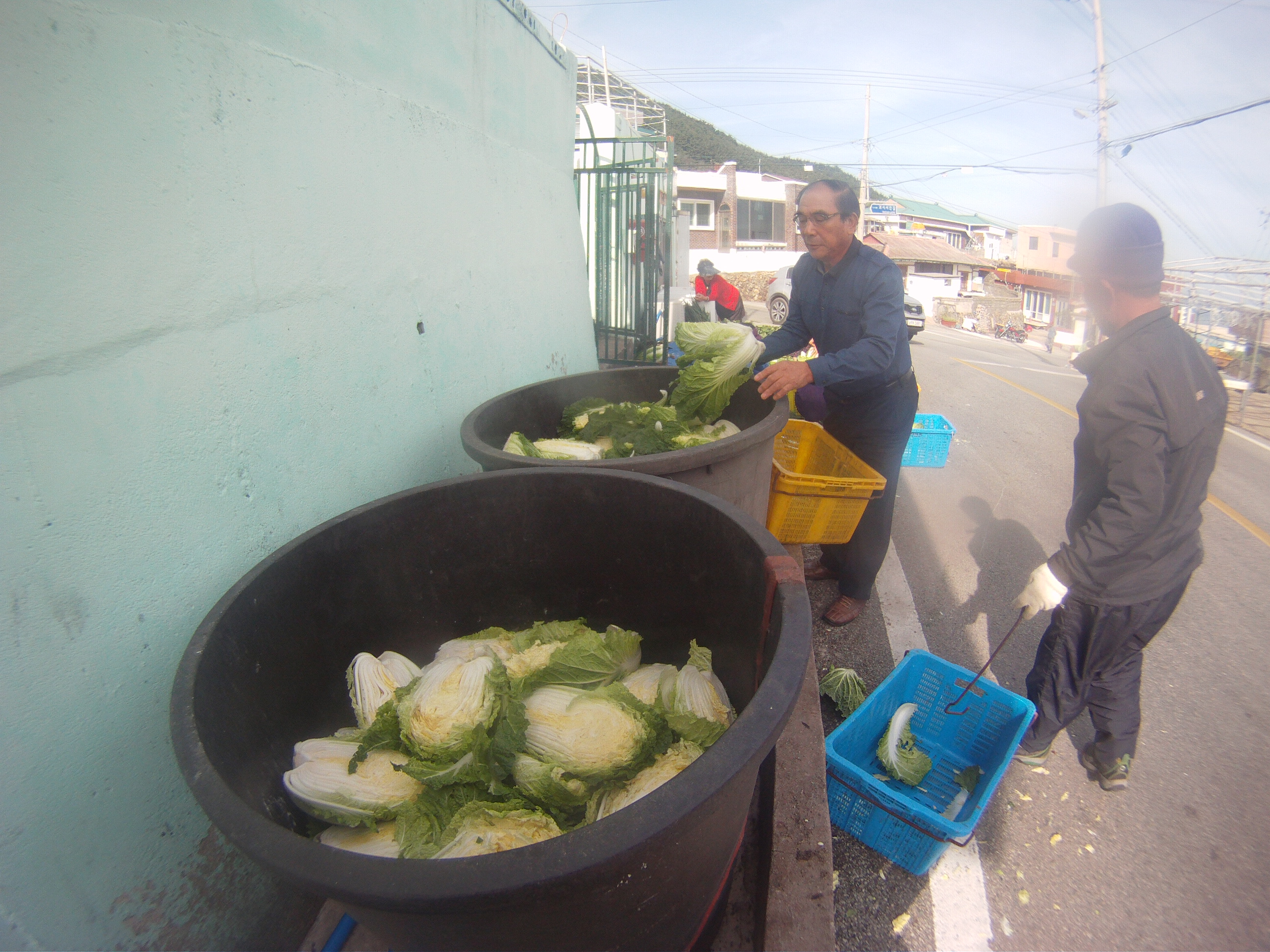
Two huge batches of Napa cabbage. The cabbage will sit with other ingredients for over 3 months before fermenting and becoming Kimchi
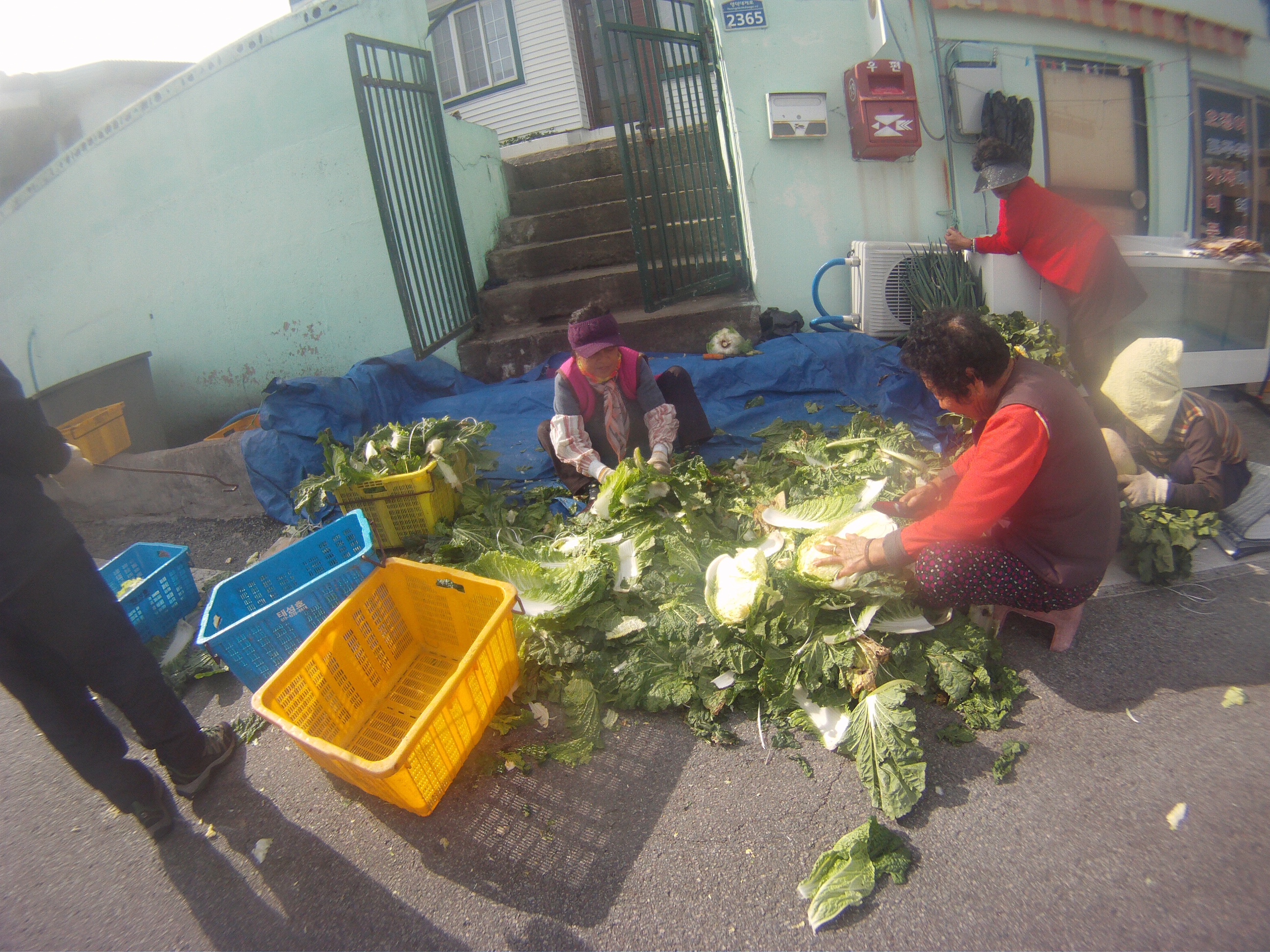
Ladies on the sidewalk sift through the good, bad and ugly cabbage
Gifts for the traveler, the cabbage on the left is too yellow in color therefore too bitter and the one on the right is too big and lacks flavor. This was dinner for 3 straight days!
I hope this is as Asian as I get
Always a celebrity, making friends in a local restaurant, the search still continues though for Korea’s famous bbq wild dog.
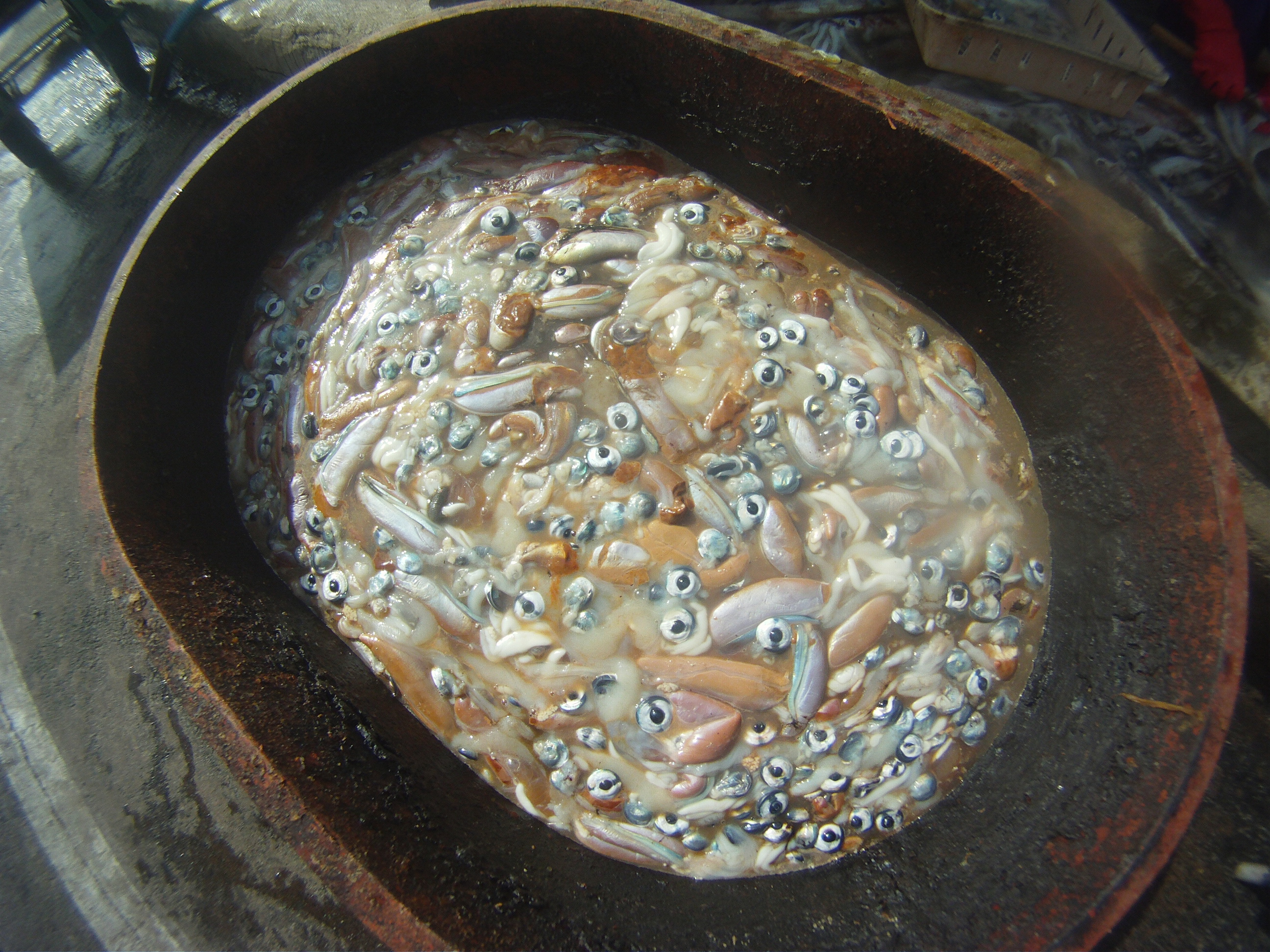
A huge bath of squid guts, brains and eye balls
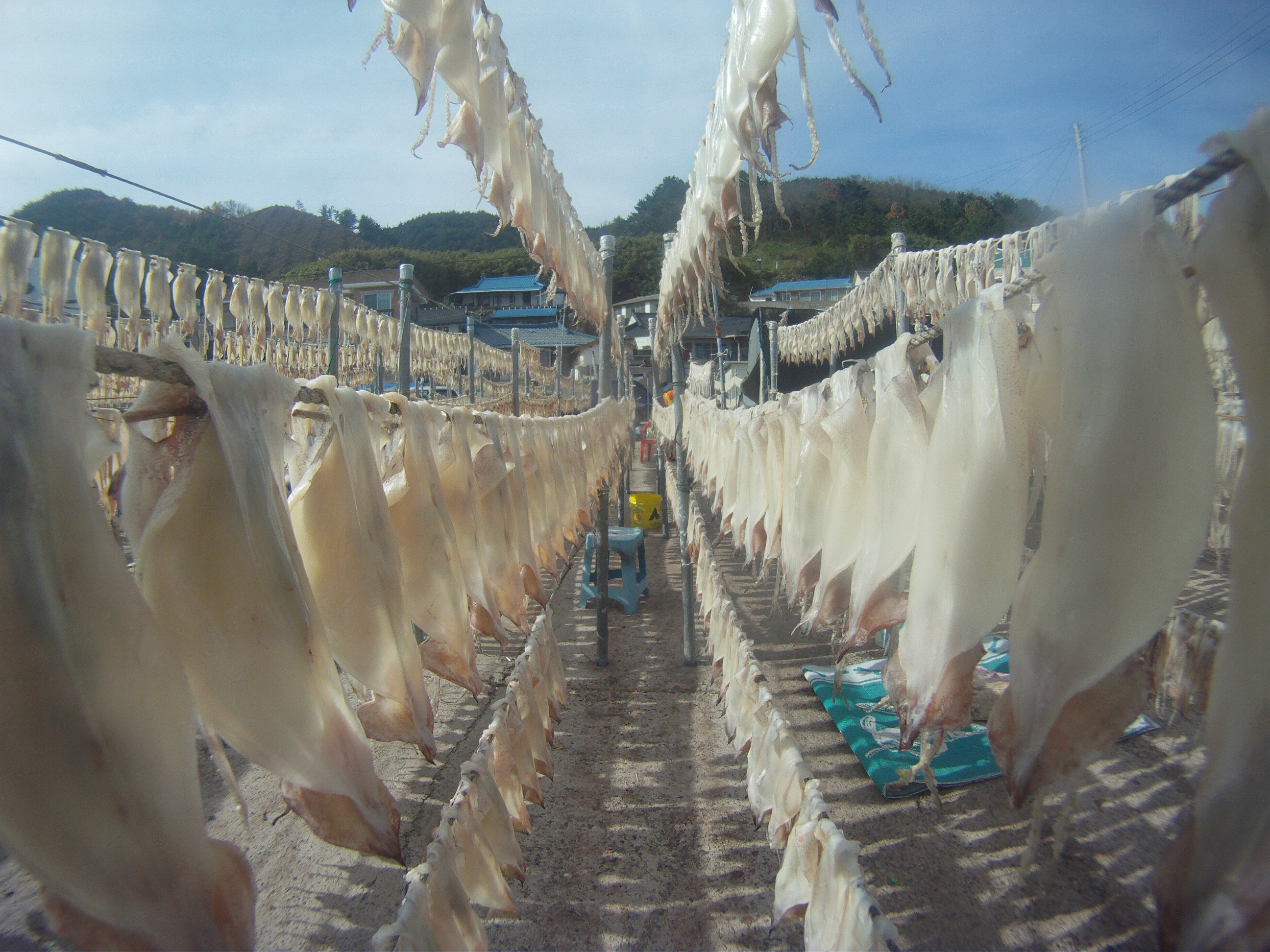
Squid jerky drying in the sun. The smell permeated the coastline for several kilometers, and reminded me of the time when my father tried to cook squid in the toaster over. The extreme heat made the carcass explode and forever after all of our toast and poptarts tasted like squid.
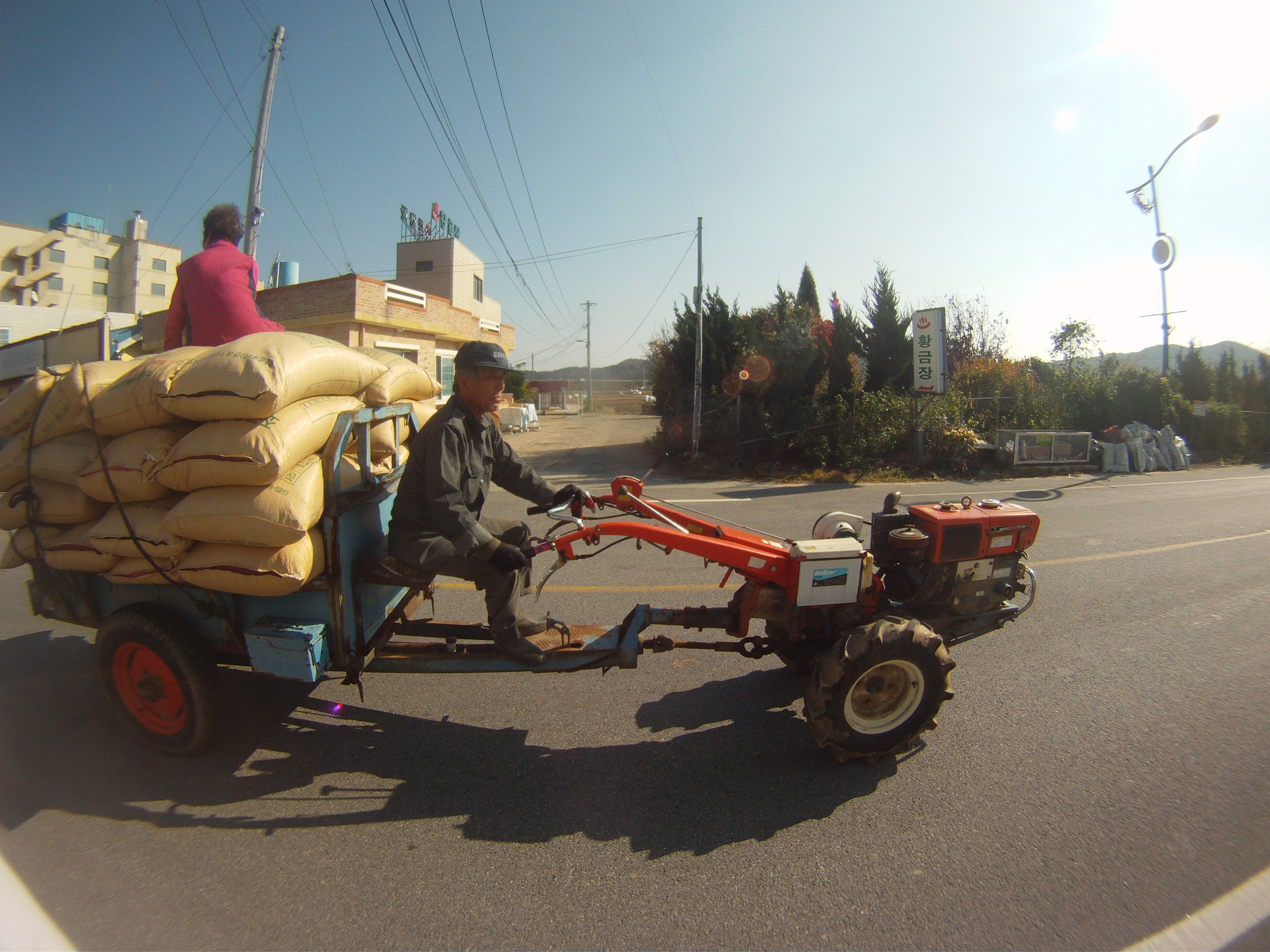
Remains of older times. A farmer races his tracker through downtown, while his old lady keeps the rice down.
Beautiful rice field in the shadow of corporate Korea
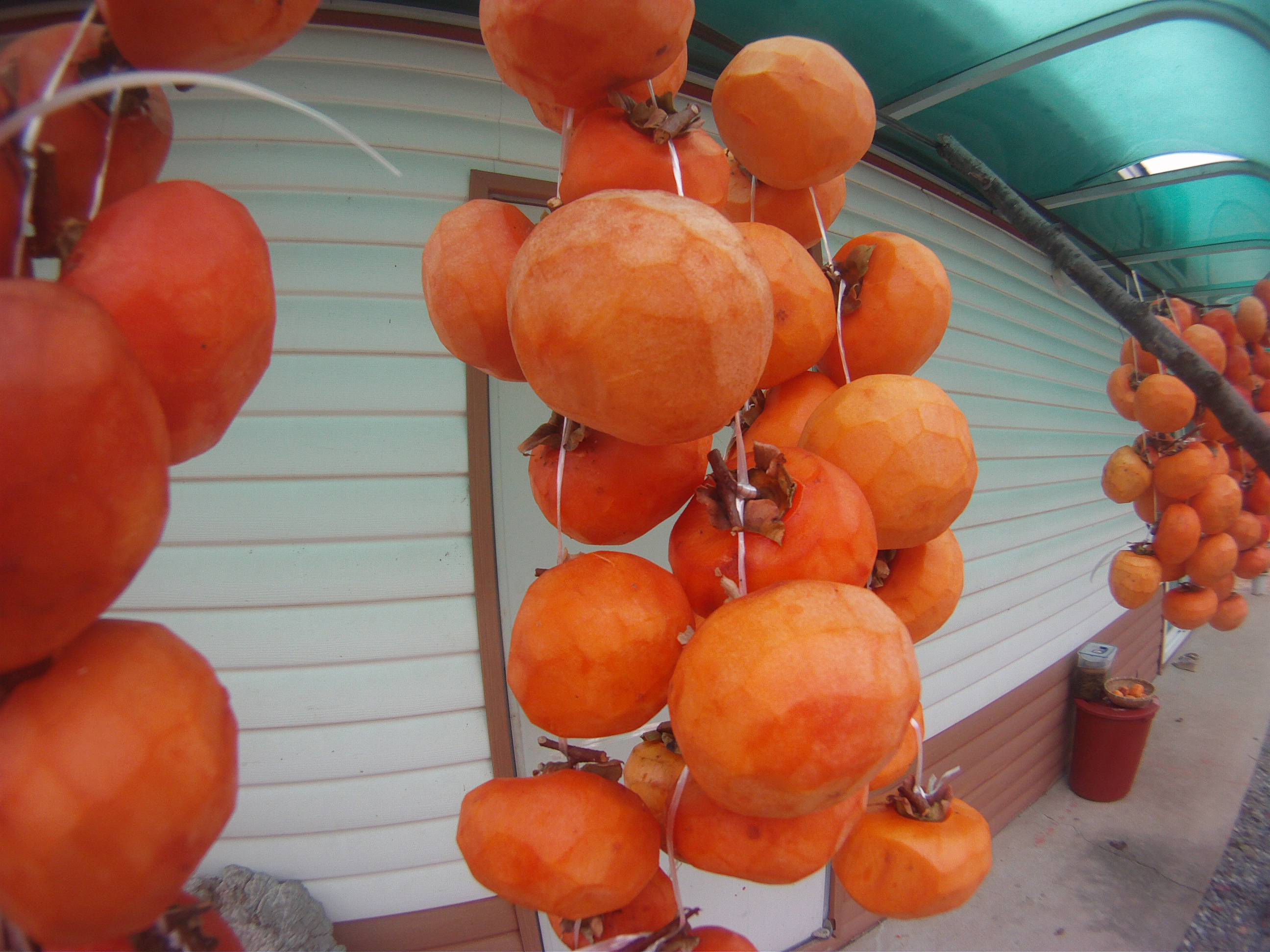
Skinned persimmons drying in the sun, these decorated the front porches of many in the interior regions.
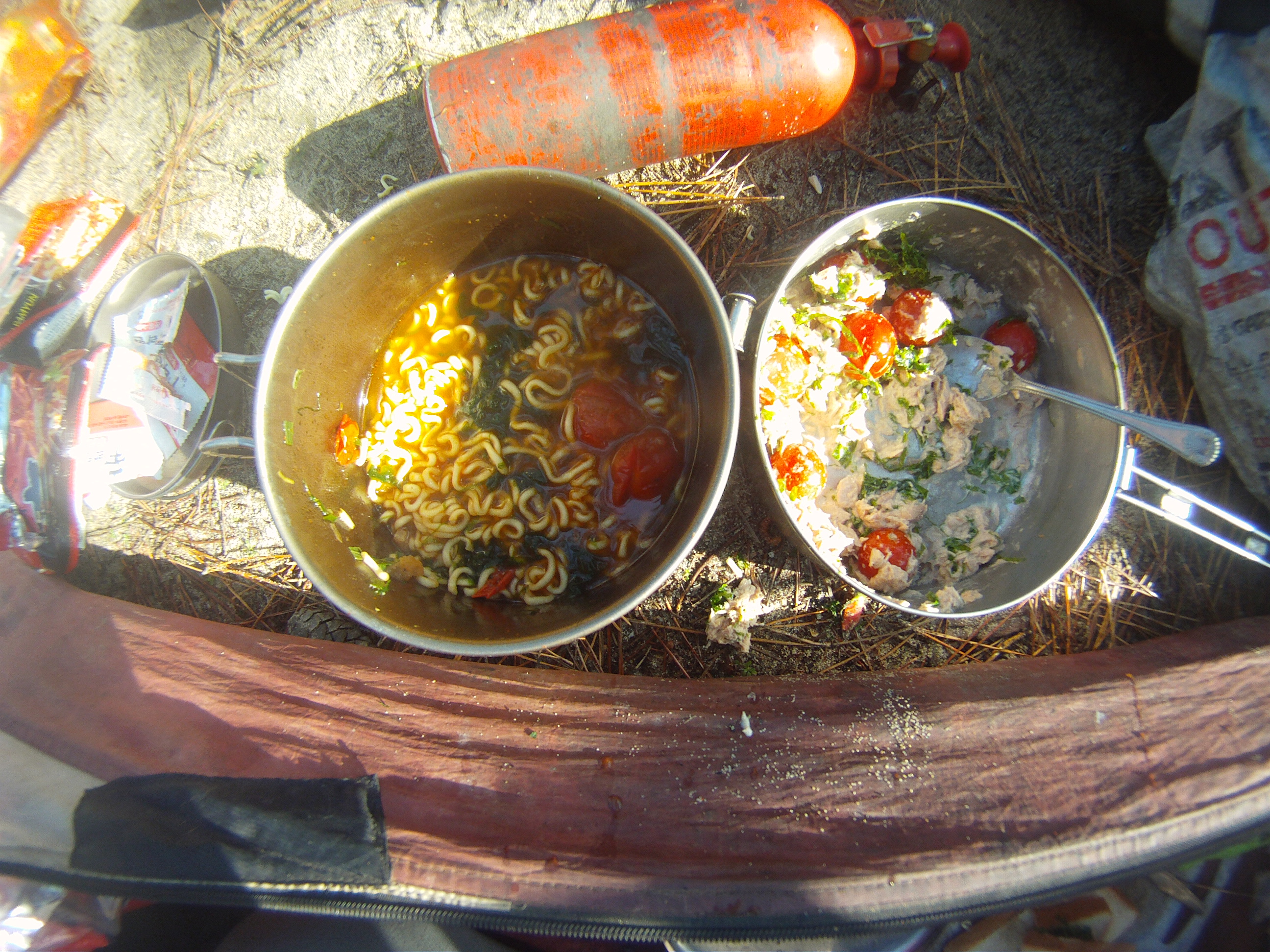
My standard breakfast, Ramen noodles mixed with kimchi, tuna fish, seaweed and cherry tomatoes
Most beaches along the east coast are barbed off, just incase the North Koreans run out of Kimchi
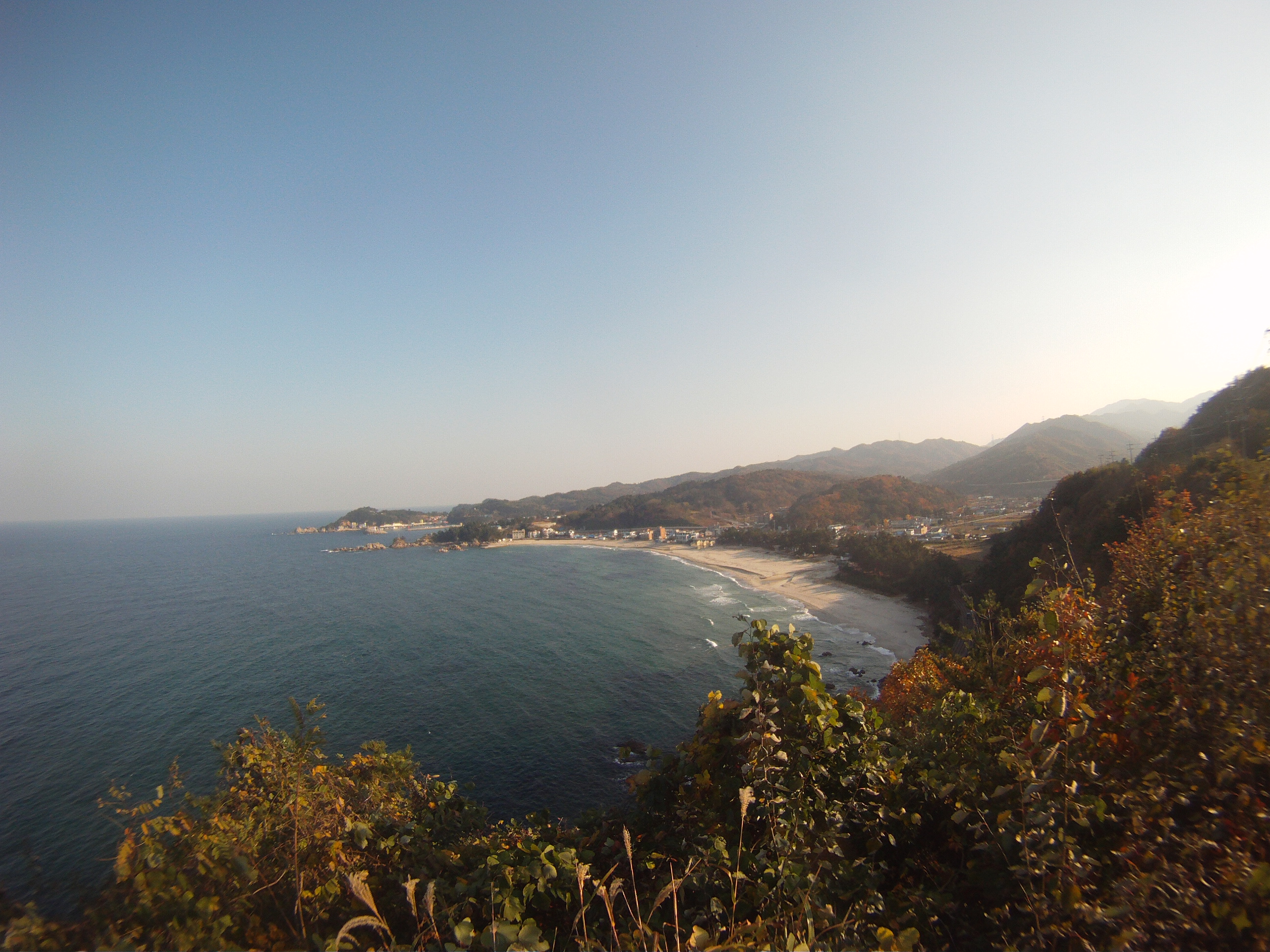
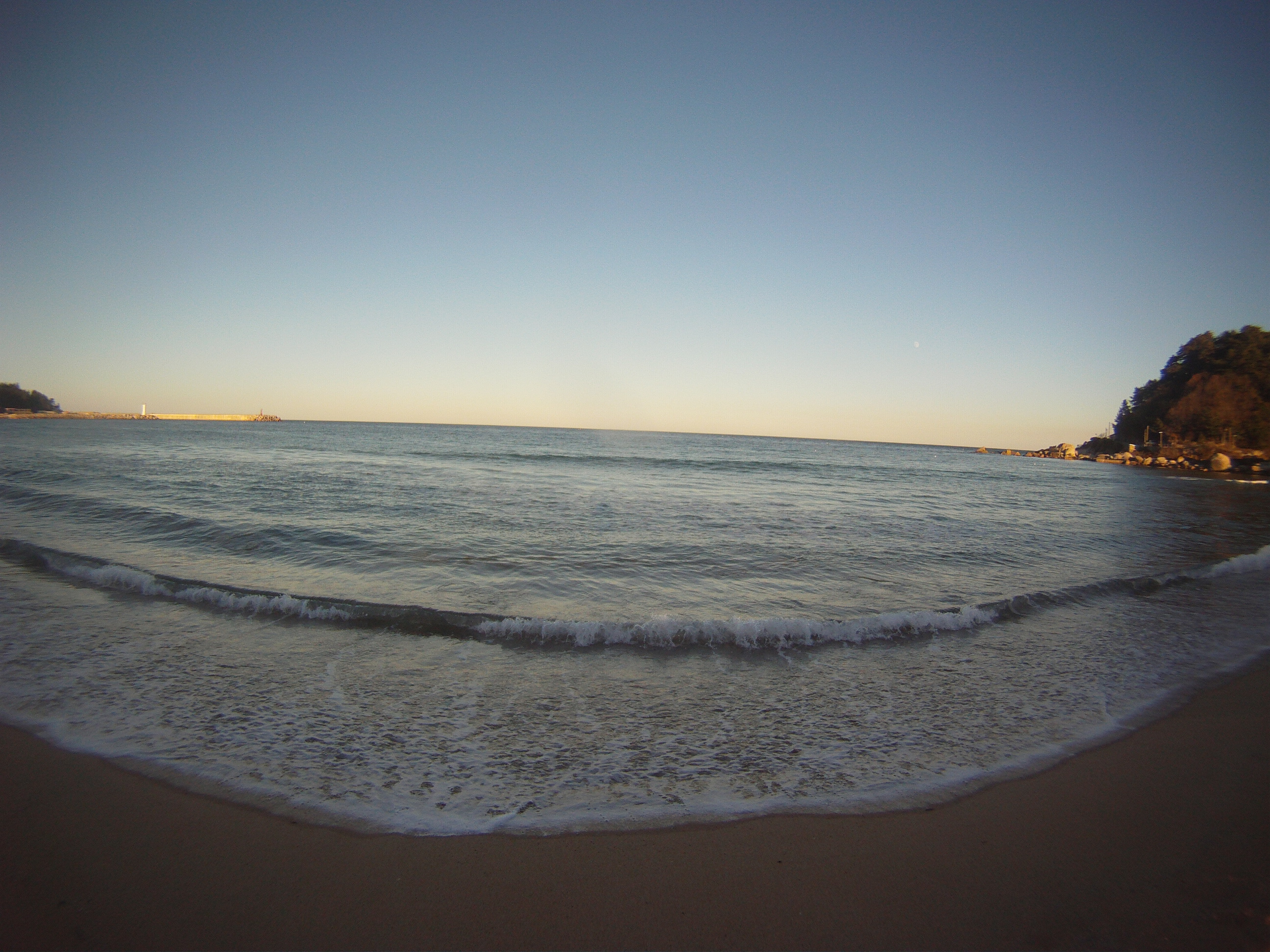
Korea’s coastline
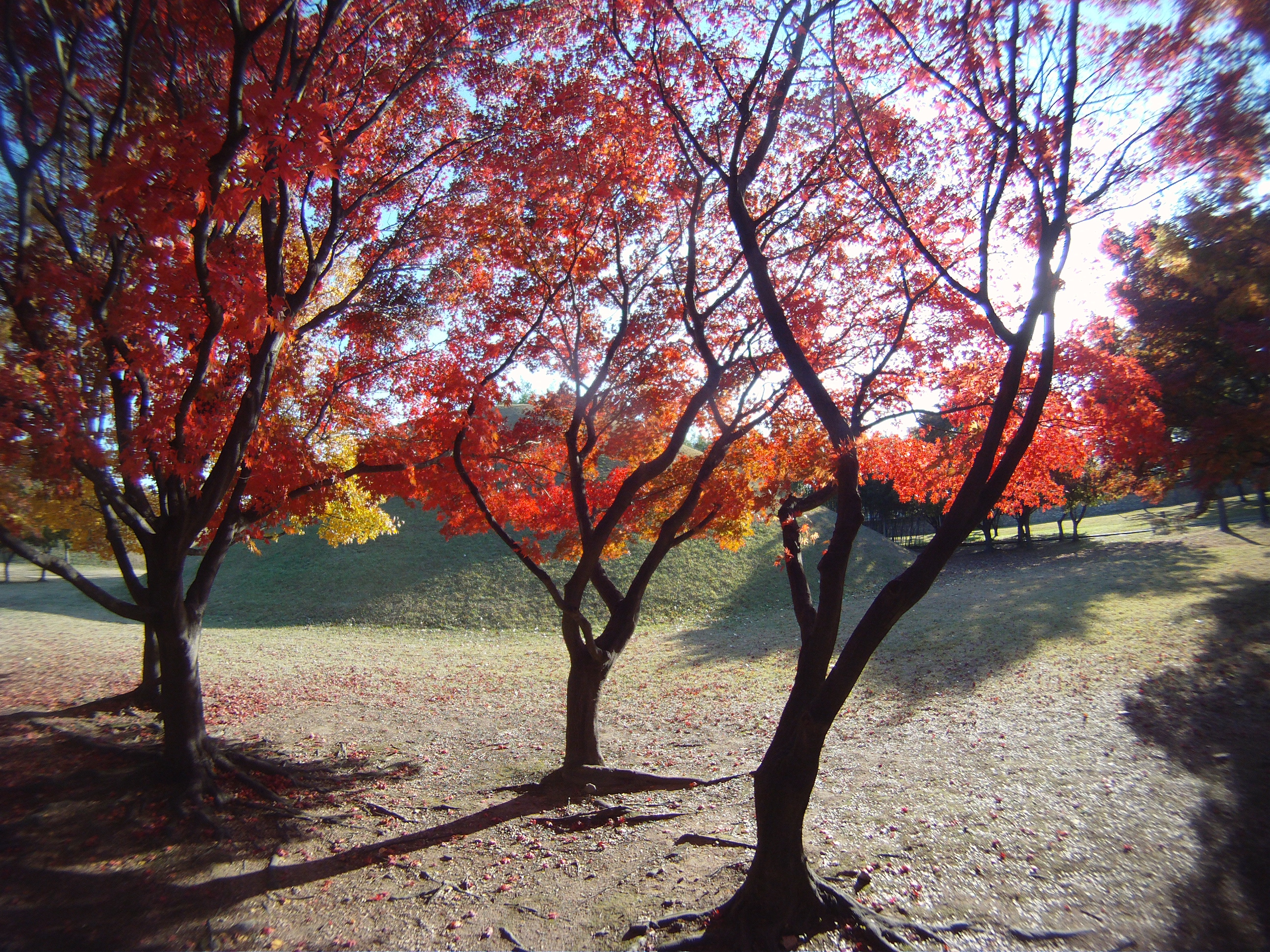
Fall in the country
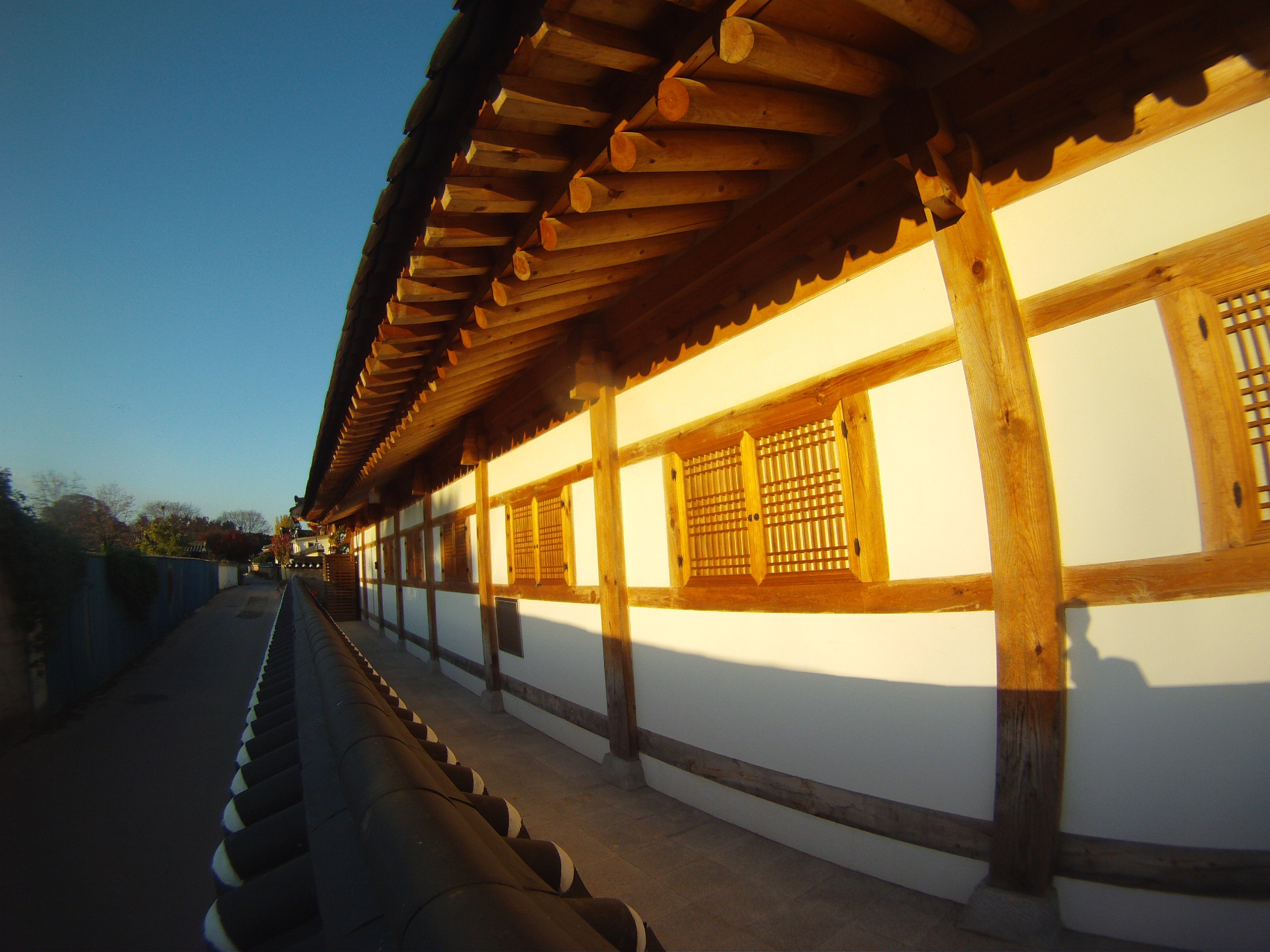
Donations hanging in a south Buddhist temple
I am now on my last leg of my travels in South Korea. Today I spent a long, hard day pedaling the mountainous coast finally ending up in the city of Pohang before evening. After a bit of asking around and wandering about I found the local Jim Jill Bang (spa house lodge). I am now eating noodles, drinking fermented rice water and lounging in the spa, preparing for a nice evening out of the tent. I am not far from Busan, where I will take the overnight ferry to Japan, but before leaving Korean I plan on visiting the tropical island of Jeju located between the two countries. Will touch base again before heading to Japan, hopefully from Jeju Island.
Meditation hall I Korea’s Oldest Monastery Seoraksan.
The transition from Central to East Asia was not easy. Like a plant that had grown roots from Norway across Europe and into the far east of Central Asia, I was plucked and transplanted to a completely different environment. No longer would there be a struggle to survive or a constant undertone of adrenalin as I pedaled through distant villages ravaged with wild dogs, there was suddenly so much wealth in front of me. I had only taken a few steps off the plane before a runway escalator transported me to immigration, following a quick electronic finger printing and thermal scan for Ebola symptoms, an elevator took me down to the luggage carousel, where friendly airport staff carried my boxed bicycle and panniers through customs. In the bathroom a Mozart piano concerto covered up the sound of flushing toilets and urinals. I quickly realized that the adventurous world which had been so prevalent through the last few months of my life had changed, after traveling thousands of kilometers, I was in more than just a new country.
Dried fish stink up the sidewalks in Seoul, no one guards the fish as I take it stinky fish theft is very uncommon
The Incheon International Airport is located on an island off the north-western coast of the country, about 60 kilometers from the North Korean border. Directly to the west are the two islands of Baengnyeongdo and Daecheongdo, who’s ownership have been the subject of constant conflict between the two countries, not to mention the continuous shelling from both sides across the Demilitarized Zone (DMZ), since the end of the Korean war in the 1950’s. I would quickly observe that the wealth, future and economy of South Korea though currently so stable could quickly fall to the North’s largest standing army, creating constant fear in the government and the minds of many of its citizens.
Old Village district Seoul
I boarded the airport railroad and headed towards the capital city of Seoul. Each stop was called in 4 different languages, and I looked out the window and marveled at what looked (after so many months in Central Asia) like a city from the future. Bridges, tunnels and highways intertwined in the shadows of skyscrapers half lost in the clouds of the afternoon overcast sky. Everything was silent. The trail glided effortlessly across the tracks and the passengers sat still and gazed at the screens of their cellphones. A little girl sitting opposite me jumped off her distracted fathers lap and pummeled into my knee, the father taken by surprise quickly put down his cellphone and profusely apologized for his daughter’s misbehavior. No sooner did she return to the parental figures lap did he return to his cellphone.
Domestic tourists march in matching vests
“Last stop Seoul station” blasted over the intercom in Mandarin, I awoke to find the street car empty and I slid the 28 kilogram bicycle box and 3 over stuffed panniers off the train and into the elevator. “Main floor” the elevator called out, and without pushing a button I was shuttled up 5 stories to the ground level of the city. The doors opened to a long corridor that connected the elevator shaft to the rest of first floor of the train station, pushing and walking slowly I was passed by busy Koreans carrying shopping bags and briefcases, and I looked out the window and noticed that I was walking in a glass tunnel above a large fountain. I since arriving in Korea I had traveled so far but had yet to breathe the outside air. There was small waiting room at the end corridor, “It’s time to put Gabriella back together, and explore a new country” I thought. “Welcome to Korea”.
Fall is in full swing here and the mountains and hills are covered in color
The first Korean word that I learned was “Chi Naga Yo” which means “Please (politely) watch out”. After close to an hour of assembling and repacking Gaby I pedaled through the busy streets trying to navigate my way to the “Old Village” district in town. Cars no longer honked as I took up the entire slow lane, and passed with caution utilizing their yielding lights, showing no sign of road rage. The sidewalks however were a spectacle, a craze of mopeds, cyclists and pedestrians dominating for space. I held my breath as “kamikaze” like Koreans pedaled head-on at full speed on flashy BMX bikes. There was so much commotion between everyone that is seemed like it was all choreographed and that if one person stopped everything would fall apart. A taxi cab pulled up beside me and offered to lead me to my destination. Pedaling on I passed store fronts selling dried fish, pharmacies advertising miracle skin creams and restaurants venting the smell of kimchi into the streets. The traffic signal turned from green to yellow and all cars seemed to stop at the same time letting the mob on the sidewalk pass. Ten minutes later I arrived in the old village district only to be shocked as I watched a large camouflaged truck unload a group of soldiers carrying automatic weapons. “What is this….Israel” I thought. An official directing traffic asked me where I was going and before I answered, I asked him what was going on with all the military troops. “North Korea” he said to me in a heavy accent, and waved me through.
I spent two days in Seoul, half the time wandering through busy streets converted into open shopping malls and the other half try to rest after the long red-eye flight. I was back to the world of Capitalism. Name brand clothing shops dominating the late night shopping scene, and McDonald’s and fast food restaurant chains served hungry customers into the early morning hours in Mypeoeng district. It seemed like every other shop was a 7-11 or CVS convenience store, selling everything from seaweed rice wraps to shampoo and skin cream. I contemplating camping in the forests outlying the city, but decided on a cheap guest house. I worked hard for what little rest I would get struggling for close to an hour at getting Gaby and all my panniers up to the third floor and into a room the size of a closet. Though small it still had all the amenities; TV, refrigerator, shower, toilet, sink and an air conditioner. I was literally in a tiny house that even had an ironing border and a clothes line. The staff was a bit confused when I asked about how much it would cost for me to do laundry, “Its free” they said, “There is also plenty of detergent for you to use as well”. Free laundry! I remembered countless occasions of bargaining with landowners over how much laundry would cost. In Bukhara and Samarkand, the owner wanted $10 for a single load, those times were over.
Very common site, instant noodle debris in the bathroom sink
The next morning I asked for a late checkout and the man at the desk told me I would need to write him a “Thank You” note, and then I could do as I pleased. After writing “Thank You” on a yellow sticky note, he stuck it to his desk with the rest of the thank you notes written in Korean and smiled, I checked out 3 hours later with no hassle.
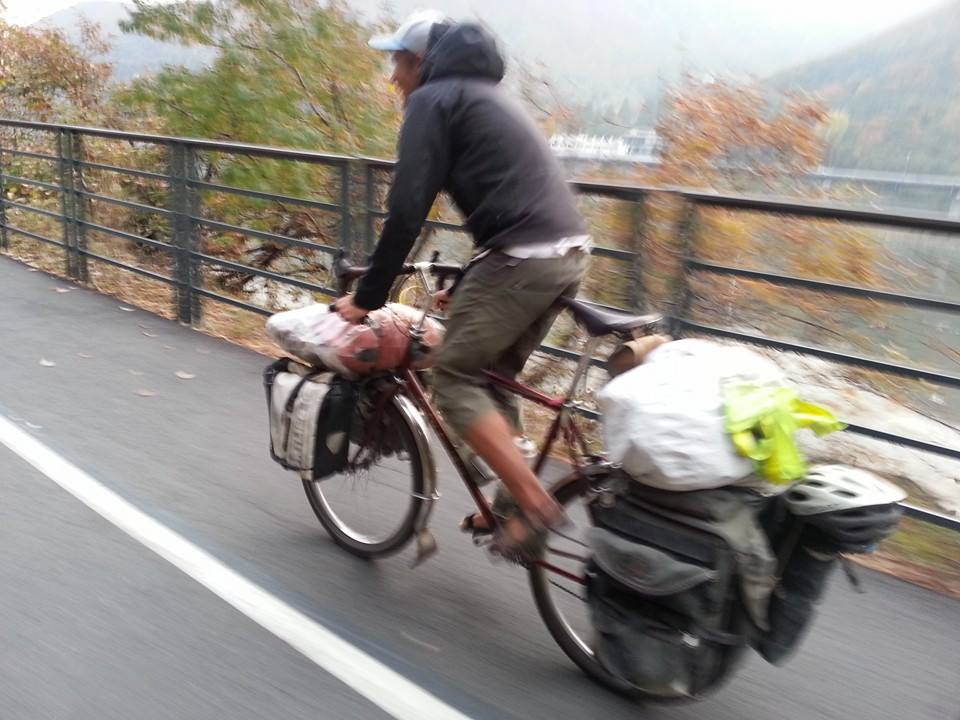
Seoul sits at the meeting point of 4 large rivers, and I followed a beautiful bike path east towards the more remote part of the country. The path was separate from the main road and traveled over streams, flooded rice patties and on wooded decks through fertile fields. My loaded bicycle drew constant attention and I was repeatedly asked to pose for photographs, eventually leading to a lunch invitation. I made friends with fellow cyclists and at a large bowl with sweet noodles and ice “King’s Noodles”. It is not uncommon for most large cities to have a Teddy Bear Museum and I contemplated visiting until I found out that the entry fee was $15 to see a bunch of Teddy Bears.
Large Buddha statue Seoraksan
My first night of camping was a bit challenging, as after 4 hours of pedaling I still hadn’t escaped the suburbs of Seoul. After an hour of looking I give up and just put my tent somewhere. Sleeping on a dirt mound between two large tract like houses I awoke the following morning to see both house owners washing their Black Hyundai sports cars. Packing up I pedaled to the nearest 7-11 for breakfast. These stores are seriously the convenience store of the future, free boiling water, use of microwave, WIFI, toilets and tables. Instant noodles are by far the most common food consumed in country. Throughout the streets gutters are usually filled with dried vegetable and noodle remains and sinks in most public restrooms are usually clogged with noodle debris. Large grocery stores, blasting Korean Pop songs sometime on distorted speakers often dedicate a full aisle to all the different flavors of instant noodle. Individual packs are also sold at the cashier beside packs of gum, cigarettes and condoms.
The bike path followed this river all the way to the Sea of Japan
By the third day, I had finally escaped the suburbs of the capital and arrived in a small village. Farmers cleaned and dried fish, hanging them on wooden racks and old women washed cabbage in large plastic buckets preparing to make kimchi. Occasionally I see remnants of older times mixed with the present like a well-used bamboo wheeled barrow with shiny new wheels, or a lien two shack street vendor selling cellphones. There is not much left to be seen of the old, the new is in full force over here, and the youth quickly adapt and forget. This is where China and eventually the rest of South East Asia will be, and it seems like all roads in Asia eventually lead to the same place; development and the adaptation of the western life style.
My new favorite snack, dried fish jerky with cheddar cheese, these packets sell out quickly at most stores!
I am in search of the untouched and forgotten lands of South Korea, they must exist somewhere! I will pedal and search the mountainous interior for the remote. Almost as if foreshadowing my first week in the country, no one in Seoul understood the meaning of the word “countryside”. -Julian
My connecting flight to Japan is delayed! 12 hours maybe 24 who knows! A bit restless and ready to hit the road I made the decision to ditch the flight and pedal out of the airport. I am now in the north of the country and am full of options. I really have no idea where I am, in terms of where in the country the Incheon airport is as well as how far I am from Busan. From what I remember south Korea is not that big. Well, here we go; another country, language and so many new customs. It all begins right here and now. My east Asian adventures begin in Incheon!
I reflect upon the difficulties experienced at the Tel Aviv airport in Israel, and look for any alternative to avoid a similar experience
It’s any and all a travelers nightmare, dealing with jet lag, lay-overs, and strange foreign airports. However most avoid the worst: An oversized, cardboard bicycle box weighing close to 50 lbs., carrying your only method of transportation. If you call most airlines, and ask about their bicycle policy, you will be transferred to several different customer service reps before someone can finally give you a straight answer. It is then always a good idea to have the agent email you the policy so you can print it out and have it as a backup at the check-in desk. Before traveling to Israel I have had extremely good luck with checking Gabriella, where most if not all the time oversized/overweight fees were not access, and Gaby traveled safely with the rest of the luggage in the bowels of the airplane free of charge! Then came my experience at the Tel Aviv airport which, in retrospect turned out OK, but since then I have tried to avoid a similar experience.
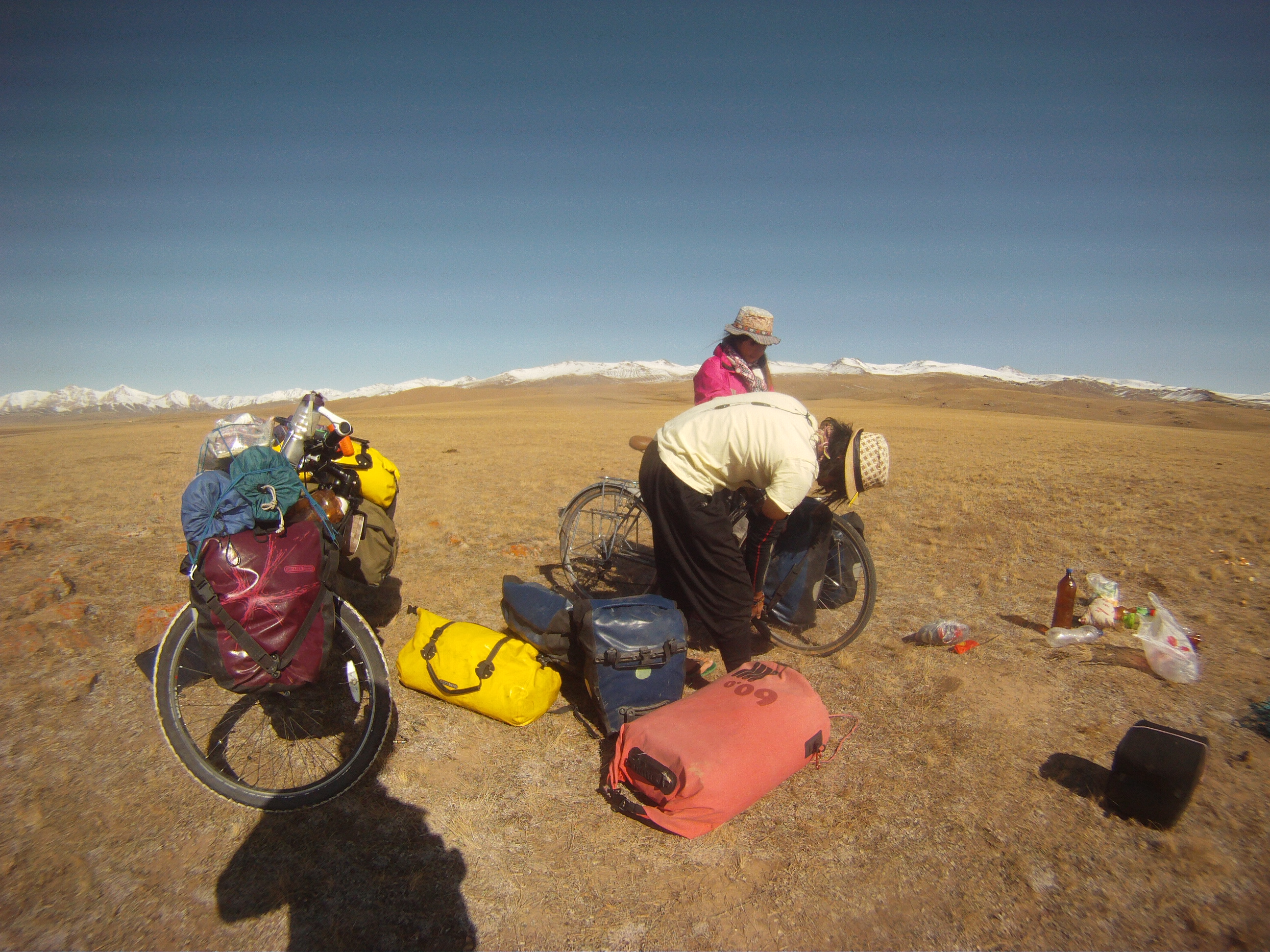
Lost pictures from Song Kol. Two Asians with similar footwear and packing style prepare for the unknown. My bike however without the movie projector, color printer, 2 kilos of condiments, 20 feet of x-mas lights, 4 iPhones and 2 computers probably weighed 20 kilos less.
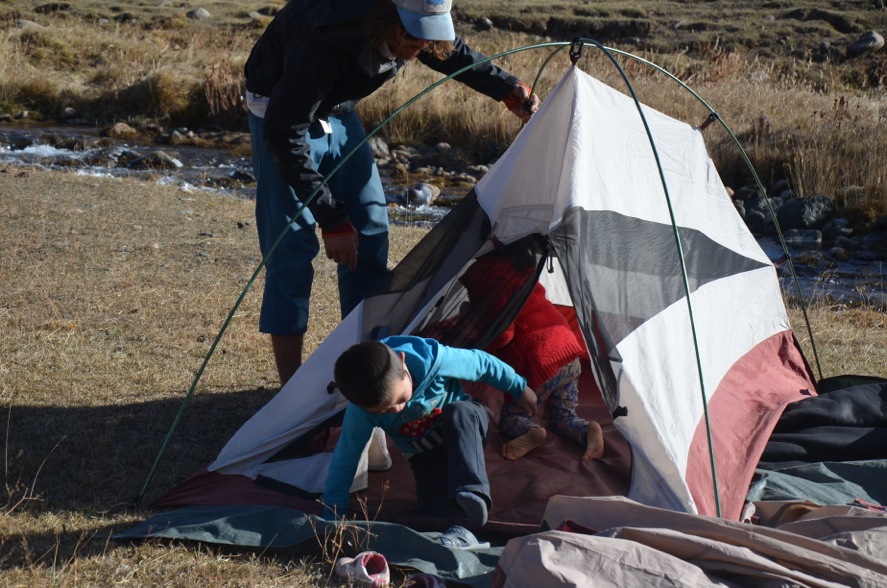
Lost pictures from Song Kol. Local kids play hide and seek in my tent
It should not come as a surprise to most that I am a frequent flyer mile packrat. Always applying for new credit cards that offer tens of thousands of travel miles upon first purchase, then burying them deep in wallet to avoid the occasional spendthrift. My ticket to Sapporo was nothing out of the ordinary, a cheap, 30 hour, 4 lay over flight stopping in Mongolia, China, and Malaysia before making its way to Japan. On, Tuesday Oct 21st, I called the airline to inform them that I would be traveling with a bicycle (most airlines ask for a 24 hour notice). After give the agent my confirmation number, I was told that since I was flying on 4 separate airlines I was required to check and re-check my bicycle at each stop along the way, subsequently paying an oversize fee each time! “Can’t the airline check my bicycle all the way to Japan” I asked. After a brief hold the agent returned and informed me that each airline could only check the bicycle for its leg of the journey. This was a first. In all my travels this had never happened before, as usually once luggage is checked it arrives at your destination, this was not the case in Central Asia with bicycles. I quickly did a search of the 4 different airline’s sports equipment fees and determined that it would be cost me close to $500 to check Gabriella all the way to Sapporo! With all the help from sponsors, my bicycle doesn’t even cost that much, let alone could I afford it. The other big problem was that many of my lay-overs were less than 30 minutes, making it impossible claim and re-check the bicycle before making the flight.
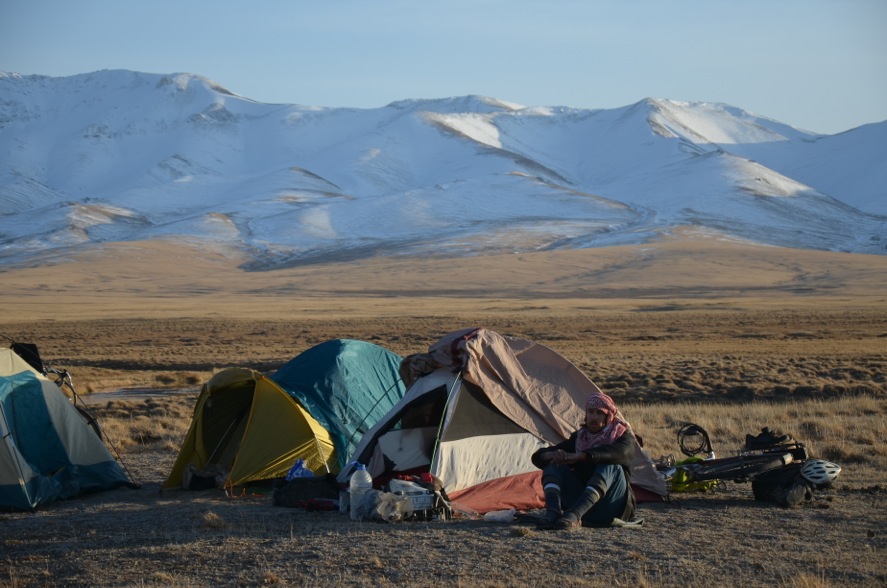
Lost pictures from Song Kol. Snowy mountain tops and headscarves
Lost pictures from Song Kol. Yuki pushes Kei’s bike to no avail.
I had no choice but to change my ticket, unfortunately to avoid flying on the 4 separate airlines I had to change my departure and arrival location. I am now headed back to Kazakhstan, and my destination is also no longer Sapporo, but rather Fukuoka in the south. As much of a hassle as it is, there are benefits. I can now travel to South Korea immediately upon arrival and hopefully avoid the extreme cold, before traveling back into southern Japan. Here we go. A new reservation, departure and arrival! Tomorrow I head back to Kazakhstan for a 250 km journey to the capital. My health has made a full recovery and I am already itching to hit the road! If all goes according to plan my next post will be from Korea!
Lost pictures from Song Kol. Boiling water for a “Yu Tampo” Japanese for hot water bottle in sleeping bag
I did not have the strength to continue pedaling through the city (my fever seemed to have returned and the sea of fumes made me nauseous) I decided to take a local cab to the guest house, and after some bargaining I put my bike and panniers in the trunk and off we went. We soon stopped to pick up more passengers, “What is going on” I said in terrible Russian, “this is a taxi cab not a minibus”. My jaw quickly dropped and I watched in awe as I saw that the two passengers and driver stuff a full-grown, live lamb into the trunk with Gaby. Bishkek, Capital city of Kyrgyzstan yesterday afternoon.
This is probably hundreds of times better than the treatment of live stock in the United States! I just wish he/she didn’t urinate on my panniers!!
After my epic trip to the Pamir Mountains I didn’t expect to find the rest of Kyrgyzstan to be anything as exciting…. Boy was I wrong. My last few weeks in Central Asia would push me to a new level both mentally and physically while I climbed icy, steep, snow-capped mountains, through extremely isolated remote territory, and shivered through the coldest nights of my life.
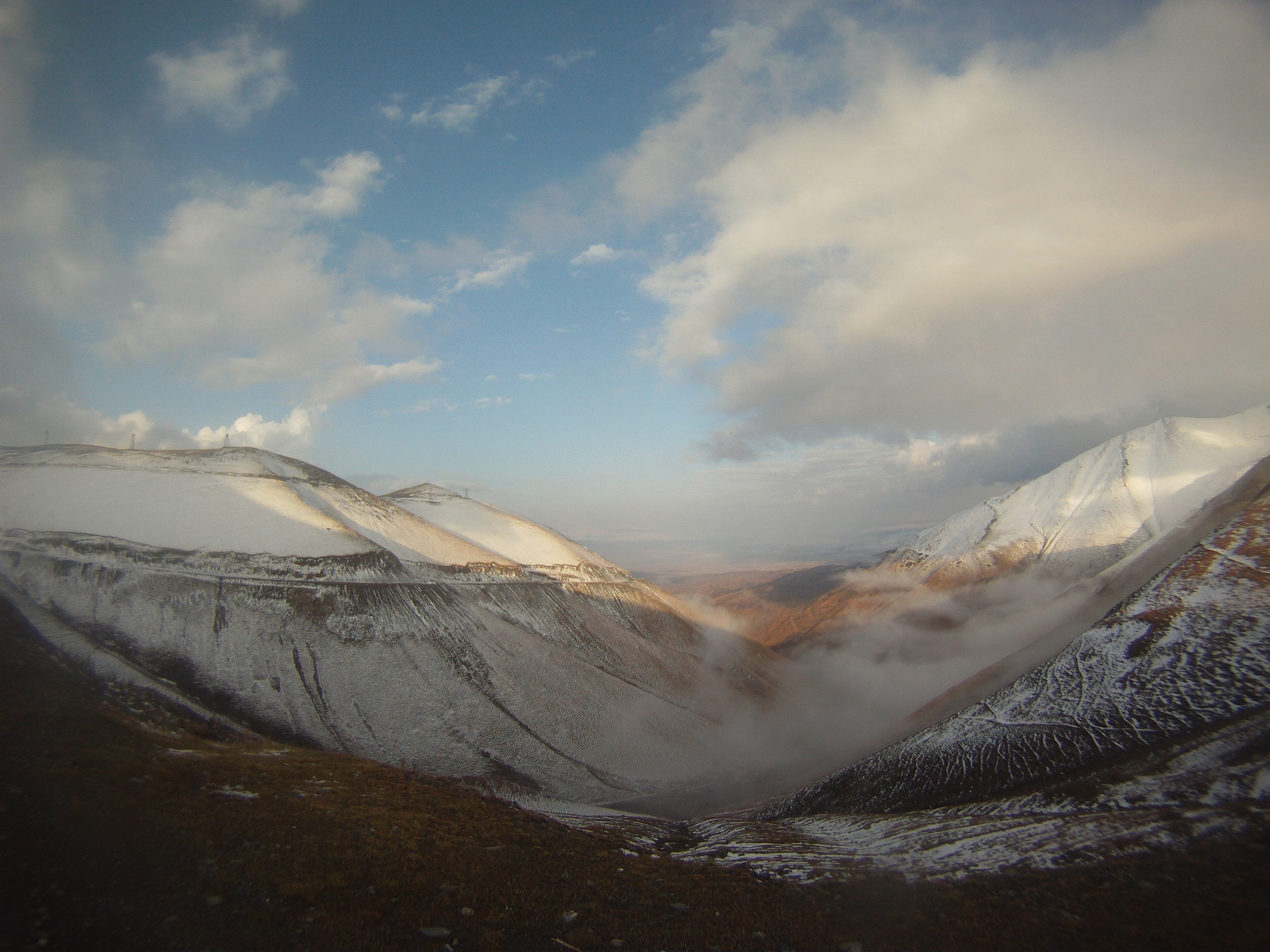
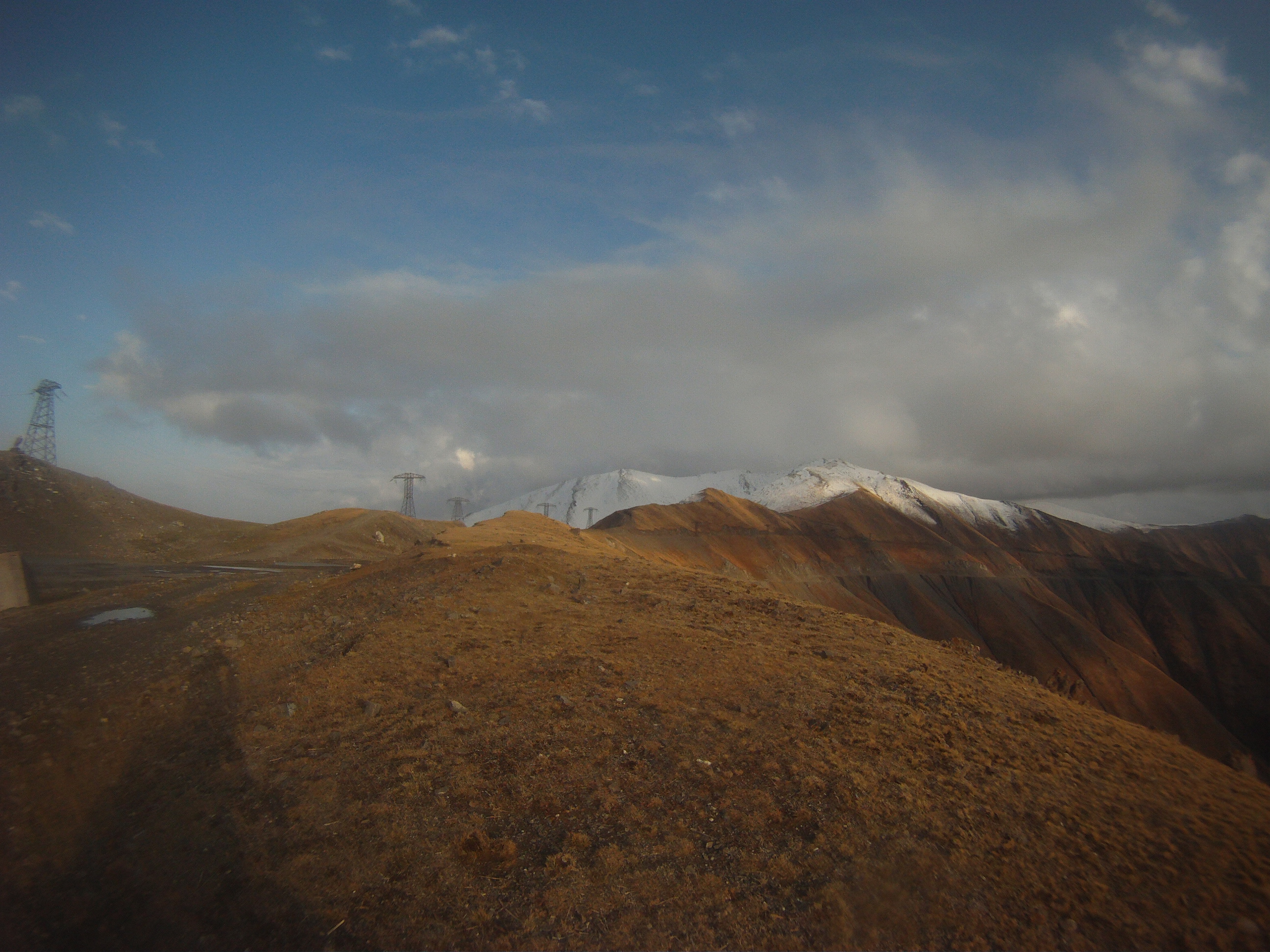
One of the several passes en-route to Song Kol
From Osh, my destination was Song Kol lake, a remote body of water located 10,000 feet above sea level in one of the coldest and most remote regions of Kyrgyzstan. Always looking for a challenge, I chose the most difficult route, traveling 400km on rough, muddy, unpaved roads following the river as it passed through desolate valleys, and tiny villages. Foreshadowing the difficulties I would experience on the journey, I departed on a cold, rainy day. The weather report had forecasted sunshine but as always in Muslim countries Inshallah “God willing”. The rain became so bad that I spent the entire second day in my tent perched on the edge of a cliff, teaching myself the Russian alphabet and patiently waiting for the storm to break. With a few zip ties and alligator clips I was able to make a small window in my tent so I could at least look at the snowy mountains I would be crossing soon. After 36 hours, half a bottle of vodka, and a few naan, the sun finally came out and I pedaled to the city of Jalal-abad where I hit the local Bazaar for supplies. Jalal-abad was a warm city with a small university. College students traveled around the busy streets on vintage Chinese bicycles and older folk lounged and drank tea in the park. A very friendly city, with plenty of resources for the traveler.
Kyrgyzstani local who invited me for lunch near Jalal-Abad
An hour and a half and $20 dollars later I had the following items stuffed into my panniers;
A pair of black sport shoes, 1 lb of raisins, ¼ lb. of kebab spice, ¼ lb. of chilli powder, 3 lbs of eggplant, 2 lbs of onions, ¼ lb of soup base, 1 lb of paprika, 3 heads of garlic, ¼ lb of fresh chilli peppers, 3 lbs. of apples, 3 large naan, 2 somsas, 1 pack of cigarettes (for public toilet use), 1 liter of gasoline, 1 liter of water, 1 liter of fermented cow milk, 2 lbs. of sugar, 1 liter of oil, 1 lb. of pasta, ½ liter of vodka.
The sun finally comes out
With a Gabriella exceeding 55 kilos, I pedaled toward my first mountain pass. The summit was completely covered in snow and after 3 hours of slowly climbing switchbacks I encountered a group of drunk Kyrgyzstani’s drinking vodka and shooting a shot-gun. They quickly invited me to some bread and cold lamb and gave me a few shots of vodka because “It’s going to be so cold at the top of the mountain”. Refreshed and with a slight buzz I climbed the rest of the pass and nearly froze as I descended 6,000 feet in a shadow. Finding water is never a difficult task in Kyrgyzstan, but what is difficult is find it in an area where there is no livestock. Even at the summit there were sheep droppings and cow dung, does Giardia propagate in such cold conditions? I didn’t want to find out so even after finding a relatively clean source I boiled all water I consumed, this would be my practice throughout Kyrgyzstan, however I doubt that boiling water at +10,000 feet does much to sanitize.
Icicles at the top of the pass
The next afternoon, after pedaling hours along a brown river I stopped at a small house to ask for fresh water. The owner invited me inside and I walked past stacks of cow dung collected for combustion during the harsh winter. After filling up my water containers I was offered fresh-baked bread, kefir, and candy, I was even offered a place to sleep but decided to continue down the road to find a secluded campsite. While loading up Gaby with the new-found supplies a Land rover with a German license plate passed and pulled over. How funny it is to see western tourists in remote regions! A well-groomed couple, with clean smelling clothes got out of the car and came over to greet me. They had both gotten fed up with their desk jobs in German and decided to sell everything and hit the road, two months later they were in Kyrgyzstan. They had an extremely fancy Rover that had a tent built into the roof of the car. They talked of cooking sausages and drinking cold beer and I quickly asked them where they were going to camp that night. They seemed a bit concerned that it was getting too cold to sleep outside but I convinced them that my worn single ply tent was a lot colder. Unfortunately, after we said goodbye they drove off and I never saw them again. I could only dream of pork sausages and beer.
After an extremely frustrating 10,000 foot climb, (switchback after switchback with what seemed like no end in sight) I descended into a huge valley, flanked by tall snowy mountains. At an elevation of 5,000 feet the valley floor offered a warmer campsite, and after talking with a few locals I learned that Song Kol lake was completely covered in snow and that the road was closed.
Road to Song Kol
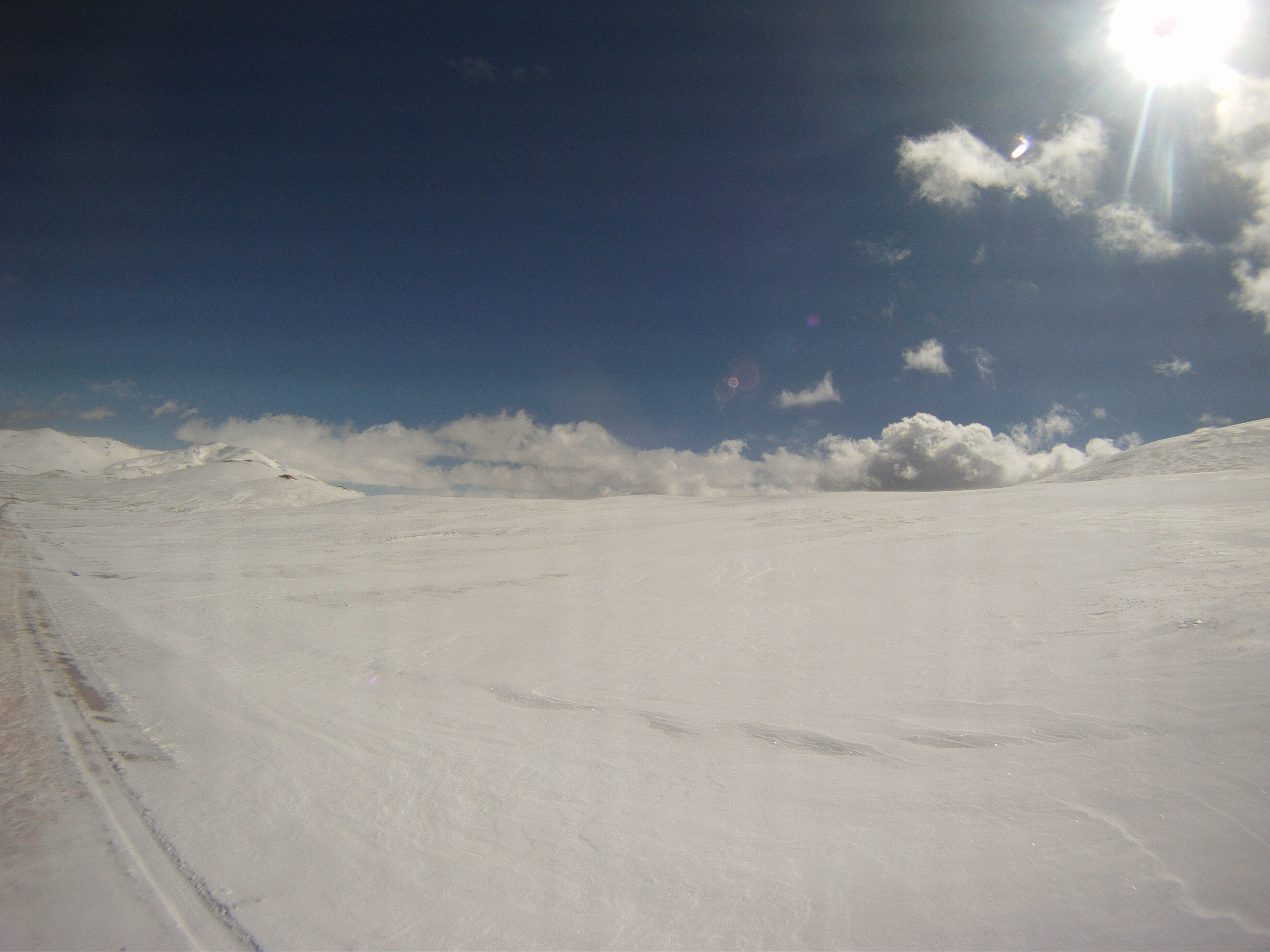
It had taken me close to 5 days of hard riding to get out here and at this point I was not about to turn back. With the thought of sleeping in the snow at an elevation of 10,000 feet I went from door to door in the local village looking for extra clothes. I quickly found a thick wool jacket and along with some vegetables, pasta, bread and vodka pedaled the final pass to Song Kol Lake. The last 2 km were covered in snow and ice, requiring excessive patience while pushing sockless in the cold snow. From the summit I looked down at the Song Kol and realized that I was about to descend into a large crater, similar to that of Crater Lake in Oregon. A real winter wonderland in mid-October, everything was white with fresh snow and only the turquoise color of the lake broke the repetition of color. Somewhere, past the lake was a small road that would take on to the Capital city where I would connect with my flight to Japan.
Gaby at the summit
I pushed on from the summit and slowly made my way toward the lake. The snow had a muted effect on the sound as the crater was completely silent. Once in a while the wind would pick up and a small howl could be heard but other than that, the area was devoid of life. The sun set as I arrived at the muddy banks of Song Kol Lake, tired and freezing I set up camp for what would be one of the coldest nights of my life. The ground was too icy to push my tent stakes into the soil but my tent quickly froze to the ground, and required no extra help to keep stationary. Within minutes of the sunset all my water began to freeze. A thin layer of water would freeze instantly in a pan or on the ground, and my thermos of hot tea froze inside my tent! I slept with all my layers of dry clothes and my new wool jacket but had trouble moving about in my sleeping bag because my body became so large with all the excess fabric. My pattern of sleep for the night was the following; 2 hours of sleep, 1 hour of shivering, and so on until the sun rose. By that time everything was covered in a layer of ice, and all my water was completely frozen.
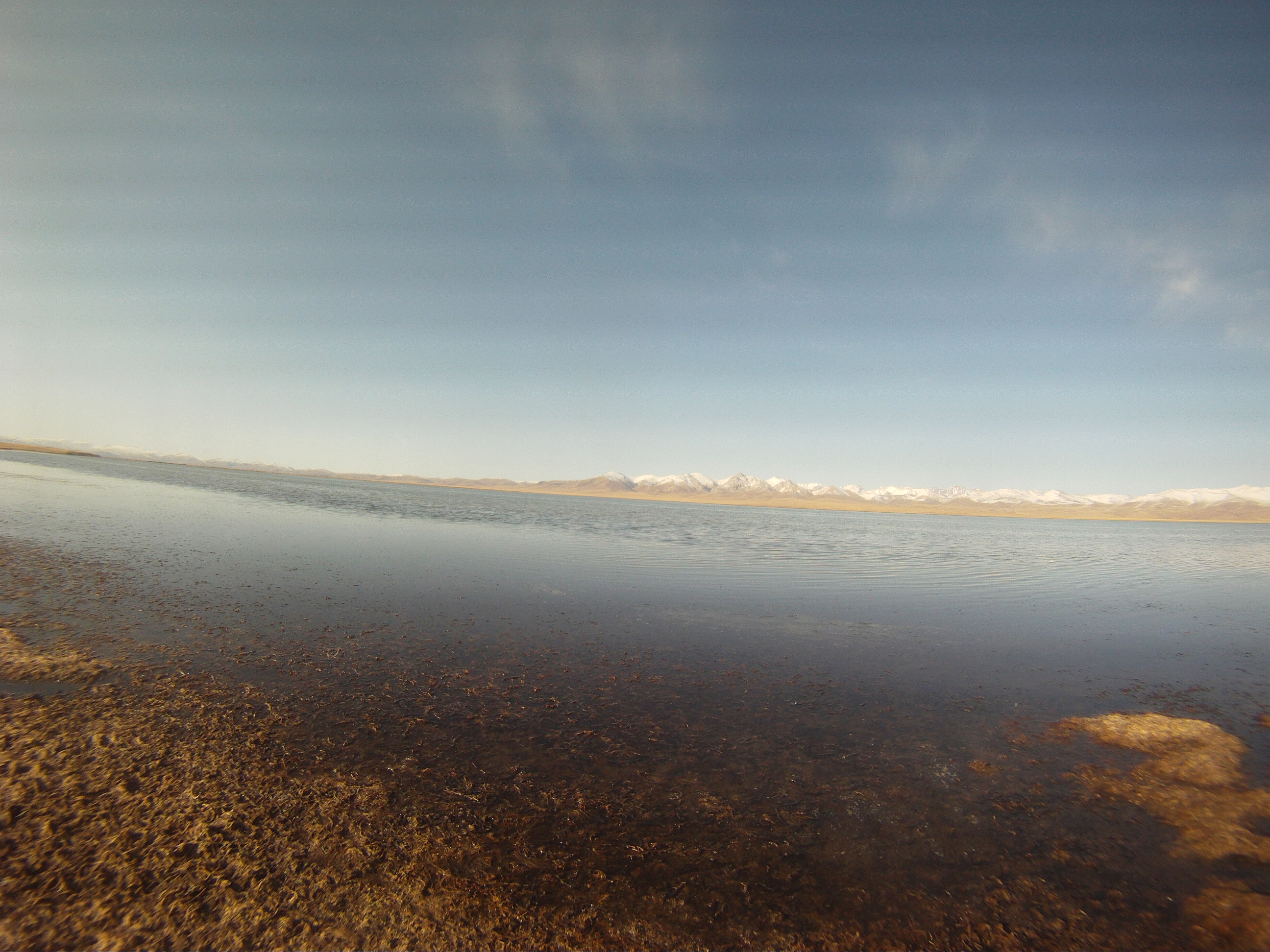
Song Kol Lake on first visit
It was too cold to stay another night; I packed up and headed in the direction of Bishkek. Again the road was covered in snow and required hours of pushing before I finally dropped down to a temperate altitude. I made up my mind to head to warmer conditions and leave the mountains behind but a few days later I met a Japanese couple, Keiichiro and Yuki, who inspired me to return to Song Kul. Keiichiro had been traveling by bicycle for over three years but moved very slowly, as it took him close to 3 years to pedal across China (Shanghai to Kashgar) . His partner Yuki, was an intensive Care nurse who after working several years decided to give up a career for the open road. They had been pedaling together for three months and were now headed for Uzbekistan. After a night of vodka and Chinese Hot Pot (Kei carried over 2 kilos of condiments including many hard to find Chinese soy and Chili sauces), I decided to join them the next day and travel the difficult road back to Song Kol Lake.
Yuki and Kei pack their mountains of gear, Kei was not a fan of a bump ride so had his tires at half pressure
I should have paid a litter more attention when Kei said it took him close to 3 years to cycle across China, because this Japanese couple was super slow!! The first 30 km approach to the pass took them all day, and the next day when we climbed the pass I had travel back down to push Kei’s bike up through the snow. They were such a sweet and carrying couple though and even though it was a few hours from dark didn’t seem to be pressured by the quick onset of below zero temperatures. Kei even wanted to stop and help a ground of 5 men push a car through the snow but I convinced him otherwise.
We camped by the lake for 2 days and I quickly learned that Kei and Yuki could speak some Chinese. We had many funny conversations and told stories of our travels in China. In the two days we spent together, I also had the opportunity to learn what random items Kei carried in his bulging six panniers. (His rear rack was stacked so high that he could lean back while pedaling). He was the type of guy who could not throw anything or give anything away so he carried many items that he had never used. For example he had a 20 foot roll of X-mas lights he had gotten in China, a full color printer and scanner, 4 I-phones, a Mac computer, two tablets, two sets of speakers, two solar panels and a movie projector! When he set up camp it was like a DJ preparing for his set, Kei had wires and electronics everywhere! Both of them really liked Japan Pop so in the silent serene atmosphere of Song Kol I listened to sappy Asian love songs. Kei also had a special tempura cooking set, and two fishing rods but we couldn’t catch anything in the lake. At night I joined Kei and Yuki in their handmade Gor- Tex tent for movie night, Kei had close to 5 GB of bootlegged films, but we watched the 90’s classic Cool Running’s instead.
Fresh water from melted snow flows down the crater to Song Kol Lake
The evenings were just as cold but did not seem as bad with company. Kei worked hard to make Yuki comfortable and throughout the freezing cold evening I could hear him boiling water to make their sleeping bags warm. This is extremely classic among cycle touring couples, where it seems that the man has to put in a lot of extra effort to make his women comfortable. Once again it’s not bad being alone.
Song Kol
I woke up on the third day with a bad headache and decided to depart. I wasn’t sure if I was getting the stomach flu (Kei and Yuki tended not to boil the water, but rather make it warm and I drank a few cups of coffee from them the prior evening) or if I was experiencing symptoms of altitude sickness. It took me a while to say goodbye as Kei and Yuki wanted to depart with me, meaning I had to wait close to 2 hours for them to pack up their gear and push their bicycles to the main road. Luckily enough our paths drifted apart after 3 km as they headed south, and I north. Unfortunately for me by the time I finally started pedaling my way I had come down with a fever and was experiencing chills and breathlessness as I climbed my way out of the crater. I was getting worse by the kilometer, and soon I could barely pedal. I got off and pushed but the Gaby felt like a train. “Fuck!!” I thought, “If I don’t make it to the top of this pass and out of the crater, I may not survive another night down here”. The thought of crawling in and out from under the broken zipper of my tent fly in the snow at minus 15 C, with an upset stomach, forced me to push on.
Slowly I made it down and quickly started feeling better as I got below 10,000 feet. I pedaled passed several farm-houses and eventually found a room with an English teacher in a small village. My fever was bad, I was borderline delirious and she offered me a back room near the barn. “It is cold inside but I will give you a heater” She said. Fifteen minutes later she returned with an old 1970’s Soviet Union heater with a new looking power cord. “My husband works at the power station and he fixed this, it will keep you warm”. I plugged it in and fell asleep only to be awakened a few hours later by the smell of burning plastic, I turned on my headlamp to see that the power cord had melted and was beginning to burn the rug I was sleeping on. I safely unplugged the cord, but was left with the terrible smell of burning plastic, and sheep hair from the rug, and the damp onset of frost.
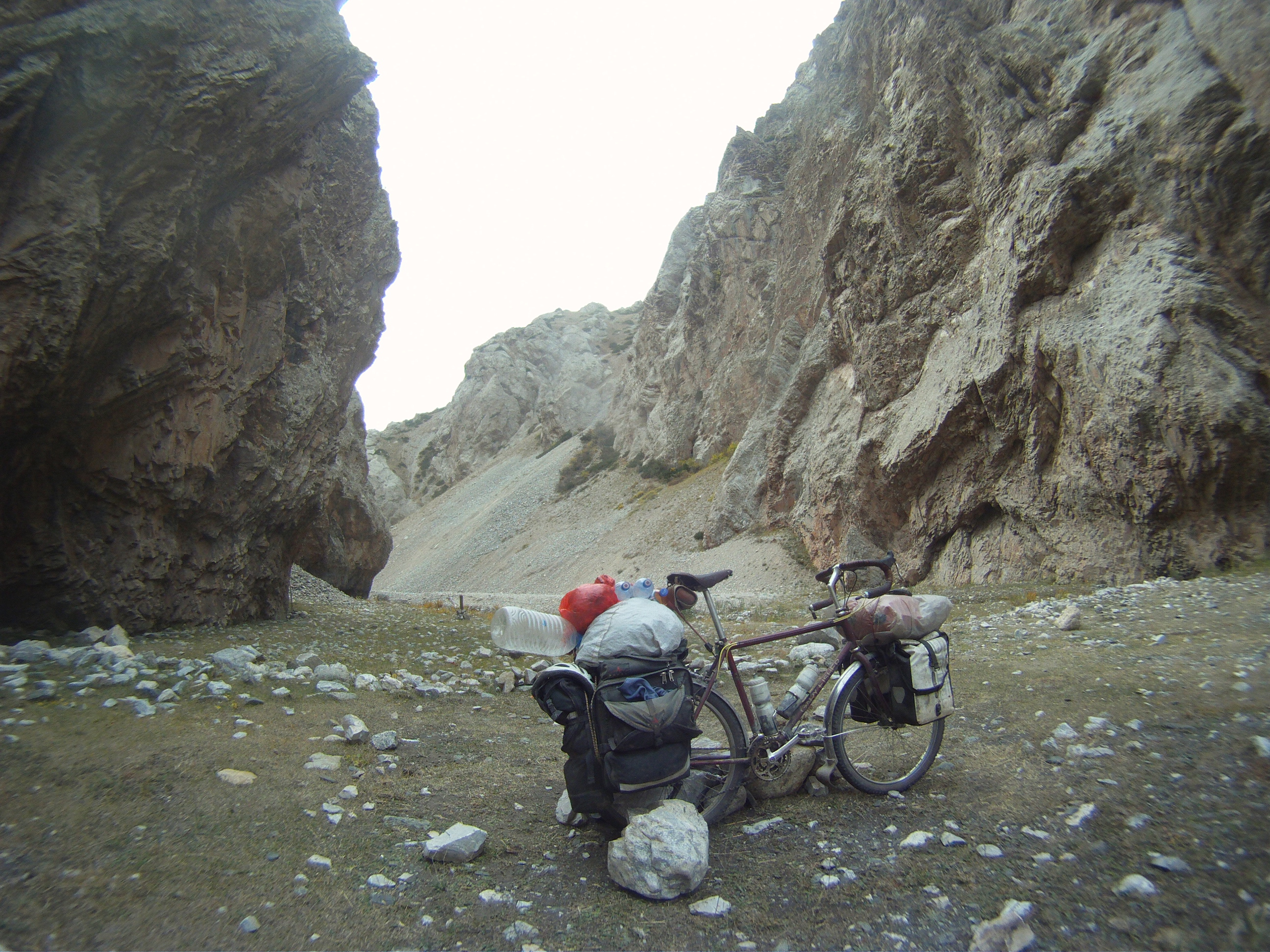
Finally down to a low altitude cycling through a gorge
I said goodbye and pedaled the rest of the way to Bishkek, I was still feeling sick but wanted to get to the capital ASAP to prepare for my coming flight. The English teacher referred me to a guest house in the city but when I arrived I was quickly overwhelmed by the terrible traffic and excessive exhaust. I have not pedaled through a capital city since Baku, Azerbaijan, and had forgotten what its like pedaling during rush hour. Bishkek is by far one of the dirtiest and most polluted cities I have visited thus far, with locals spitting in all directions and cars honking in long lines, waiting at blocked intersections. I didn’t have the strength to continue, so decided to take a local cab to the guest house. After some bargaining I put my bike in the trunk and off we went, but stopped after a few kilometers to pick up more passengers. Before I could ask what was going on I saw two men with help from the driver stuff a full-grown, live lamb into the trunk with Gaby. It was absolutely shocking sight to see a live animal treated like luggage. The four legs were tied, and the men grabbed the animal by its ears, the lamb could do little to struggle as it was stuffed in the corner next to my rear wheel and crank set.
After two hours of driving in gridlock we finally reached the guest house, I unloaded my bicycle and panniers, all my gear smelled terrible as the lamb had relieved itself several times on the journey. As I paid the driver he attempted to go back on the deal saying I owed him more. I refused and tried to leave but he grabbed my rear rack and held me back. “Haram”! (Forbidden in Arabic) I shouted. “Call the police if you want but I am leaving” I said. I pushed away and entered the guest house but was soon bombarded with him yelling outside and pressing the call button over and over. The owner told me to pay him so that he would go away, as he was yelling threats about violence, I told her that if she was scared she should call the police but that I would not give another penny to the dishonest, lying, crook of a man outside. I took a bath and could still hear him yelling outside, “I hope this doesn’t go on all night” I thought, like some sort of protest outside an embassy. I finally got in bed and went to sleep. It is now morning and I have 2 days before leaving for Japan.
Hey friends! I have spent the last 10 days climbing unbelievably beautiful passes and sleeping in sub-zero temperatures. Since pedaling into Kyrgyzstan I have climbed five 10,000+ foot mountains. There are many adventures and pictures to show from the last few days and I will post them soon. I depart for Japan in 10 days!!
A moss-covered lake near the highest pass, Alai mountains
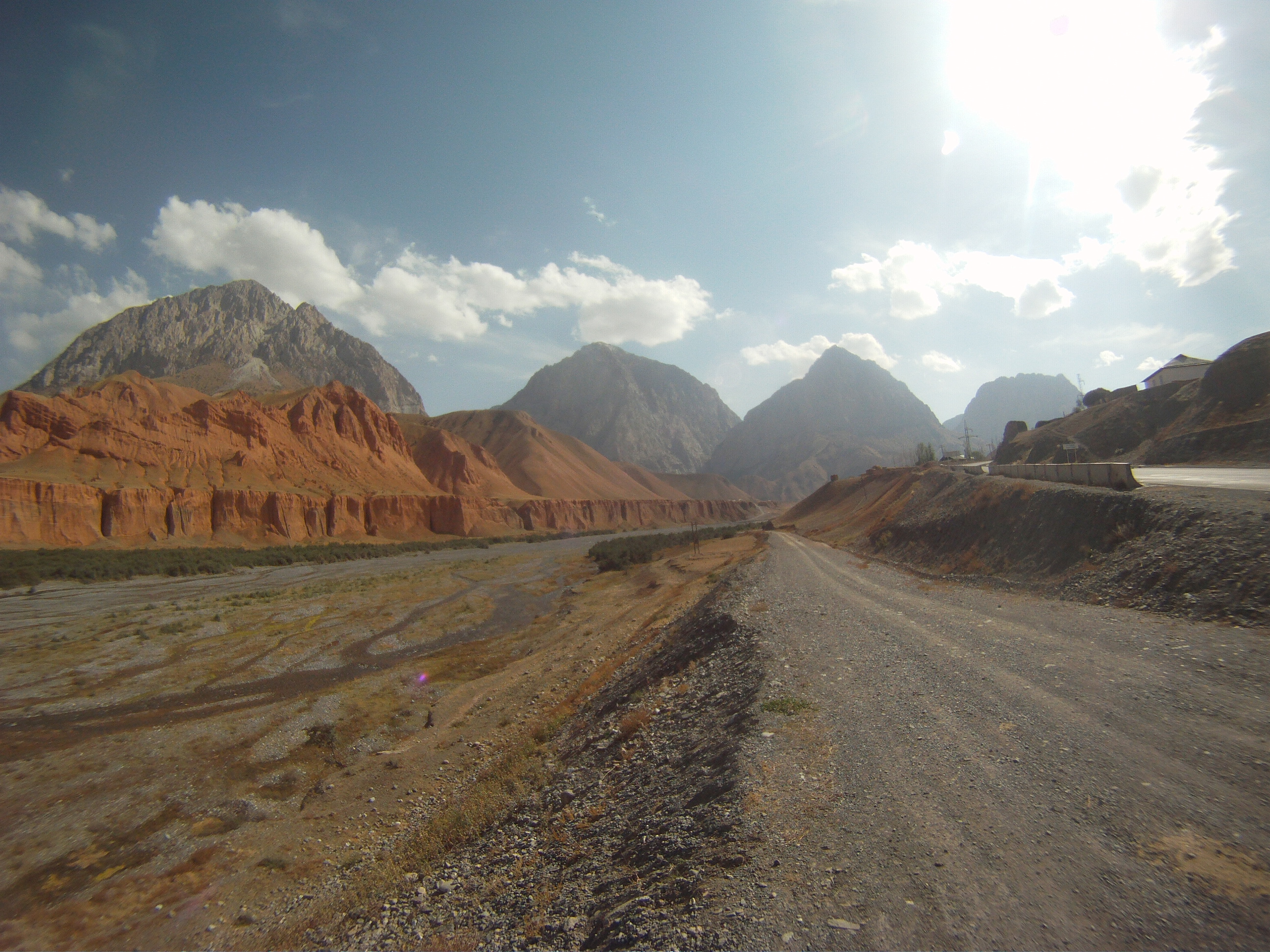
Deep valleys and long canyons on the road to the Pamirs
The polluted city of Osh, Kyrgyzstan offers a brief respite from the hardships of the road. A local three course meal costs as little as $2 and roadside food vendors sell a plethora of fresh comca and dumplings. A culture that would be Chinese had Buddhism been the major religion spends the day working long hours in office buildings and industrial manufacturing plants and evenings in fancy restaurants that line the main strip. A 30% discount on all produce can be found in the morning at the local bazaar where vendors compete for business selling local fruits and vegetables, and arguing over small variations in price. The zealous traveler is quickly reminded of the beautiful countryside when one looks to the south, where snow-covered peaks have an orange glow in the evening sunset.
Looking back after 60 km of climbing
After reading countless tales of Marco Polo and other earlier explorers crossing the vast mountain range separating Tajikistan from Kyrgyzstan, I was excited to for the journey to the Pamir Mountains. It is said that Marco Polo crossed the range during winter time, but after my brief trip to the region I find that very hard to believe. Unfortunately I was unable to receive a Tajikistan visa, as well as GBAO permit which is officially required for travel within the Pamir’s. But from several accounts from various tourists and cycle enthusiasts I heard that there are relatively few check points when traveling through the mountains on the Krygyzstani side of the border. With no rush to get to China, I stocked up on supplies at the bazaar, checked out of my cheap guest house and pedaled south.
Looking down from the highest pass 3,600 meters
Departing from Osh, the two lane road climbed through the Alai Mountains. The small road was often filled with trucks carrying coal from one of the largest coal mines in Kyrgyzstan located in the valley between the Alai and Pamir mountains. When there were no trucks there were herds of sheep and cows moving from village to grazing, and children in uniform walking to a from school. Everyone seems to know the word “Bye” and when cycling through each village I was greeted with waves and “Bye”….”Bye”….”Bye”. The road followed the river, and the first two nights I camped at its side. I watched the landscape change as I slowly climbed above 10,000 feet, trees vanished and hills became barren. The wind also took on a shape edge that seemed to cut through even the thickest clothing. On the third day I awoke to the smell of burning brakes and instantly knew that there was a steep climb ahead of me.
Summit 3,615 meters
Slowly I pedaled from 3,000 meters (10,000 feet) to 3,600 (12,000 feet) climbing the tallest pass in the Alai range. Snow and bits of hail greeted me at the top. There is no break from breathing when cycling at this altitude. By this I mean when I stopped breathing to swallow I would get out of breath. At the summit however the air was so cold that it almost felt like taking a drag off of a cigarette, in that you could feel its contact with the phylum in your lungs.
First glance of the Pamirs
I descended the pass to the large valley between the two ranges, and quickly realized that I was in an environment of extremes. The valley floor never dropped below 3,000 meters, and has the strongest winds in the country. It is not uncommon for the wind chill to bring evening summer temperatures to 0 C, and in the winter the average temperature is -35C! I soon realized that I was ill-equipped to handle these extremes especially as the effect of the elevation slowly permeated my body.
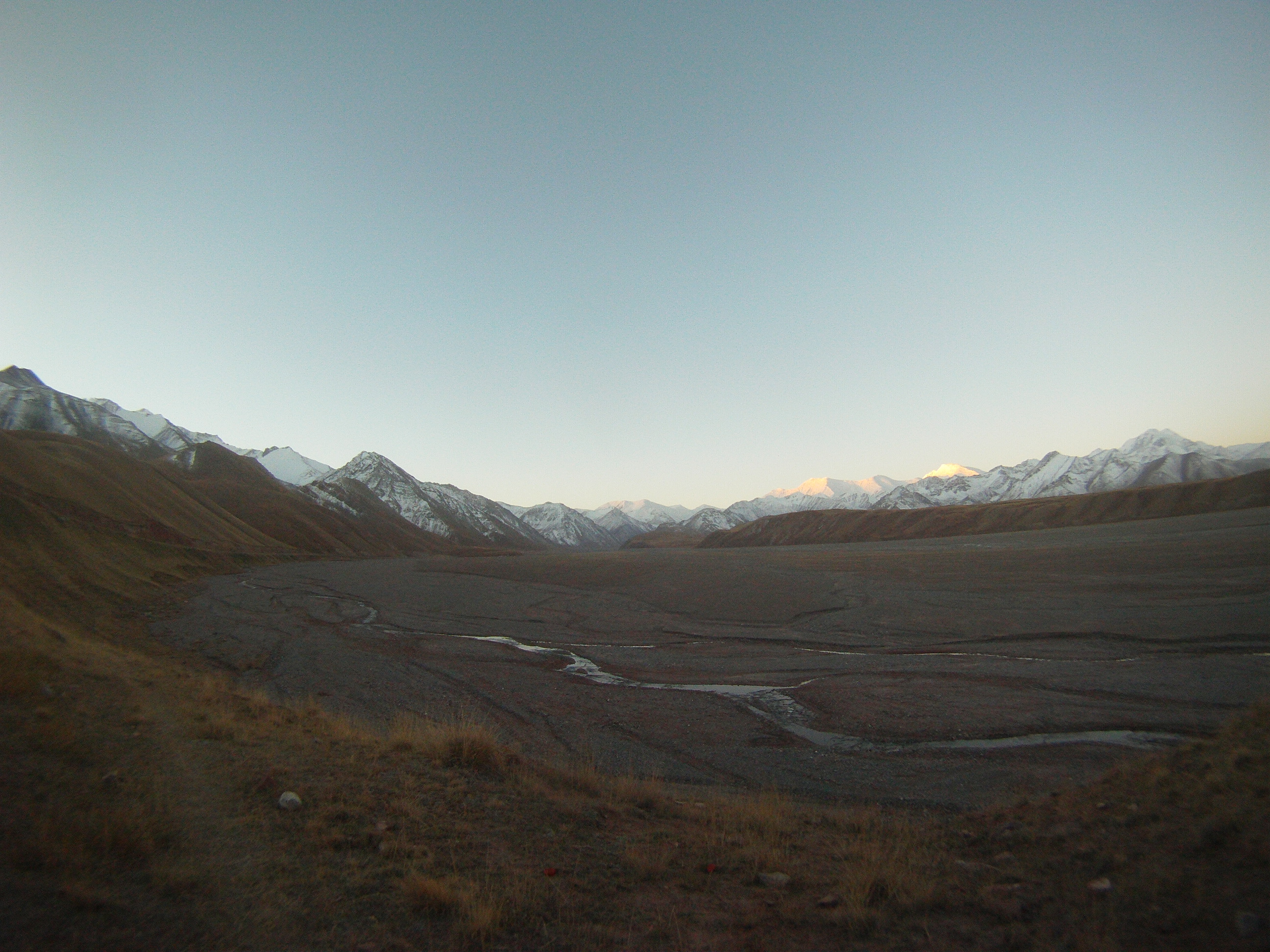
Morning sun on the mountains
I had to remind myself that days before departing for the Pamir’s I had spent a full month pedaling through the arid deserts of Kazakhstan and Uzbekistan, during which my diet consisted of mainly melons, bread and a few tomatoes as heat seldom brings the felling of hunger. On many occasions I pedaled all day without more than a few bites of bread. My body took on a new form, that of a desert nomad handling a daily average of 120 km and temperatures of +45 C.
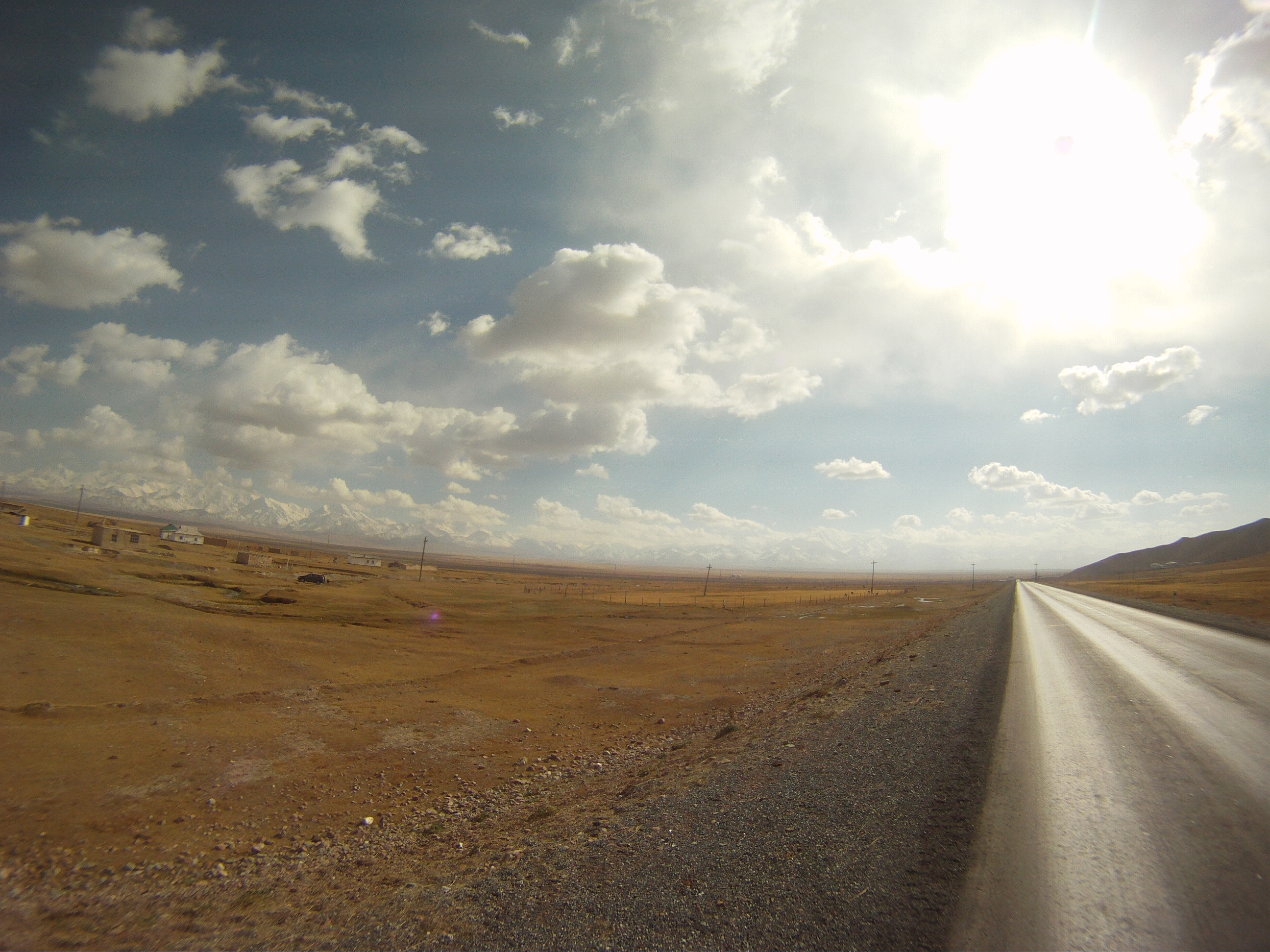
Valley floor facing south towards Tajikistan
Within hours of descending to the valley floor my head began to ache and my limbs felt like they were underwater. However I denied the invitation to stay at a warm guest house and instead loaded up on bread, salted meat, and vodka at the small of village of Sary Tash. I searched for more clothes or even a pair of shoes but could not find more than a pair of wax dipped work gloves that are so bright they seem to glow in the dark.
Camping spot here the base of the Pamirs
Half wondering if I would find myself back in the village again by evening I followed the Pamir highway and slowly inched my way to the Tajikistan border. My first thought was to attempt to sneak my way into Tajikistan but when I got closer to border I noticed that there were barbed wire fences and heavily armed patrol guards. “Maybe they will have drinking water and by asking them they will see how cool I am and will then be obliged to let me enter visa free” I thought. I approached the border and when the patrol man walked up to me I asked “Do you have any drinking water”. He didn’t seem to understand so I asked my second question “I just want to spend one night camping in Tajikistan, do you think you can let me through visa free?” The second question seemed to get through the robust skull of the camouflaged individual, and he laughed. Back to plan “A” I thought so I grabbed my empty water bottle and shook it upside down. The guard then opened the gate and invited me to dinner with the rest of the unit stationed at the post.
Blonde tall grass on the foothills
The guard told me to go into the station and wait in the dining room, not sure which door lead to the kitchen I opened door after door and interrupted some sort of interrogation which almost got me kicked out of the station! Lucky for me my new friend appeared just in time. Soon after I was sitting at a table with 6 armed patrol guards who quickly started to act like normal Central Asians, after the bottle of vodka was passed around. Bread was broken for everyone at the table, and we ate a large chunk of cold lamb fat with chai and bowls of vodka. The guards were ecstatic when they heard that I was from America and quickly asked questions in broken English mixed with Russian about Mike Tyson, Arnold Schwarzenegger and O.J Simpson. After close to an hour of festivities I noticed the sun falling low in the sky and decided it was time to bid my acquaintances farewell. “We have nos, then you leave” a large Russian looking man said to me. “OK”, I said as he pulled out a large bottle from the refrigerator. I had tried “nos” on several occasions in Kazakhstan and Uzbekistan, but Kyrgyzstani nos is an entirely different beast. I was poured a small handful of green pellets the same size and shape of sprinkles. I put the handful of sprinkles under my tongue, one of the fastest methods of delivering a drug to the system. “Holy shit…this stuff is strong” I thought, either the nos was especially strong or the combination of alcohol, nos and elevation had just gone to my head. I felt like I was completely drunk and about to vomit so I jumped on Gaby and pedaled away so that I could be alone in my discomfort.
Water from the spring
I pedaled back in the direction I had come and passed a small spring unnoticed on my arrival. The cold, clear water had a sobering effect on my mind and I decided to camp nearby. The drilling in my head continued but the sound of water kept me calm.
I am not sure exactly how cold it got that night, but I awoke the next morning with completely frozen water bottles and icicles all over the inside of my tent. However the cold sensation could not distract me from the morning sun gracing the snow-capped mountains. Tall, blonde grass swayed in the wind, clear passed over timeless rocks and the Pamir’s overpowering presence had a magnifying effect on my heart. I was completely surrounded by snow-capped peaks all over 4,500 meters. I spent the next 3 days camped near the spring deep within the Pamir’s. Each day I would walk over the smooth rocks in the valley and climb small peaks only to realize that the beauty was unchanged. The evenings were just as soulful as the daylight hours, for when the sun went down the galaxies appeared. The evening sky was split in two by the white Milky Way glob. The evening begins with the fall of Scorpio in the south and the rise of Orion in the north. Freezing and wearing all my clothes I would delay putting on the tent fly, completely enthralled by the Kyrgyzstani night sky.
Remote moss lake found while hiking the Pamirs
It was on the third day that I noticed cumulus clouds and felt the wind picked up. Like a large white sheet, fresh snow was being blown off the top of the large peaks, making each peak look like it had a tail. The morning sun was covered in a thin layer of grey clouds, and I could feel a change taking place. I decided it was time to break camp and find a valley at lower elevation where I would be safe from a snow storm. I pedaled 50 km towards the east and took side roads that lead me to a gigantic coal mine. The mine was noticeable from miles away, in that it looked like a volcano of ash. Surrounding the mine was a workers camp made up of trailers, mud brick houses and broken beer and vodka bottle. Pedaling over inches of crushed coal I rode through the camp only to notice that it was empty. I continued on and followed a small river around the mine and into a canyon. The wind continued to get stronger, and my fingers and lips began to feel numb. I quickly needed to find a place to hide from the storm, as it was getting dark and colder. Finally I came upon a large rock that had an enclosure which would protect me from the wind and rain. Without much thought I quickly set up camp but not before the rain brought down a small avalanche of rocks from the top of the large rock. “Shit that was close” I thought, I could have been sleeping when that happened!! My tent and ground tarp were now soaked and I looked around for another place to camp. “What would Baba do” I thought? I am too tired to go on and there is no shelter here from the wind. I mustered all my remaining strength and picking up large rocks from the river bed built a temporary wall in front of and behind the tent. The rock wall had a noticeable effect on the wind. The sun fell and the wind slowly died down. I set up my tent a second time.
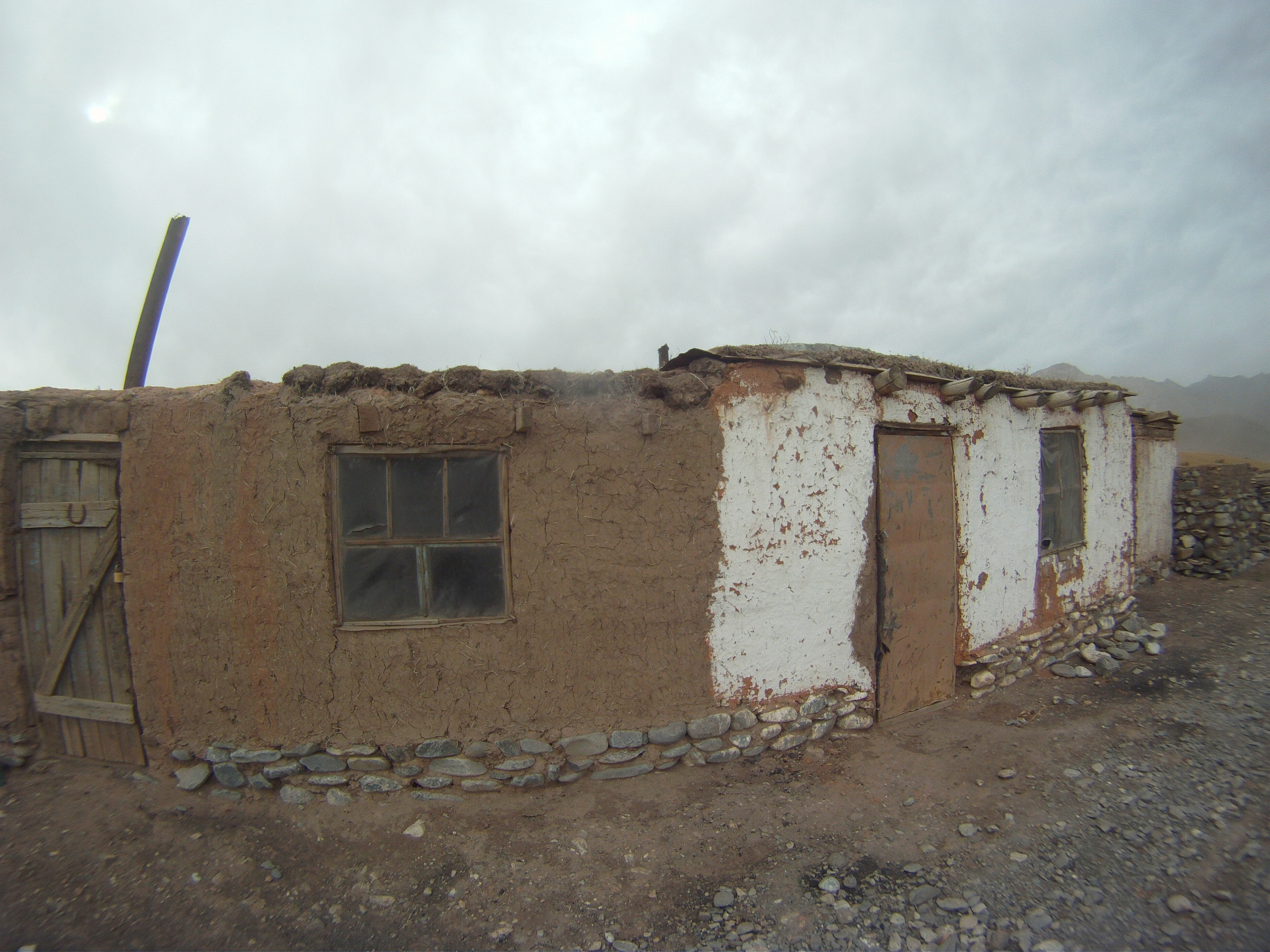
One of the many abandoned mud houses near the coal mine
Packing up to leave valley where I built rock walls to protect from wind, large rocks are propping up Gaby
Soon after the wind picked up again and was so strong that my tent began to rip. It was pouring raining but I had no choice but to leave the tent and find more rocks to hold down the tent from the wind. After about 20 minutes of work I was wet, cold, hungry and I couldn’t even get my stove to start because of the wind. I searched my panniers and found a packet of soup mix, I mixed it with cold water and drank it with mushy, rain-soaked bread.
Once again the open road
The next day it was time to depart and head to a lower elevation. I climbed again the large 3,600 meter pass but quickly descended below 3,000 meters. Once again I saw trees, animals, and inhabited villages. The evening temperature was well above freezing and for the first time in 4 nights I slept well!
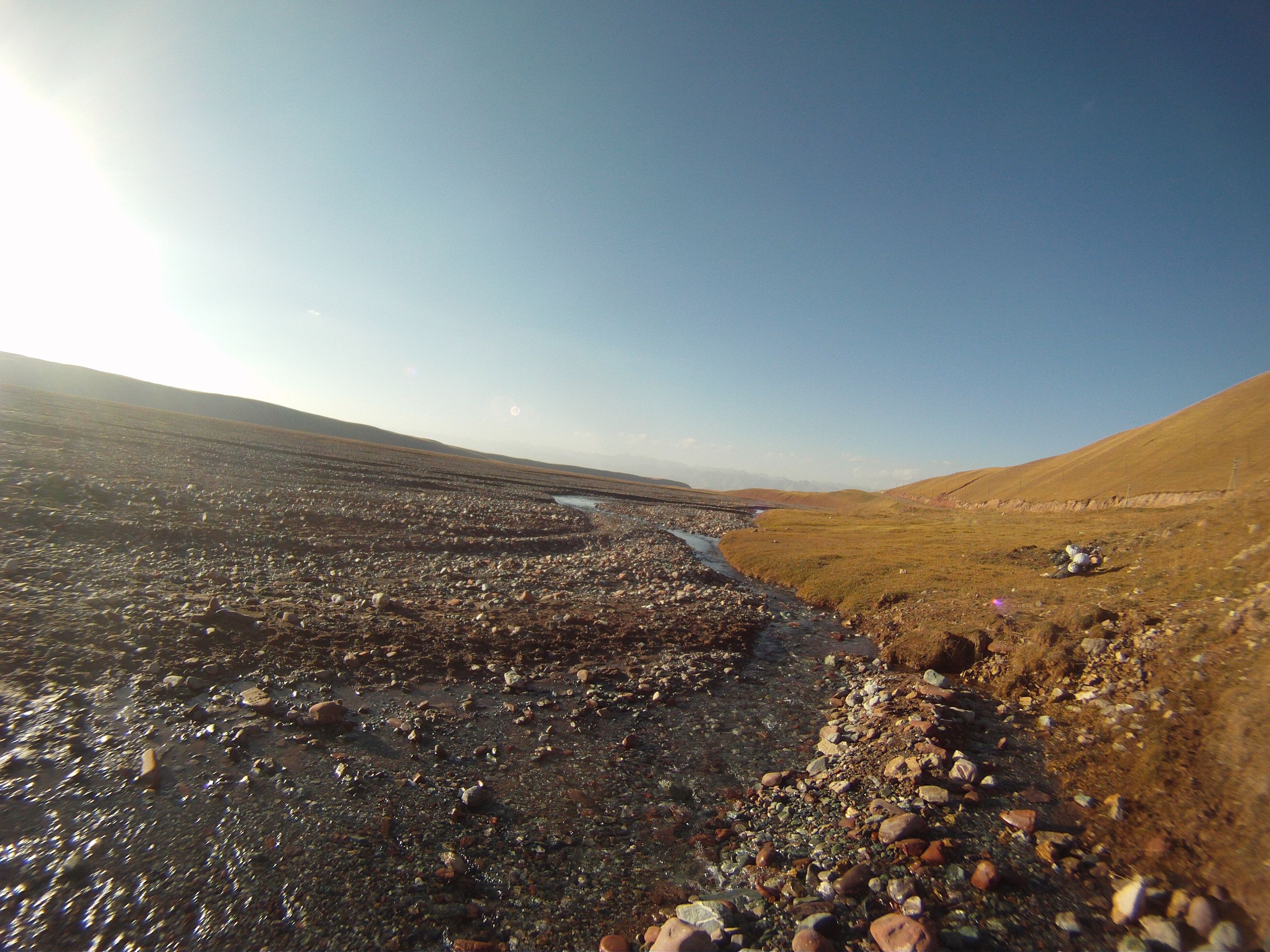
Lower elevation river campsite
Departing through road valley roads
I am now back in Osh and am soon departing to explore the northern regions of the country. I have booked my flight to Japan and will be flying from Bishkek (the capital) to Sapporo on Oct 21st. There is plenty of remote mountainous territory here; I just hope I can get to it before the snow does. Tomorrow I head north to Jalalabad and continue on dirt mountainous roads to the remote lake of Song Kul. I will then cycle to the nature reserve around Issyk-Kul lake, visiting the historic city of Karakol and then on to Bishkek. My posts in Kyrgyzstan will be infrequent as there is no internet to be found outside the cities. I will touch base again as soon as possible.
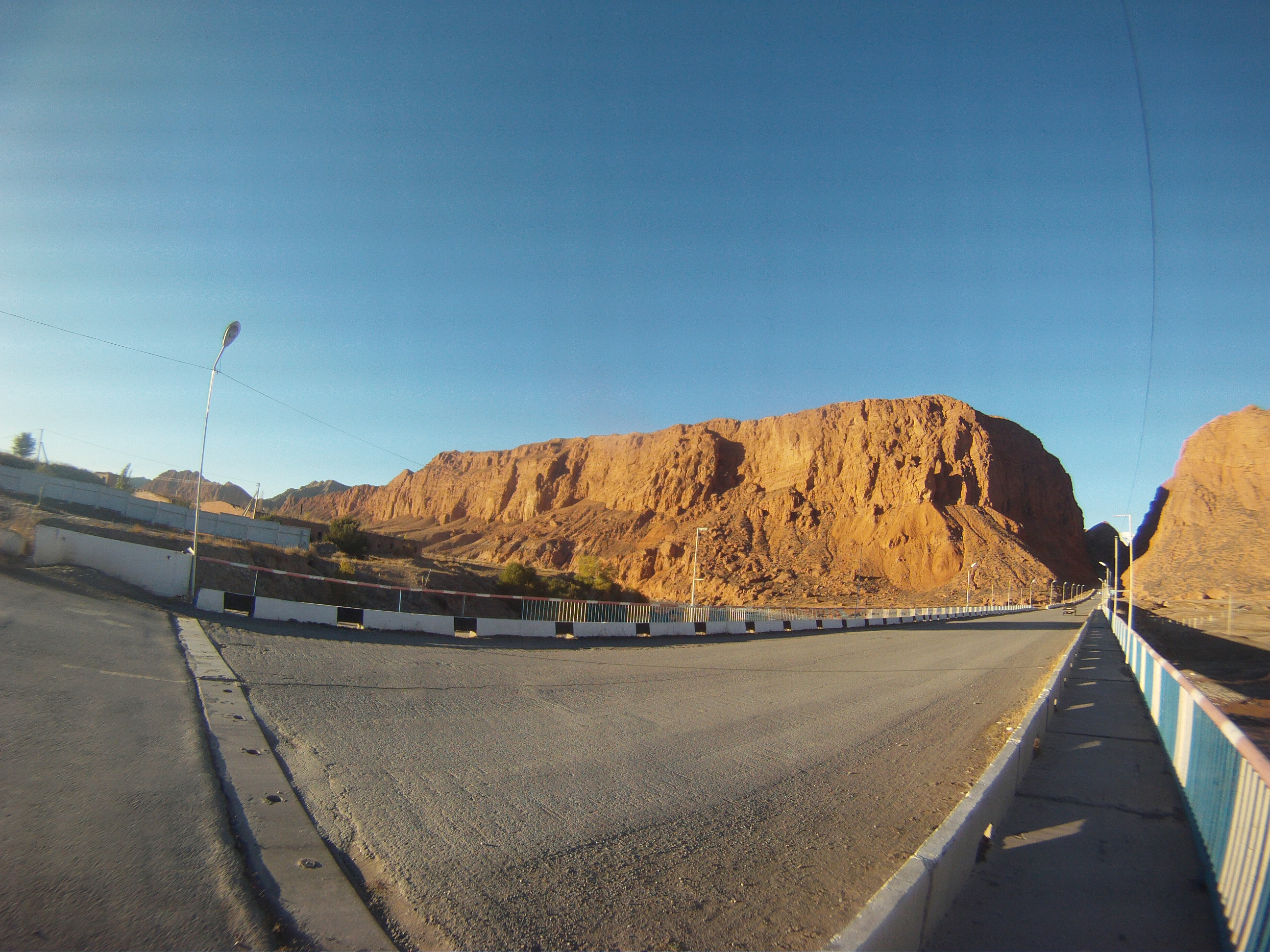
Pedaling and climbing through the Fergana valley. I was pushed by a strong tailwind, dust-covered the sky, trees and road, and I saw the sign “Qashqar 450 km. September 21 less than 300 miles from China
A work of art, and a gift from the baker fresh Uzbekistani naan
I have just crossed the border into Kyrgyzstan, and am in many ways sad to leave the remote country of Uzbekistan. Hours ago I left a beautiful Uzbekistani woman behind, probably never to return or see her again. The last ten days have been full of challenges, and random encounters with spiritual individuals. My health has not been good as more than once now I have been sick from consumption (Vodka) and roadside food stands. It seems that on almost every opportunity imaginable (gas stations, super markets and restaurants) I am met by friendly locals who quickly pull out a bottle of local vodka and start filling rice bowls. No sipping, and your only hope for survival is that there is plenty of bread on the table.
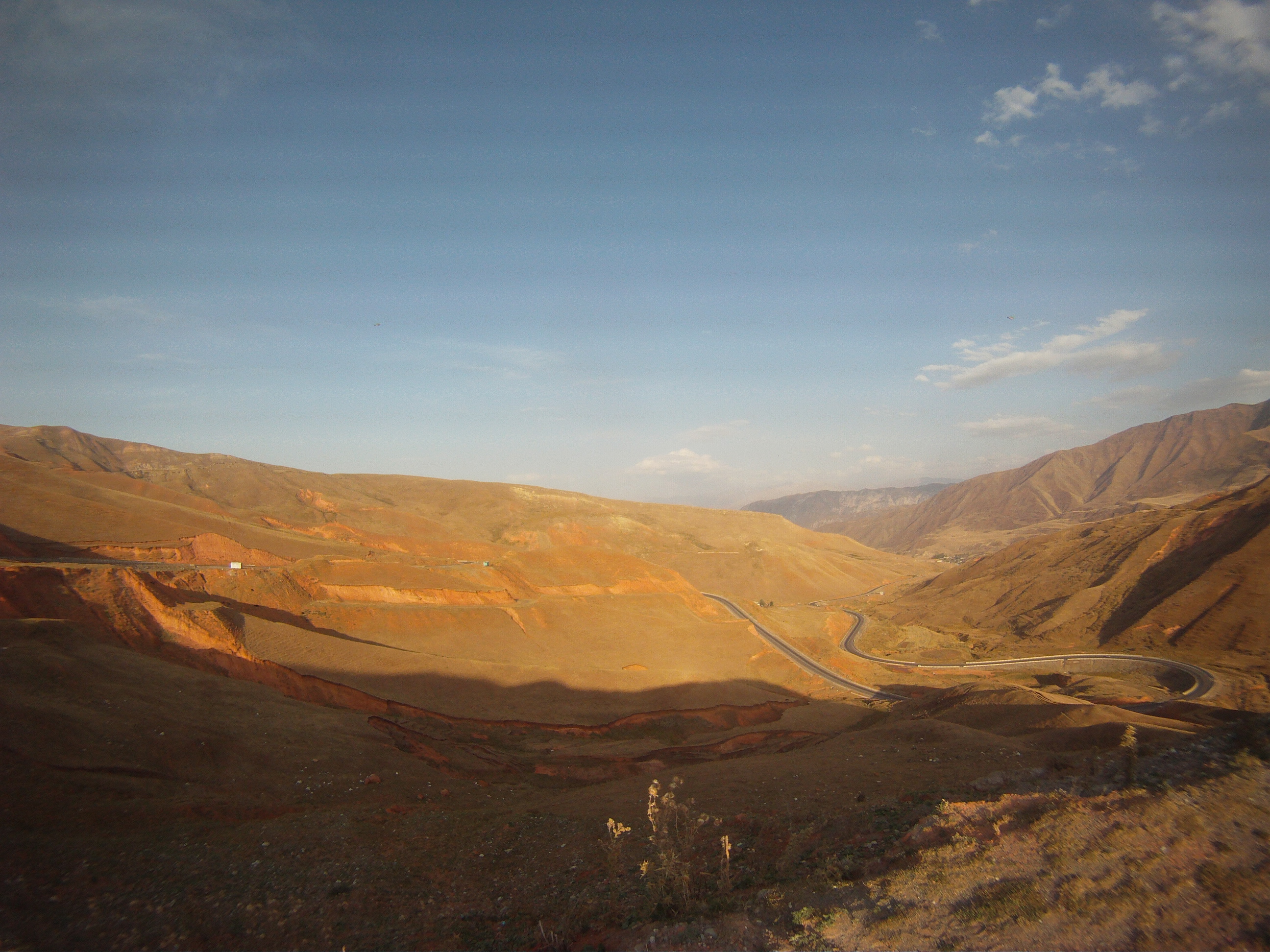
Dry, desolate mountains as I pedal down through the Fergana valley
Uzbekistan, has by far the most abundant use of bicycles. Children, not yet tall enough to reach the seat or make it over the top tube, pedal with body slanted to one side, trying to keep up with me as I pass. Teenagers, and young adults pedal their girlfriends and wives on the rear rack home from school and to work, and older men transport propane tanks, and other various goods to and from their homes. Like all Muslim countries I have traveled to, there is a noticeable separation between the sexes. Restaurants, tea houses, roadside café’s are all only frequented by men, and very rarely do I see couples in public. Women out here work in the cotton fields, produce markets and pharmacies.
Polluted skies and large mountains of ash just outside of the capital Tashkent
The eastern side of the large country was full farmland and plenty of open fields. Each night I camped thinking I was alone only to be surrounded hours later by a herd of sheep or cows, followed by a friendly shepherd with a half empty bottle of vodka. I will truly miss Uzbekistan. It has the most beautiful and hospitable people you could image, where it was not uncommon to have your groceries purchased by a stranger or have your panniers filled with fruit from a smiling farmer who refuses any money.
I now prepare for the steep, cold mountains of Kyrgyzstan. Fall is in full swing here and two weeks ago the mountains were covered in a half a foot of snow. Once again my panniers will be filled to the brim as I pedal towards the Tajikistan border in hopes of viewing the legendary Pamir mountain range. China does not allow cyclists to pedal from the Kyrgyzstan border to Kashgar, so there is no point on entering China yet. I plan to spend 3-4 weeks cycling the remote regions then flying to Japan in mid-October. I will return again to Kashgar in the early spring of next year hopefully with a Pakistani visa, planning to pedal the Karakoram mountain range into the legendary Kashmir region. -Julian
My forbidden shish kebab evening followed by stomach sickness was definitely a story to tell, for those of you who are sensitive to bodily functions such as diarrhea and vomiting you may want to skip the end of this post….. So pedaling through the small city of Ohangaron (About 350 km from the Kyrgyzstan border) I quickly befriended the local baker, who after teaching me how to make the local bread, told me about a super cheap hotel. I personally do not like hotels or guest houses, but in Uzbekistan every tourist must register at a hotel every 3 days, otherwise a fine of up to 8,000 USD can be applied! (This is another story as some hotels will often try to blackmail you if you do not have the correct amount of registration slips in your passport, I only registered a few times but was able to avoid trouble). After a night around town, and eating several lamb kebabs at the roadside grill I found the mentioned hotel. It took me close to an hour to bargain the price down, and half way through my stomach started rumbling in an all too familiar way. At least I will be in a room with a toilet I thought and got a room for $3. After getting Gaby and all my panniers up to the second floor, I fell asleep.
Hours later I woke up with a fever, and terrible stomach pains. The whole hotel was dark, and it seemed that the power was out. I scrambled around trying to find my headlamp and my room key and while holding back the pain fumbled for several minutes on the 1920’s style hotel key, trying to unlock the door. After finally getting out of the room and fumbling again to lock the door, I searched the second floor for the toilet. No bathroom. The toilet was all the way down two flights of stairs and through a long corridor. Once there I learned that not only was the power out but so was the water!! The water must have been off for a while, maybe the hotel had no water as all the squatting toilets were filled with excrement. The sight of the bathroom, accompanied by the smell made me vomit and I decided I would have to be creative and make something work out in my room, as the bathroom was too far and too disgusting. Luckily, my room I had a small balcony, and earlier that evening I had purchased a large 5 liter bottle of water. I dispersed the water to a few bottles and made a make shift toilet by cutting off the top of the 5 liter plastic bottle. I used a few books and a piece of wood found under the bed to elevate my feet, and there it was a water bottle toilet.
All night I prayed that it wouldn’t fill up as I made countless trips to the balcony, my stomach was so painful. I had plenty of antibiotics in my panniers but I always try to avoid them and continue to do so in this situation. By early morning the fever and diarrhea were gone but now I had close to 3 liters of excrement in the bottle on the balcony. No matter how terrible the hotel was, I would never leave that for someone else to deal with. Disguising the bottle by putting it in a plastic bag I tip toed towards the bathroom but was met halfway by hotel staff who thought I was trying to steal “things” out of the room or hotel. I am not sure exactly what this lady was saying but she wanted to see what I had in the bag! “Can’t you smell it” I said and she looked inside, she made a stinky like face then walked away, I guess a 5 liter bottle half filled with diarrhea is nothing shocking in Uzbekistan.
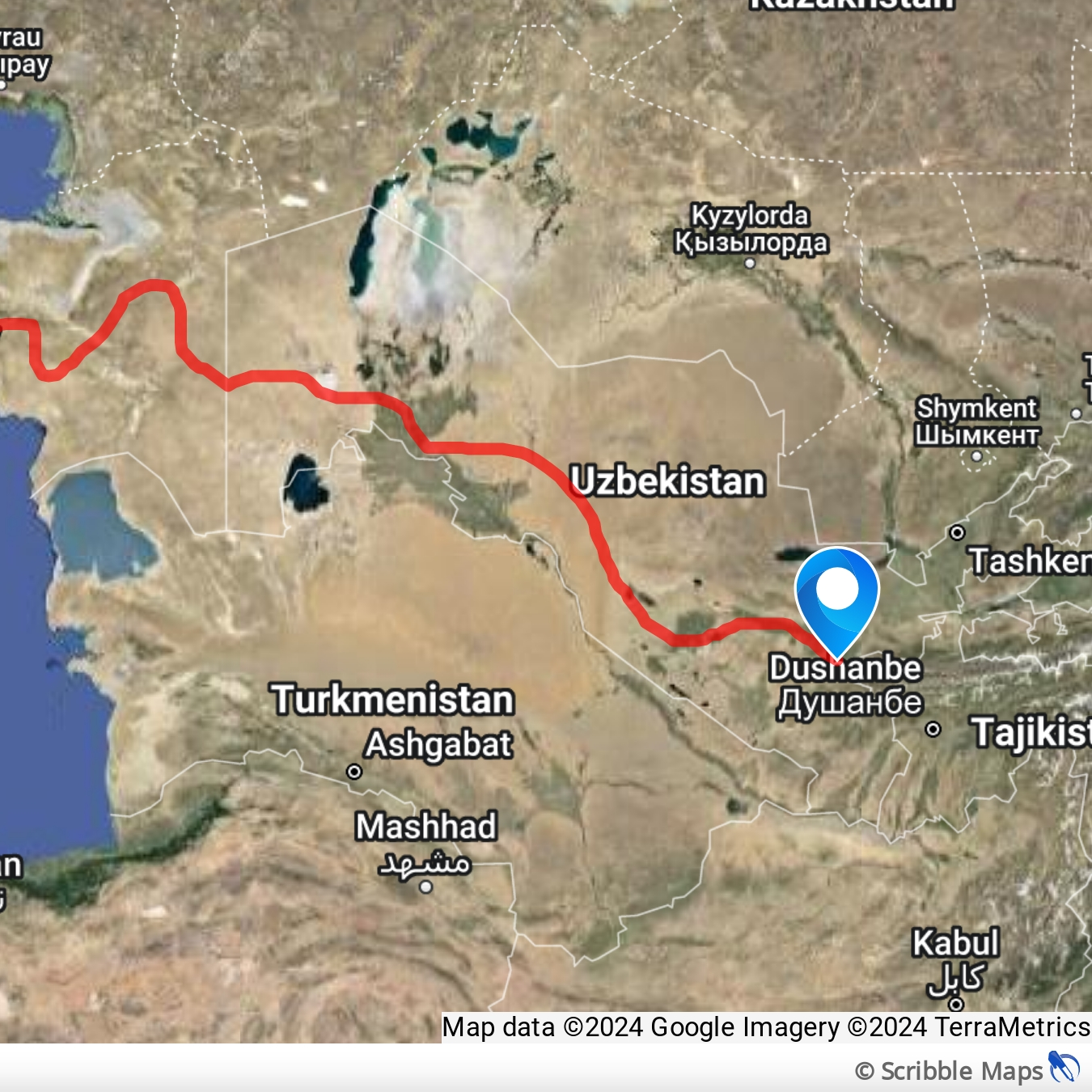
I cannot sleep….. Dreaming would only take me away from what is present; sounds, smells, tastes, tactile sensations, languages in strange tongues all of the ancient spice route linking Europe to China. Frequented over the centuries by caravansaries and traders on the backs of camels. Thousands of years of culture, religion, philosophy and art have all traversed this long, lonely, desert road.
Here we are: The Silk Road.
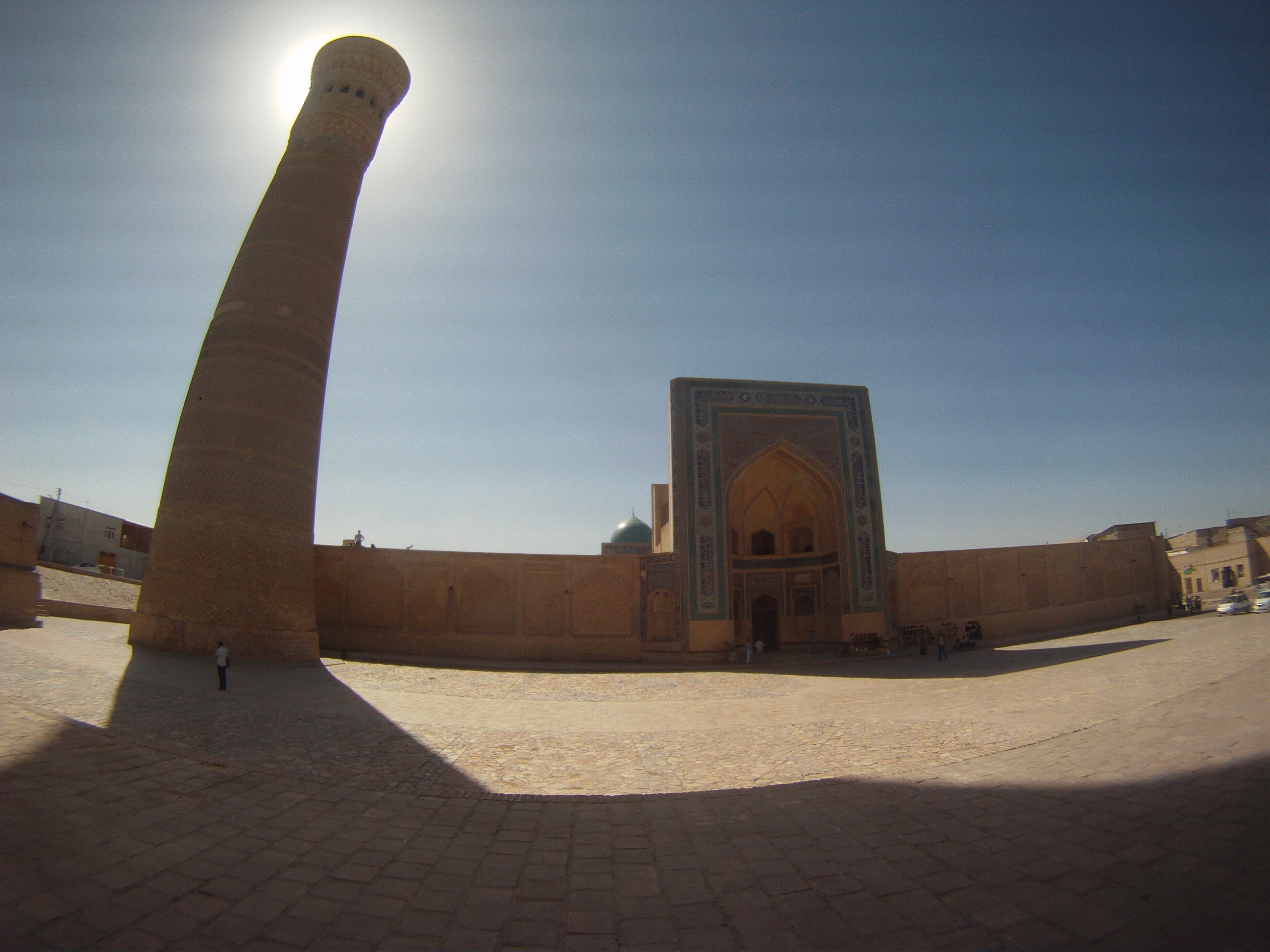
Po I Mosque and Minaret, Bukhara
Corridors inside Mosque, (This mosque was so similar in design to the Mosque seen years earlier in Turpan, Xinjiang)
Quiet, small neighborhoods of Bukhara, my favorite city in Uzbekistan. Some alleys one can purchase fruits others construction tools, some though are just quiet and reflect the past.
I touched off my last post upon entering the city of Bukhara, where I got my first taste of the silk road. I pedaled into the busy, dirt streets of the ancient town. My eyes frequently wandering off the road in the direction of tiled Mosques and listing minarets. Old men and women brushed the sidewalks with straw brooms and city employees in bright-colored uniforms cut the grass with scissors. Bukhara was a city that seemed untouched by the years of development. The roads were filled with potholes, sidewalks were made of clay and business owners poured cold tea on the ground to keep the dust down. I moved about the city for four days, sleeping in a new bed each night. The city was a complete marvel, with a long history of Islamic practice and devotion the Mosques, Madrasas (Islamic schools) and Mausoleums were built to withstand centuries of practice with such attention to detail that it makes one wonder whether he/she has chosen the right religious path.
More of the famous Minaret in Bukhara. Each day I would come to the square and watch the sun slowly fall behind, tracing a half circle, before drifting off into the horizon.
Friday, Juma, service at the old wooden Mosque in Bukhara.
It was Friday when I journeyed to the central Mosque for prayer. After washing and listening to the sermon (Khutba) in Uzbeki, I was quickly befriended by two, extremely dusty construction workers. We talked for a few minutes, I in Russian them in Uzbek. I could tell from the dust on their clothes and faces that they were sanding drywall and I tried to convey to them that this was my least favorite part of the job. They were impressed with my little explained knowledge of hard labor and invited me into the interior of the Mosque. We took off our shoes and I followed their lead by crawling through a narrow hallway covered in a few inches of drywall dust. The lights were dim and flickered as the power cord unraveled under my knees. After a few meters the tunnel gave way to a large interior. Inside I watched workers on ladders painting Koranic phrases in bright blue and yellow, while my new friends cleaned the floor and laid a long rectangular rug. “Kushi” they said (Lunch time). The men on ladders quickly returned to the floor, and we all (about 15 people) sat cross-legged around the rug. A huge bag of fresh naan was brought out, and everyone started ripping the bread into pieces and preparing them in stacks for the up and coming meal. I joined them in prayer, and nibbled on naan, telling them stories of where I had been, watching large plates of pilaf come to the floor. One plate per two, were all shared, passing plates around and ate the rice with our hands, sometimes using the naan as a utensil. I was sitting in single lotus, and was soon asked “Budhish”? I said yes, thinking that they were asking me about my religious beliefs but soon realized that they were asking me if I wanted more food! A neighbor passed me his half eaten plate of pilaf, and I ate everything as a gesture of respect. The best pilaf I have ever had!! The dish consisted of three layers; on the bottom was the Basmati rice cooked in oil and cumin, followed by thinly sliced carrots, topped with lamb.
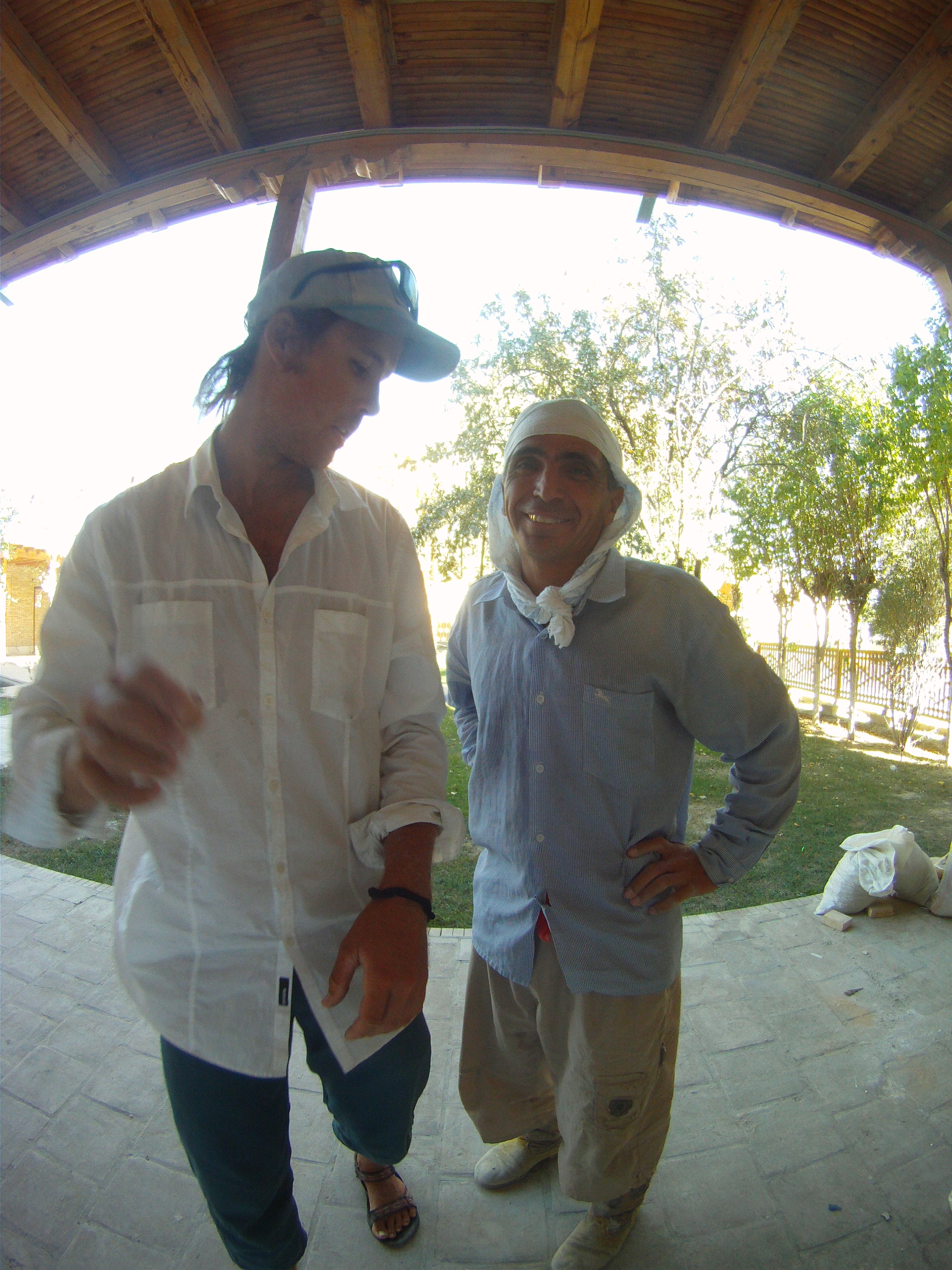
Fellow Uzbeki construction worker Omar Hasian
After two plates I joined the group for tea and noshbi (Central Asian crewing tobacco). We cleaned up, I said good-bye, and they hurried back to work, but not before inspecting my bike and helping me carry it up the stairs.
More local amigos demonstrating the proper method for eating melon, I average about 1.5 melons a day. It is local knowledge that you can buy up to 3 melons for the same price of a 1 liter bottle of soda.
Back in town I ran into two separate solo cyclists, and all of us being the classic solo cyclists, greeted and acknowledged each other, then went off again on our own. Hours later I ran into both of them at the only restaurant serving beer on tap. We drank pint after pint on the dusty village streets and talked about what our lives have been like on the road. Jack, was an impressive architect from southern France, who had been on the road for 5 years, sailing, hitch hiking and cycling the globe. Probably in his forties he was currently renting his flat in Paris and earning money while traveling. He had countless stories of the beautiful yet simplistic life in the south Pacific, and recommended visiting East Timor on my journey to Indonesia. Pascal was a true nomad, with a long beard, and honest, kind eyes. He had been a software engineer for the past five years in Australia and was now making his way back to his family in Quebec. I am not sure how to describe it but I felt a deep-rooted connection with the two of them. Of the few cyclists I have met most fall into two categories, those that are pedaling toward some sort of social acceptance/approve, and those that are obsessed with physical challenge. Very rarely do I meet two, enlightened human beings who are just here to witness and enjoy the remote parts of the world. We talked till 11 pm the Uzbekistan curfew, and then we bid each other farewell.
Gaby waiting outside the Bazaar
I left Bukhara with refreshed spirits and pedaled on towards Samarkand. Day one, brought me to a small village with a fragrant aroma of spiced meats and fresh-baked bread. I dropped in to a local roadside café and ate noodles, pilaf and a liter of beer for less than $3. I then slept in a local dormitory, too tired to venture out again for $4. The desert has a way of slowly changing you. It has left its mark on everything I own, from my head to my fingernails, my sandals and sleeping bag. Almost as if time moves faster out here I watch as my gear and body slowly wears away.
The original Silk Road, this was used for countless years before the highway was put in
Getting closer to Samarkand the sand once again changed into fertile farming land and I soon found myself unable to find a secluded place to camp. Caught after dark I asked a farmer if I could camp on his land and he offered to let me stay in his home. Not wanting to be a burden, and knowing from past experiences the laborious hospitality this farmer would grant a foreigner on a bicycle, I refused and slept between two rows of yet harvested cotton plant. The next morning I awoke to a Uzbekistan lady yelling at her cow as she pounded a staked leash to the soil for grazing.
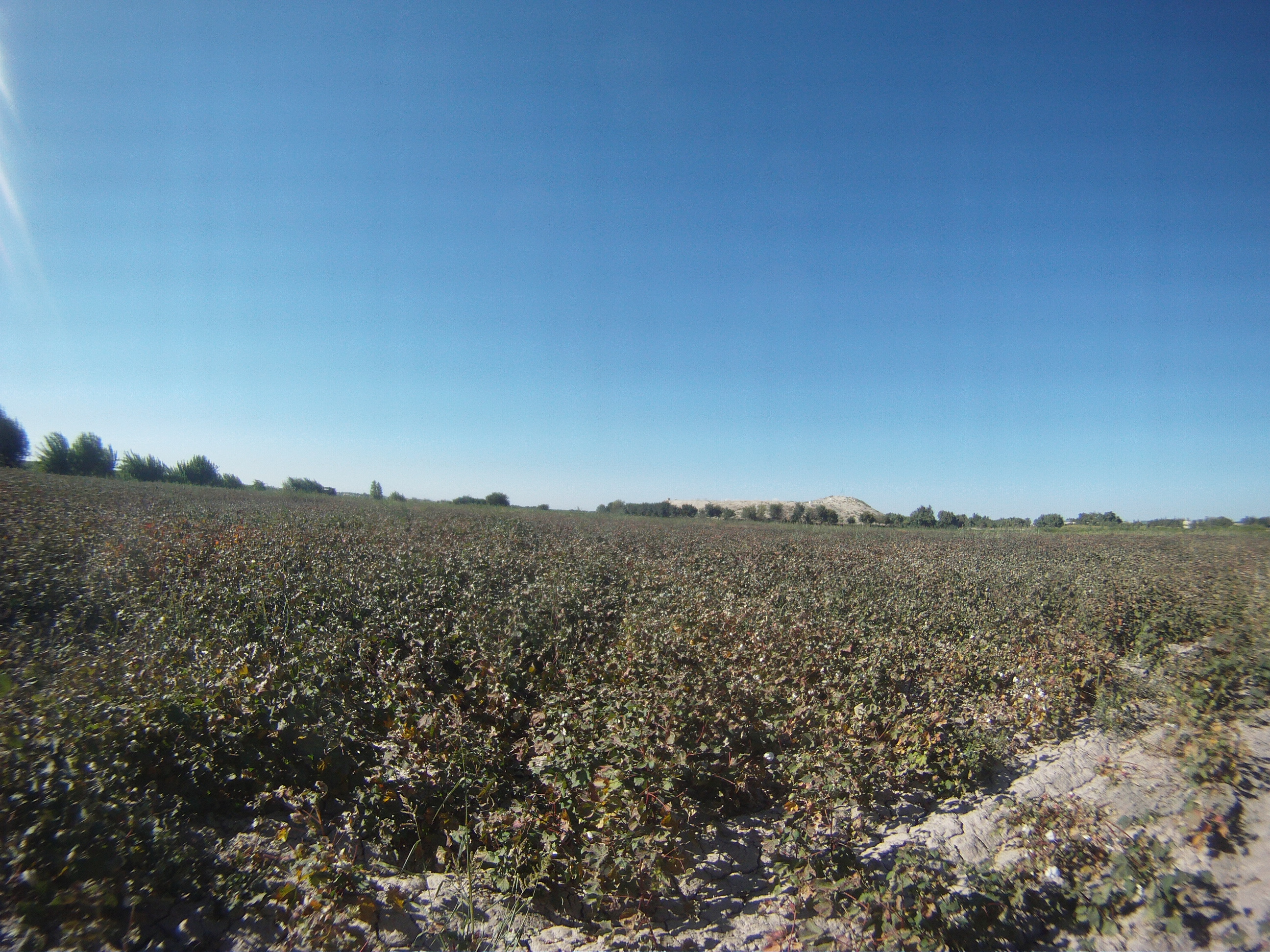
Acres and acres of cotton on the Silk Road. Photo somewhere between Bukhara and Samarkand
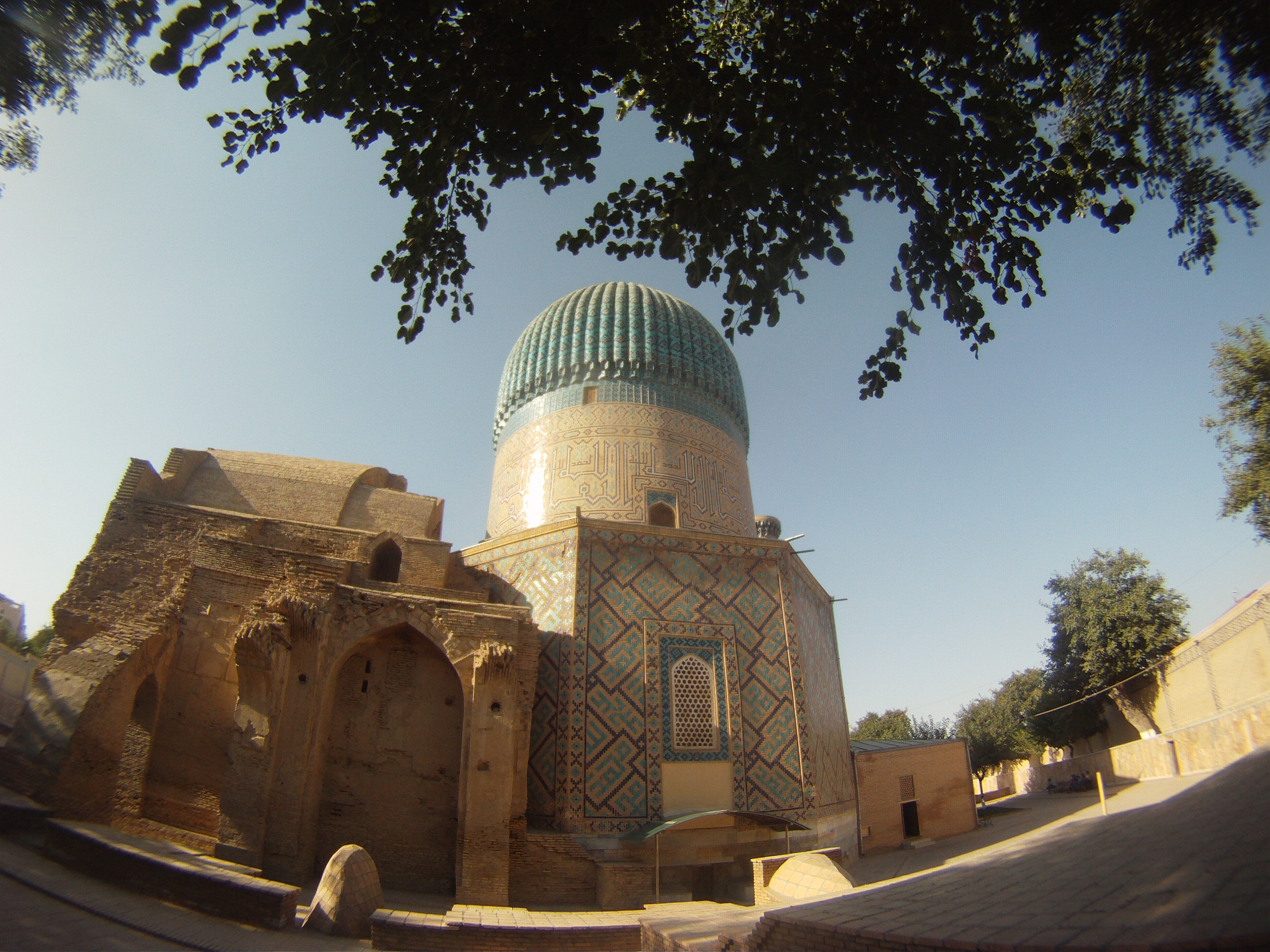
Amirs Tomb Samarkand
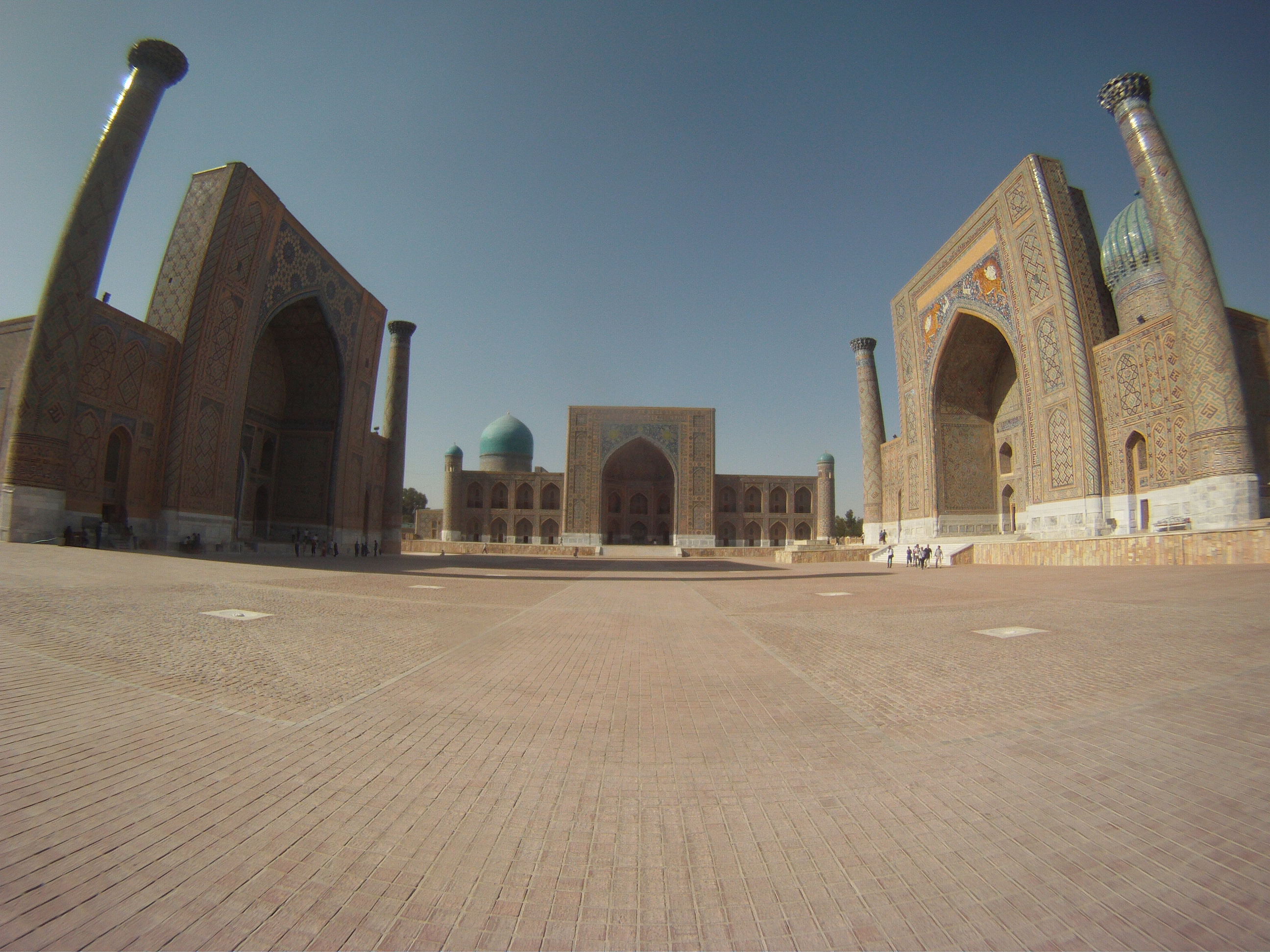
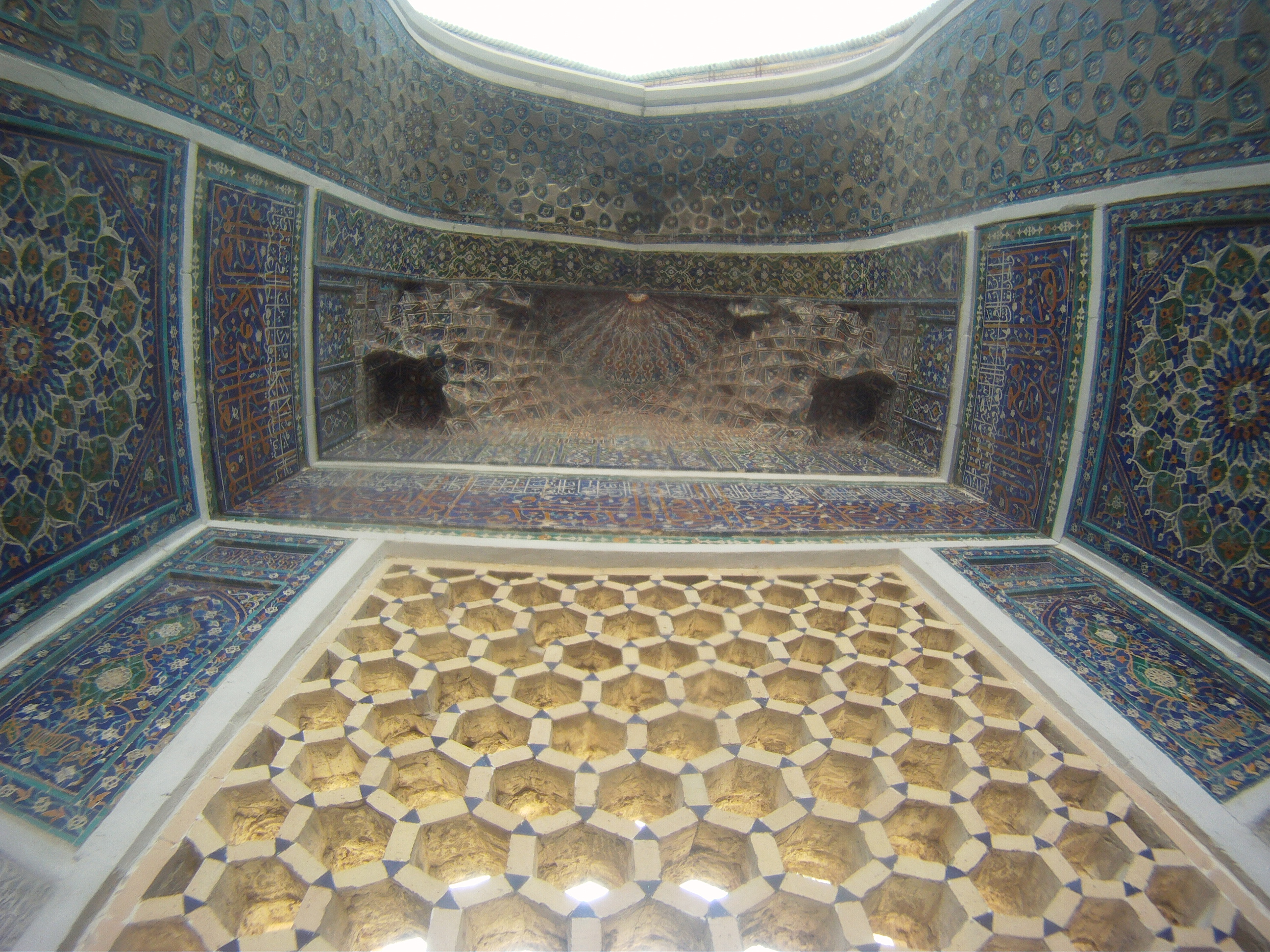
Inside the Registan, Samarkand
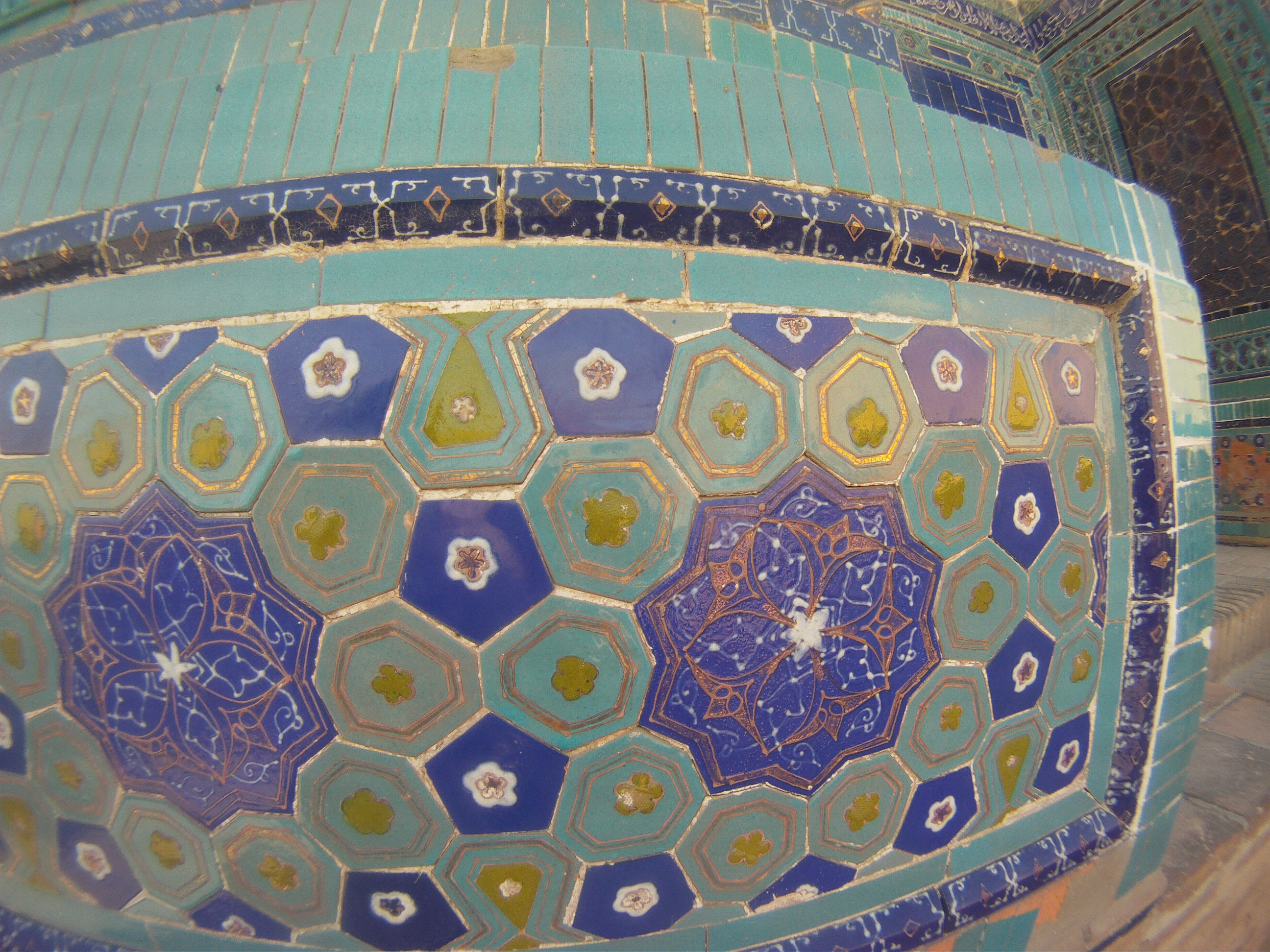
Close up of tiles at the Registan
Samarkand, is even more magnificent than Bukhara to scale but lacks the old city feel, so easily found in Bukhara. The entire city has been rebuilt and now feels like some sort of amusement park. Fancy bright-colored shops line the smooth tarmac, and a walk from Minaret, to Mosque feels almost as if caught in a game at a miniature golf course. The spirit of the Silk Road continues in the Bazaar where you can buy naan,melons, vegetables, spices, and dried fruits from local vendors. There is so much to learn and see in this city, I quickly become somewhat of a celebrity among the locals, as there are very few Americans traveling alone out here. For me the true Silk Road is outside of the city, where you can watch locals tend to herds of sheep and rest in the afternoon shade of a secluded tree.
The desert will soon give way to snow-capped mountains as I cross the Fergana valley into Kyrgyzstan.






































 Last trip with Baba